
Building Safety, Prevention and Response and Resilience - Guiding principles:
As outlined above, we have integrated our strategy to demonstrate how our work interlinks across the functions of our service. This approach helps us to clearly demonstrate how our work meets specific objectives, and the impact of our work.
It is, however, important to recognise that our three main services of Building Safety, Prevention, and Response and Resilience have different components and guiding principles which are noted here:
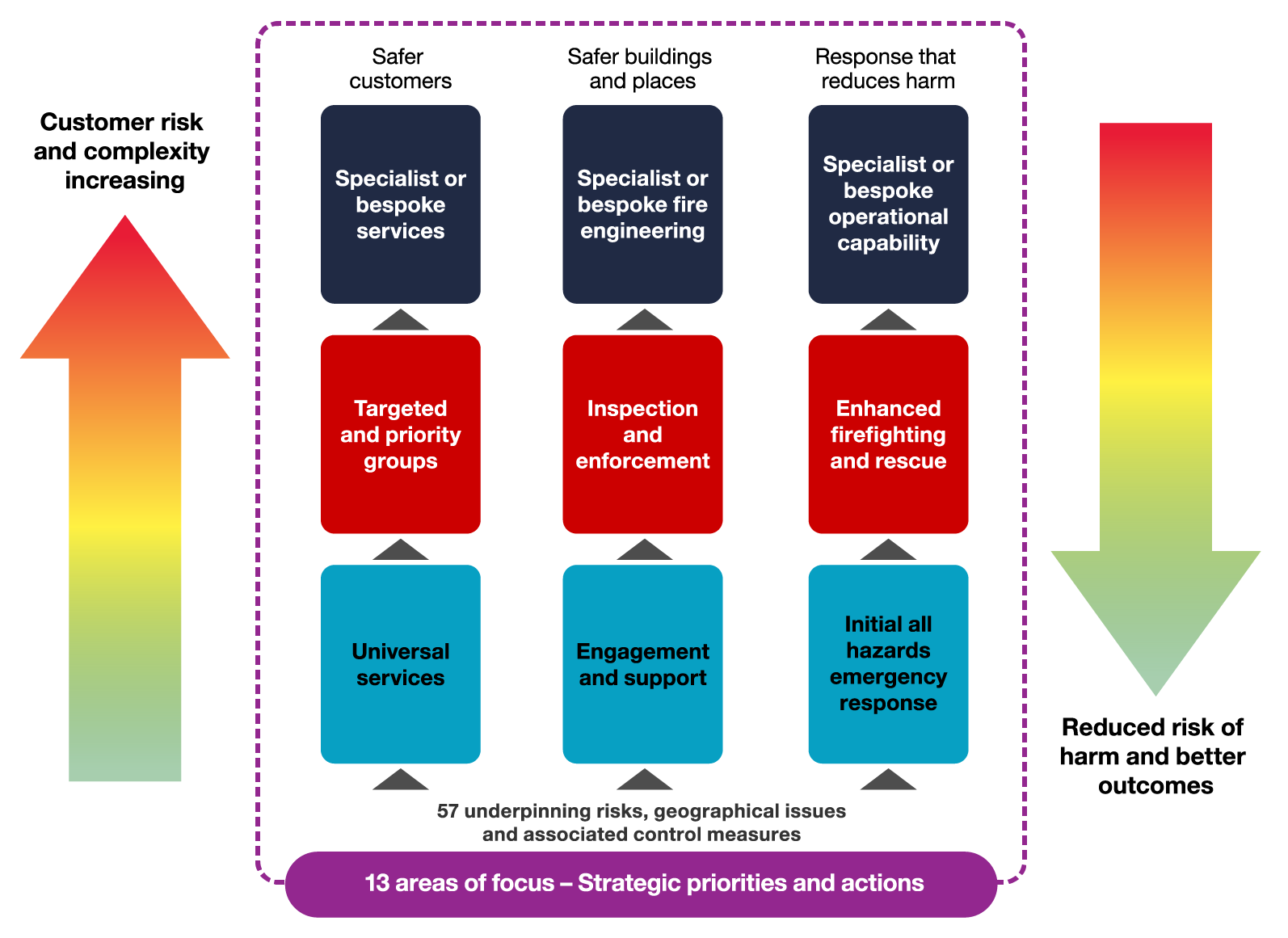
Detailed description of the above diagram
This flowchart consists of three central columns headed respectively ‘Safer customers’, ‘Safer buildings and places’, and ‘Response that reduces harm’. Each of these columns is made up of three box sections as follows: Safer customers comprises specialist or bespoke services, targeted priority groups, and universal services; Safer buildings and places comprises specialist or bespoke fire engineering, inspection and enforcement, and engagement and support; Response that reduces harm comprises specialist or bespoke operational capability, enhanced firefighting and rescue, initial all hazards emergency response. The box sections indicate a reducing risk from the top down.
Underneath these three columns are the words ’57 underpinning risks, geographical issues and associated control measures’. All this information is contained within an outer box which is labelled along the bottom ’13 areas of focus – Strategic priorities and actions’. On each side of that outer box are two arrows – a rising arrow labelled ‘Customer risk and complexity increasing’ and a descending arrow labelled ‘Reduced risk of harm and better outcomes’ which indicate the rise and reduction of risk in relation to the three sets of three boxes contained within the diagram.