
Annex 1: Procedure on receipt of a complaint
1. Preliminary Tests
1.1. The complaint will be assessed by the Monitoring Officer alone or in consultation with the Independent Person against the legal jurisdiction test in paragraph 1.2 and, if applicable, the local assessment criteria test in paragraph 1.4 below.
1.2. Legal Jurisdiction Criteria Test:
(a) Did the alleged conduct occur before the adoption of the Code of Conduct?
(b) Was the person complained of a Member of the Authority at the time of the alleged conduct?
(c) Was the person complained of acting in an official capacity at the time of the alleged conduct?
(d) Did the alleged conduct occur when the person complained of was acting as a Member of another authority?
(e) If the facts could be established as a matter of evidence, could the alleged conduct be capable of a breach of the Code of Conduct?
(f) Is the complaint about dissatisfaction with the Authority’s decisions, policies and priorities, etc?
1.3. If the complaint fails one or more of the jurisdiction tests, no further action will be taken by the Monitoring Officer and the complaint will be rejected. The Complainant will be notified accordingly with reasons, normally within 10 working days of receipt of the complaint by the Monitoring Officer. There is no right of appeal against the Monitoring Officer’s decision.
1.4. Local Assessment Criteria Test
If the complaint satisfies the jurisdiction test, the Monitoring Officer will then apply the following local assessment criteria test:
(a) The complaint is a ‘repeat complaint’, unless supported by new or further evidence substantiating or indicating that the complaint is exceptionally serious or significant;
(b) The complaint is anonymous;
(c) No or insufficient information/evidence to substantiate the complaint has been submitted by the Complainant;
(d) The complaint is malicious, trivial, politically motivated or ‘tit-for-tat’;
(e) The Complainant is unreasonably persistent, malicious and/or vexatious;
(f) The alleged misconduct happened more than 3 months ago;
(g) The complaint is relatively minor and dealing with the complaint would have a disproportionate effect on both public money and officers’ and Members’ time;
(h) The circumstances have changed so much that there would be little benefit arising from an investigation or other action;
(i) The complaint has been the subject of an investigation or other action and there is nothing more to be gained by further action being taken;
(j) The complaint is such that it is unlikely that an investigation will be able to come to a firm conclusion on the matter, e.g. where there is no firm evidence on the matter;
(k) The complaint is about a deceased person;
(l) The complaint is about a person who is no longer an Authority Member.
1.5. If one or more of the local assessment criteria applies to the complaint, no further action will be taken by the Monitoring Officer and the complaint will be rejected. The Complainant will be notified accordingly with reasons, normally within 10 working days of receipt of the complaint by the Monitoring Officer. There is no right of appeal against the Monitoring Officer’s decision.
2. Notification of Complaint to Subject Member
2.1. As a matter of fairness and natural justice, the Subject Member will be told the identity of the complainant and will also be be given details of the complaint.
2.2. The Subject Member may submit initial views on the complaint, normally within 10 working days. These views will be taken into account by the Monitoring Officer when deciding how to deal with the complaint (see paragraph 4 below).
3. Asking for Additional Information
3.1. The Monitoring Officer may ask the Complainant and the Subject Member for additional information before deciding how to deal with the complaint.
4. What Process to Apply - Informal Resolution or Investigation and/or No Action?
4.1. The Monitoring Officer may at any stage (whether without the need for an investigation or before or after the commencement or conclusion of an investigation) seek to resolve the complaint informally in accordance with paragraph 5 below. Where the Subject Member or the Monitoring Officer make a reasonable offer of informal resolution, but the Complainant is not willing to
accept this offer, the Monitoring Officer will take account of this in deciding whether the complaint merits formal investigation.
4.2. The Monitoring Officer, in consultation with the Independent Person, may refer the complaint for investigation when:
(a) it is serious enough, if proven, to justify the range of sanctions available to the Hearings Panel (see paragraph 4 of Annex 3 to these Arrangements);
(b) the Subject Member’s behaviour is part of a continuing pattern of less serious misconduct that is unreasonably disrupting the business of the Authority and there is no other avenue left to deal with it short of investigation. In considering this, the Monitoring Officer may take into account the time that has passed since the alleged conduct occurred.
4.3. Where the complaint is referred for investigation, the Monitoring Officer will appoint an Investigating Officer who will conduct the investigation in accordance with the procedure at Annex 2 to these Arrangements.
4.4. If the complaint identifies potential criminal conduct or potential breach of other regulations by the Subject Member or any other person, the Complainant may be advised by the Monitoring Officer to report the complaint to the police or other prosecuting or regulatory authority. Alternatively, the Monitoring Officer will consider the complaint against the legal jurisdiction criteria test and, if the complaint passes that test, he may pass the complaint to the police. Where a complainant has been advised to refer a matter to the police, or the Monitoring Officer has referred the matter to the police, the complaints process under these Arrangements will be suspended, pending a decision/action by the police or other prosecuting or regulatory authority. Where the police or other prosecuting or regulatory authority decide to take no action on the complaint, the Monitoring Officer will lift the suspension and, in consultation with the Independent Person, will apply the local assessment criteria test in paragraph 1.4 above.
4.5. The Monitoring Officer, in consultation with the Independent Person, will take no action on the complaint when one or more of the following apply:
(a) ongoing criminal proceedings or a police investigation into the Subject Member’s conduct;
(b) investigation cannot be proceeded with, without investigating similar alleged conduct or needing to come to conclusions of fact about events which are also the subject of some other investigation or court proceedings;
(c) the investigation might prejudice another investigation or court proceedings;
(d) genuine long term (3 months or more) unavailability of a key party;
(e) serious illness of a key party.
4.6. Normally within 20 working days of receipt of the complaint, the Monitoring Officer will notify the Complainant and Subject Member of his decision and reasons for applying one of the following processes in the format of the Decision Notice template (appended to this Annex 1):
(a) not to refer the complaint for investigation; or
(b) to refer the complaint for investigation; or
(c) to apply the informal resolution process either before or after an investigation; or
(d) to refer the complaint to the relevant political group leader for action.
4.7. The decision notice will be published on the Authority’s website. There is no right of appeal against the Monitoring Officer’s decision. However, in the event that the Complainant submits additional relevant information, the Monitoring Officer will consider and decide if the matter warrants further consideration under these Arrangements, in which case it shall be treated as a fresh complaint.
5. Informal resolution
5.1. The Monitoring Officer may, after consultation with the Independent Person, seek to resolve a complaint informally at any stage in the process, whether without the need for an investigation or before or after an investigation has been commenced
or concluded. In so doing, the Monitoring Officer will consult with the Complainant and the Subject Member to seek to agree what they consider to be a fair resolution, which will help to ensure higher standards of conduct for the future.
5.2. Informal resolution may be the simplest and most cost effective way of resolving the complaint and may be appropriate where:
(a) the Subject Member appears to have a poor understanding of the Code of Conduct and/or related Authority procedures; or
(b) there appears to be a breakdown in the relationship between the Complainant and the Subject Member; or
(c) the conduct complained of appears to be a symptom of wider underlying conflicts which, if unresolved, are likely to lead to further misconduct or allegations of misconduct; or
(d) the conduct complained of appears common to a number of Members of the Authority, demonstrating a lack of awareness, experience or recognition of the particular provisions of the Code of Conduct and/or other Authority procedures, etc; or
(e) the conduct complained of appears to the Monitoring Officer not to require a formal sanction; or
(f) the complaint appears to reveal a lack of guidance, protocols and procedures within the Authority; or
(g) the Complainant and the Subject Member are amenable to engaging in an informal resolution; or
(h) the complaint consists of allegations and retaliatory allegations between Members; or
(i) the complaint consists of allegations about how formal meetings are conducted; or
(j) the conduct complained of may be due to misleading, unclear or misunderstood advice from officers.
5.3. Informal resolution may consist of one or more of the following actions, which do not have to be limited to the Subject Member, but may extend to other Members including the whole Authority where it may be useful to address systemic behaviour:
(a) training;
(b) conciliation/mediation;
(c) mentoring;
(d) apology;
(e) instituting changes to the Authority’s procedures;
(f) conflict management;
(g) development of the Authority’s protocols;
(h) other remedial action by the Authority;
(i) other steps (other than investigation) if it appears appropriate to the Monitoring Officer in consultation with the Independent Person.
5.4. If the Subject Member is agreeable to and complies with the informal resolution process, the Monitoring Officer will report the matter to the General Purposes Committee for information, but will take no further action against the Subject Member.
5.5. Where the Subject Member will not participate in the informal resolution process or if, having agreed to one or more actions under the informal resolution process, the Subject Member refuses or fails to carry out any agreed action, the Monitoring Officer will report the matter to the General Purposes Committee.
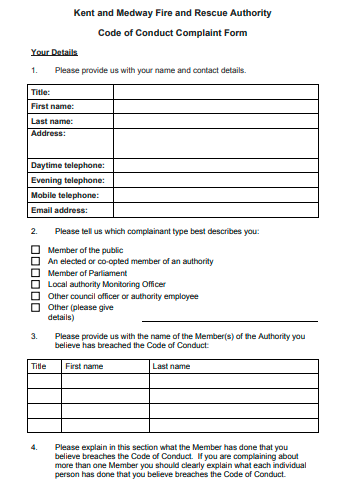
Code of Conduct Complaint Form


Example Template - Decision Notice (of the Monitoring Officer): e.g. Referral for Investigation
Parties should take care when passing on information that is in the notice or about the notice. For example, some details such as names and addresses may be confidential or private in nature, or may be personal information.
Complaint No:
Complaint
On [insert date], the Monitoring Officer considered a complaint from [insert name of
complainant] concerning the alleged conduct of [insert name of Member], a member of
the Authority. A general summary of the complaint is set out below.
Complaint summary
[Summarise complaint in numbered paragraphs]
Consultation with Independent Person
[Summarise the Independent Person’s views in numbered paragraphs]
Decision
Having consulted and taken into account the views of the Independent Person, the Monitoring Officer decided to refer the complaint for investigation.
Potential breaches of the Code of Conduct identified
At this stage, the Monitoring Officer is not required to decide if the Code of Conduct has been breached. He is only considering if there is enough information which shows a potential breach of the Code of Conduct that warrants referral for investigation.
The Monitoring Officer considers that the alleged conduct, if proven, may amount to a breach of the following paragraphs of the Code of Conduct. The Monitoring Officer has appointed [insert name] as the Investigating Officer.
Please note that it will be for the Investigating Officer to determine which paragraphs of the Authority’s Code of Conduct are relevant, during the course of the investigation.
[detail relevant Code of Conduct paragraphs]
Notification of decision
This decision notice is sent to the:
- Complainant
- Member against whom the complaint was made
- Kent County Council’s Monitoring Officer (in cases where the Subject Member was appointed to the Authority by that Council)
- Medway Council’s Monitoring Officer (in cases where the Subject Member was appointed to the Authority by that Council).
What happens now
The complaint will now be investigated under the Authority’s Arrangements for Dealing
with Code of Conduct Complaints under the Localism Act 2011.
Appeal
There is no right of appeal against the Monitoring Officer’s decision.
Additional Help
If you need additional support in relation to this decision notice or future contact with the Authority, please let us know as soon as possible. If you have difficulty reading this notice, we can make reasonable adjustments to assist you, in line with the requirements of the Equality Act 2010. We can also help if English is not your first language. Please contact us on 01622 692121 or email [email protected].
Signed:
Date:
Print name:
Monitoring Officer Address