
Digital, data, technology and AI enabling strategy 2025-2029
Building a connected, secure and intelligence-led Kent Fire and Rescue Service
The future state in one sentence
“I have the information, technology and support I need, when I need it, and it helps me do my job better.”
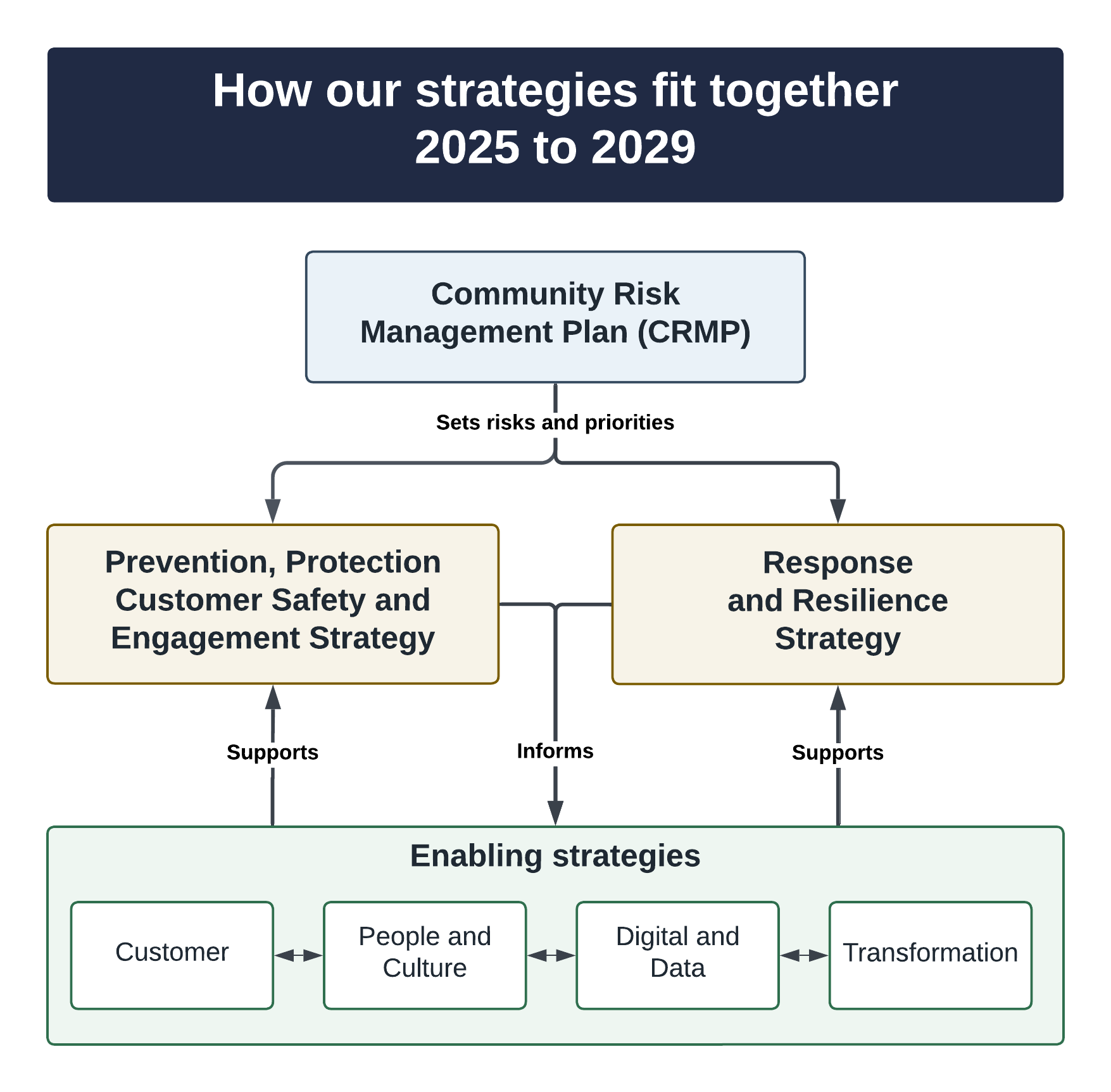
The Community Risk Management Plan sets risks and priorities for the service strategies. The service strategies inform the four enabling strategies, which support delivery of both service strategies. The enabling strategies are Customer, People and Culture, Digital, Data, Technology and AI, and Transformation.
Executive Summary
By 2029, Kent Fire and Rescue Service will operate as a more connected, digitally enabled and intelligence-led organisation. Technology, data and intelligence will work together as part of the way the Service operates, rather than being experienced as separate systems, specialist functions or individual transformation projects.
This strategy is about much more than replacing ageing technology. It describes the organisational capability we are building - reliable digital services, trusted enterprise information, stronger operational and organisational intelligence, modern and resilient technology foundations, and a workforce that is confident using digital, data and emerging technologies responsibly.
The future should feel different in everyday work. Firefighters and incident commanders should have greater confidence that the information and technology they rely on will be available when they need it. Control colleagues should experience systems that work together rather than create workarounds. Managers should spend less time finding, checking and reconciling information and more time leading. Internal Services colleagues should see simpler digital processes and less repeated administration. Senior leaders should have a clearer understanding of what is happening across KFRS, why it is happening, what may happen next and where intervention is likely to have the greatest impact.
The result will be a more resilient, adaptable and evidence-led Fire and Rescue Service: one that uses information to understand community and organisational risk earlier, makes more informed investment choices, supports its people with simpler digital services and treats technology resilience as part of operational resilience.
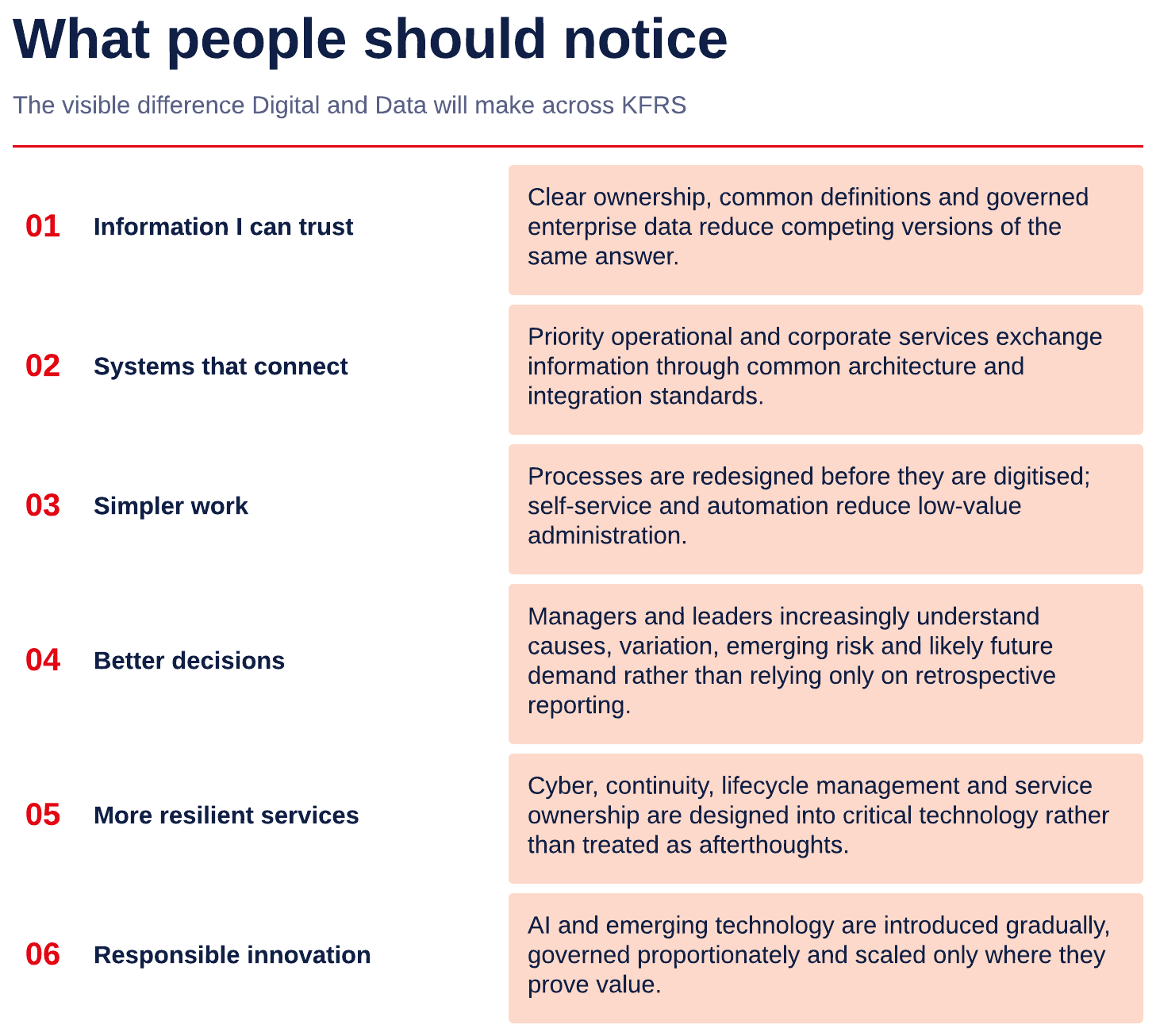
Text description: Figure 2 – What people should notice
Information I can trust Clear ownership, common definitions and governed enterprise data reduce competing versions of the same answer.
Systems that connect Priority operational and corporate services exchange information through common architecture and integration standards.
Simpler work Processes are redesigned before they are digitised; self-service and automation reduce low-value administration.
Better decisions Managers and leaders increasingly understand causes, variation, emerging risk and likely future demand rather than relying only on retrospective reporting.
More resilient services Cyber, continuity, lifecycle management and service ownership are designed into critical technology rather than treated as afterthoughts.
Responsible innovation AI and emerging technology are introduced gradually, governed proportionately and scaled only where they prove value.
Scope of this strategy
This Enabling Strategy covers Digital, Data, Technology and Artificial intelligence . It includes digital workplace services, operational technology, networks and cloud platforms, cyber resilience, enterprise data, reporting and analytics, data governance, digital and data capability, and the progressive development of Artificial Intelligence.
It does not describe wider non-digital transformation investments such as physical estate, training facilities or operational equipment programmes except where they have digital, data, integration, cyber or technology dependency. Those capabilities are governed through the wider enterprise transformation portfolio.
The strategy is one of four enabling strategies (Customer, People and Culture, Transformation) it underpins and supports our two service strategies - Protection and Prevention, Response and Resilience and ultimately our CRMP by ensuring the organisation has the right people, systems, skills, culture and capability to deliver against the risks identified in our Assessment of Risk. This is a four-year rolling strategy, reviewed annually alongside our revision of the CRMP.
1. Our Digital Future
The future KFRS will be a connected enterprise rather than a collection of individual systems, reports and individual team solutions. Operational response, workforce management, prevention, protection, finance, risk, performance and internal services will increasingly be supported by common digital foundations and a shared evidence base.
Technology will become less visible as a separate activity and more visible through the quality of everyday work. Colleagues should experience reliable devices and services, sensible integration, fewer manual steps and better access to the information they need. Technology should make operational and corporate work easier, not create additional complexity.
Information will become one of the organisation's most valuable strategic assets. Critical data will have clear ownership and agreed definitions. Quality will be measured and improved rather than assumed. Information will be integrated through a modern enterprise data platform and reused through governed analytical models, allowing KFRS to build a more consistent picture of performance, risk, workforce, finance and organisational delivery.
Performance reporting will evolve into organisational intelligence. Leadership conversations beginning will be increasingly be on what the evidence tells us: why performance has changed, whether variation is meaningful, where risk is emerging, what may happen next and which intervention is likely to make the greatest difference as data is trusted.
Operational response will be supported by modern, integrated technology that gives Control and frontline colleagues the right information at the right time. Command and Control, mobilising, workforce availability, operational risk information, GIS, communications and future ESN capability will increasingly operate as a coherent ecosystem. The objective is not simply to replace systems; it is to make information flow reliably through the operational environment so that technology supports decision-making rather than forcing colleagues to work around it.
Corporate work will also become simpler. Modern digital workplace services, self-service and responsible automation will reduce repeated data entry and low-value administration. Colleagues should spend more time applying their professional expertise and less time navigating systems or maintaining local workarounds.
Security and resilience will underpin the whole environment. As KFRS becomes increasingly dependent on digital services, a technology failure or cyber incident can become an operational issue. Cyber security, information protection, identity, backup and recovery, supplier assurance and technology lifecycle management will therefore be treated as core organisational capabilities.
Artificial Intelligence will be part of the future, but it will not be treated as a shortcut around immature data or weak processes. KFRS will first strengthen data quality, governance and analytical capability, then develop a clear enterprise AI strategy and progressively evaluate use cases. AI will enhance rather than replace professional judgement and will be scaled only where it is safe, proportionate and demonstrably useful.
Our 2029 outcome: Digital, Data, Technology and Intelligence are embedded in how KFRS works. Colleagues experience better information, less friction and more reliable services; leaders make stronger evidence-based decisions; and communities benefit from a more resilient and increasingly preventative Fire and Rescue Service.
2. Why We Need to Change
Kent Fire and Rescue Service creates and uses significant volumes of information every day. Every incident, training record, workforce interaction, Safe and Well activity, fire safety inspection, financial transaction and organisational decision creates data that can help us understand risk and improve how the Service operates.
Much of our technology and information has developed over time to meet individual business needs. Many systems work well within the function they serve, but the overall landscape has often been shaped by individual project requests, system end-of-life pressures or local requirements rather than by a single enterprise technology and information architecture.
The consequence is a mixed environment. Information can sit across multiple systems, spreadsheets and local processes. Definitions are not always consistent. Data ownership and quality can be unclear. Some reports require significant manual extraction or reconciliation before they can be trusted. Technology teams can be drawn reactively into projects rather than working from an enterprise roadmap. Legacy systems can remain in service until end-of-life forces a replacement decision.
At the same time, the external environment is becoming more demanding. Population growth, housing development, changing demographics, climate-related risk, financial pressure and evolving emergency demand require KFRS to understand risk earlier and allocate resources more intelligently. Greater dependence on technology increases the impact of cyber threats, supplier failure and infrastructure disruption.
The opportunity is equally significant. Cloud services, Microsoft Fabric, modern workplace technologies, automation, geospatial analysis, advanced statistics and Artificial Intelligence can enable KFRS to work in fundamentally different ways. But the value of these technologies depends on foundations: strong governance, trusted data, common architecture, clear service ownership, skilled people and disciplined investment.
The shift we are making
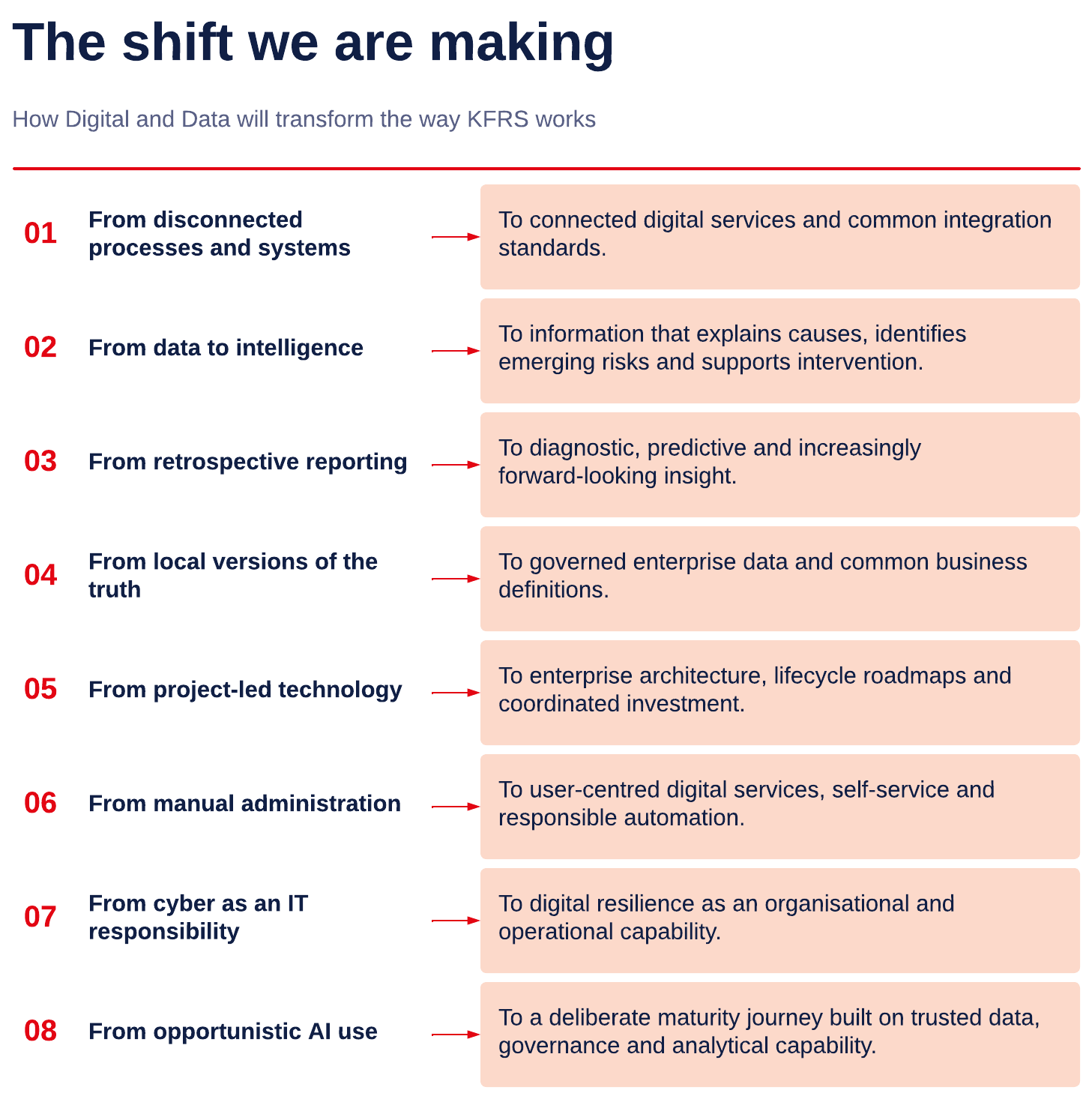
| From | To |
|---|---|
| From disconnected processes and systems | To connected digital services and common integration standards. |
| From data to intelligence | To information that explains causes, identifies emerging risks and supports intervention. |
| From retrospective reporting | To diagnostic, predictive and increasingly forward-looking insight. |
| From local versions of the truth | To governed enterprise data and common business definitions. |
| From project-led technology | To enterprise architecture, lifecycle roadmaps and coordinated investment. |
| From manual administration | To user-centred digital services, self-service and responsible automation. |
| From cyber as an IT responsibility | To digital resilience as an organisational and operational capability. |
| From opportunistic AI use | To a deliberate maturity journey built on trusted data, governance and analytical capability. |
3. What Digital and Data Will Mean for Our People
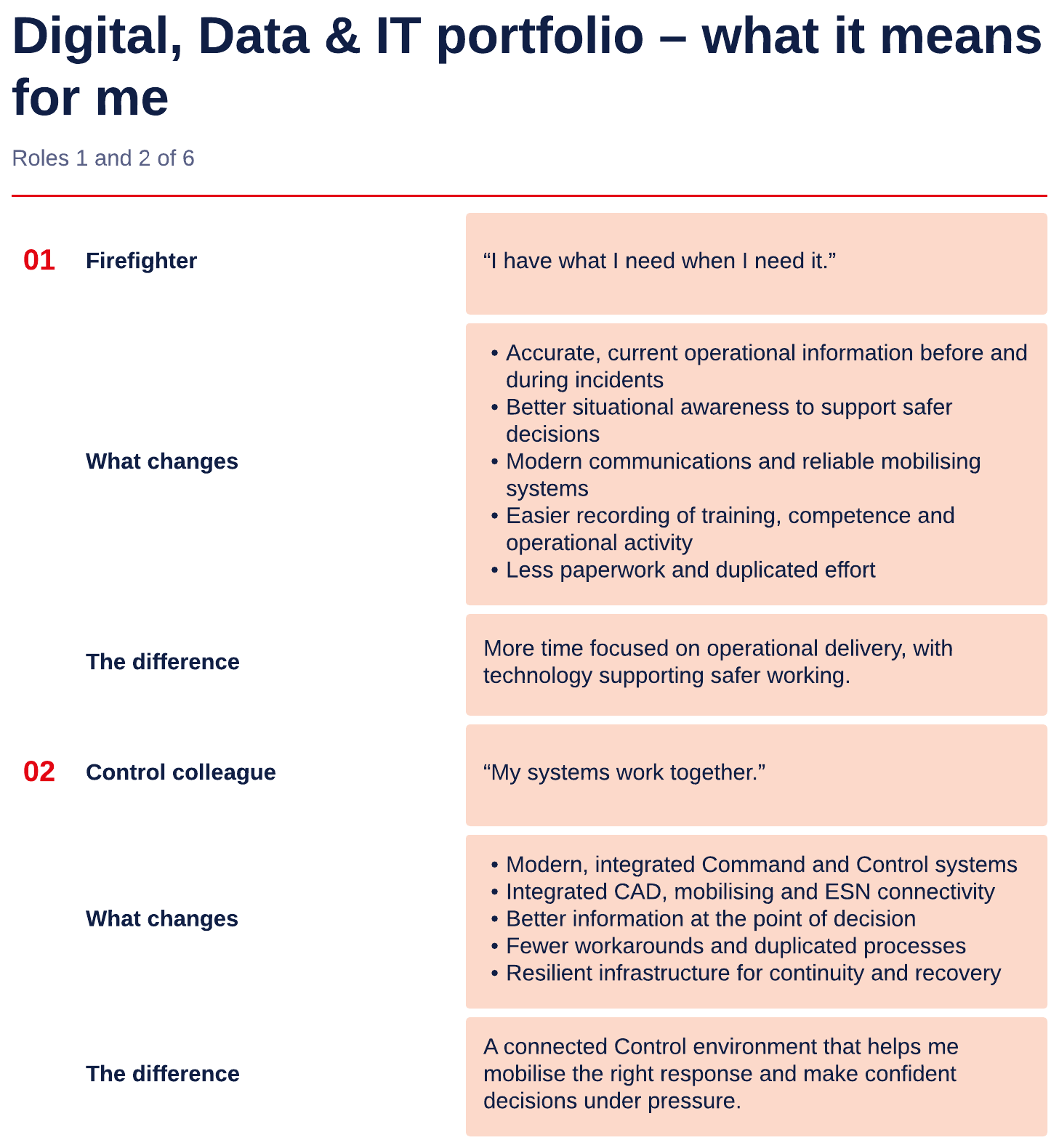
The value of this strategy is best understood through the experience of the people who will use the capability. The following future-state statements describe what colleagues and communities should see and feel as the strategy matures. They do not promise that every change arrives at once; they describe the direction and the experience KFRS is working towards.
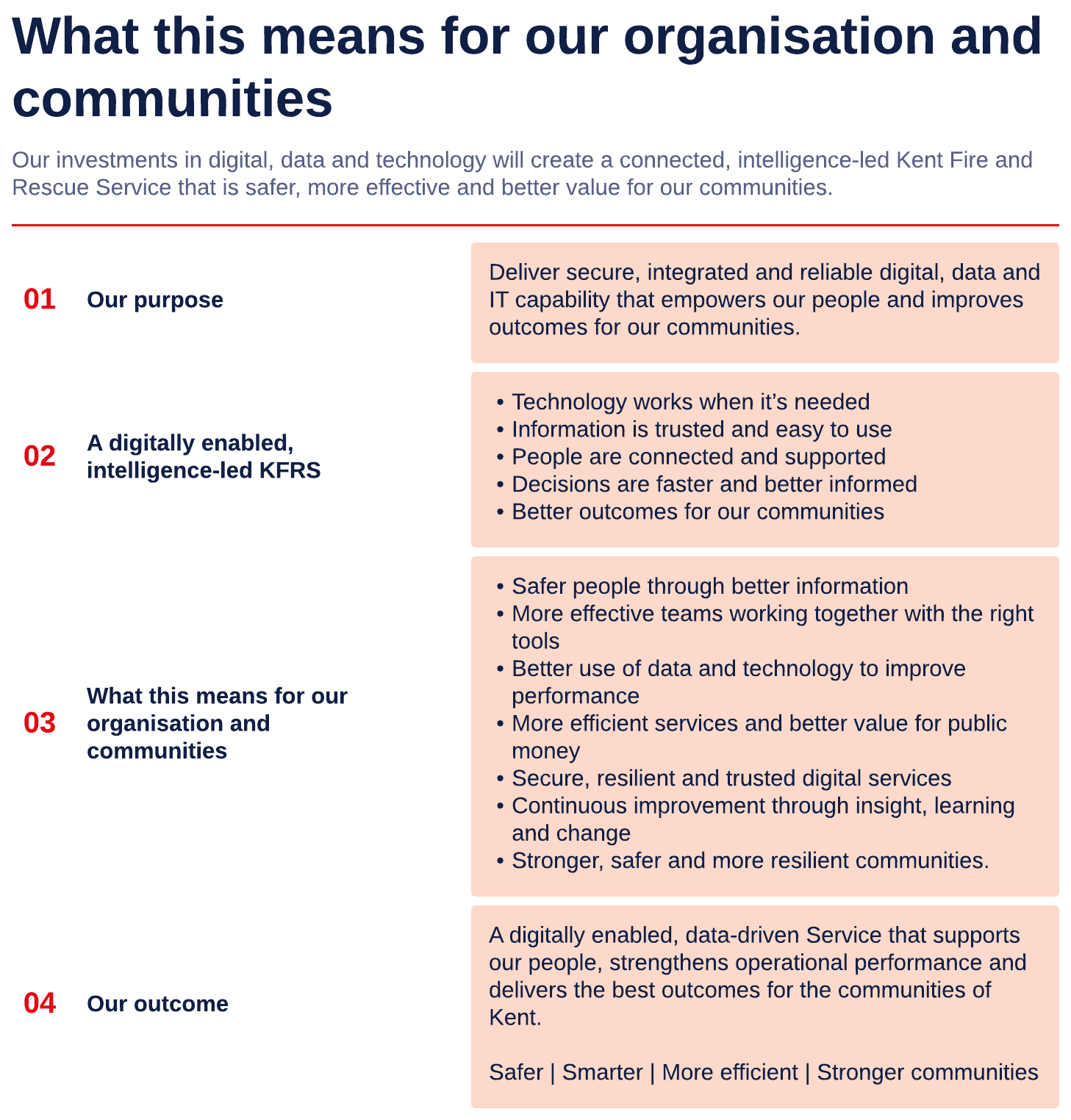
Text description of the organisation and community summary
Our purpose
Deliver secure, integrated and reliable digital, data and IT capability that empowers our people and improves outcomes for our communities.
A digitally enabled, intelligence-led KFRS
Technology works when it’s needed Information is trusted and easy to use People are connected and supported Decisions are faster and better informed Better outcomes for our communities
Organisation and community benefits
Safer people through better information More effective teams working together with the right tools Better use of data and technology to improve performance More efficient services and better value for public money Secure, resilient and trusted digital services Continuous improvement through insight, learning and change Stronger, safer and more resilient communities.
Our outcome
A digitally enabled, data-driven Service that supports our people, strengthens operational performance and delivers the best outcomes for the communities of Kent. Safer | Smarter | More efficient | Stronger communities
Firefighter
“I have what I need when I need it”
Today. Operational information can sit across different systems, devices and processes. Recording activity can involve duplicate entry and manual steps, and digital services do not always feel designed around operational work.
For firefighters, digital services should increasingly work in the background. The aim is not to create more screens or more technology to manage. It is to provide reliable systems, current information and simpler digital processes that support operational readiness and safer decisions.
By 2029, I can expect:
- More reliable devices, communications and operational systems when I need them.
- More accurate and current operational and risk information available through approved services where appropriate.
- Better visibility of availability, competence and operational information where relevant to my role.
- Information entered once and reused wherever possible.
- Less paperwork, fewer workarounds and fewer unnecessary administrative tasks.
- Greater confidence that critical digital services will remain available and recoverable during disruption.
The difference: More time focused on operational delivery, with better information and dependable technology supporting safer working.
Control Colleague
“My systems work together”
Today. Critical information and processes can depend on multiple systems, interfaces and ageing technology, requiring workarounds, duplicated checks and additional cognitive effort during already demanding situations.
Control will increasingly operate through resilient and better-integrated systems. Command and Control, mobilising, workforce availability, operational information and future ESN capability will be treated as a connected service environment rather than as unrelated technology projects.
By 2029, I can expect:
- A modern, resilient Command and Control environment.
- Better integration between CAD, mobilising, workforce availability, Airwave/ESN and approved operational information.
- Information presented at the point I need to decide.
- Fewer manual workarounds and duplicated processes.
- Better visibility of resources and operational availability.
- Clear recovery and continuity arrangements for critical digital services.
- Greater confidence in the availability, security and support of systems used by Control.
The difference: A more connected Control environment that helps me mobilise the right response and make confident decisions under pressure.
Station / Operational Manager
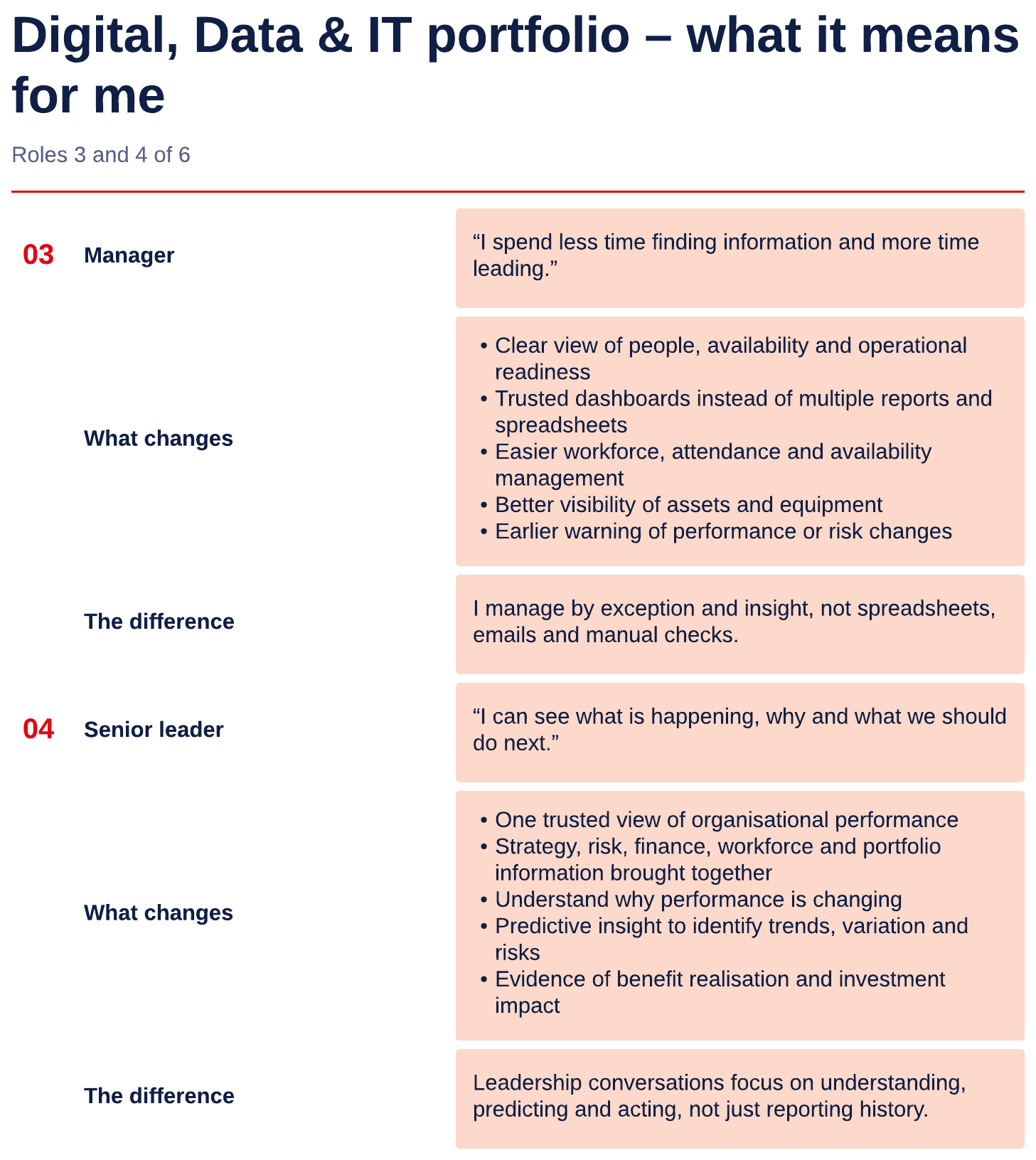
“I spend less time finding information and more time leading”
Today. Managers can spend significant time locating information, checking whether it is current, reconciling different reports and manually bringing information together before they can act.
The future state is one in which managers have easier access to trusted workforce, operational and performance information. Technology should support management by exception, highlight emerging issues and make routine administration simpler.
By 2029, I can expect:
- A clearer view of people, availability, competence and operational readiness.
- Trusted dashboards and agreed measures rather than multiple versions of the same information.
- Simpler workforce and attendance management through integrated people systems.
- Earlier warning when performance, capacity or risk is changing.
- Less manual reporting and fewer email-based checks.
- Information that helps explain why performance has changed and what action may be needed.
- Greater confidence that actions and decisions are based on a common evidence base.
The difference: I manage by exception and insight rather than spreadsheets, emails and manual checks.
Senior Leader
“I understand what is happening, why it is happening and what we should do next”
Today. Strategic information can be fragmented across performance, finance, workforce, risk and portfolio reporting. Leadership time can be spent reconciling information before discussing the decision that needs to be made.
The future state is an executive intelligence environment rather than a collection of reports. Strategy, finance, workforce, operational performance, organisational risk, portfolio delivery and benefits will increasingly be brought together so leadership conversations can focus on causes, choices, future implications and intervention.
By 2029, I can expect:
- One trusted view of organisational performance.
- Strategy, risk, finance, workforce, operational performance and portfolio information considered together.
- Better understanding of why performance is changing, not simply whether a target was met.
- Statistical analysis that distinguishes normal variation from issues requiring intervention.
- Increasing use of forecasting and predictive insight where the data and method justify it.
- Clearer evidence about whether strategic investments are delivering expected benefits.
- Greater confidence in prioritisation, sequencing, resource allocation and investment decisions.
The difference: Leadership conversations move from 'what happened?' towards 'why is it happening, what is likely to happen next, and what should we do?'
Internal Services Colleagues
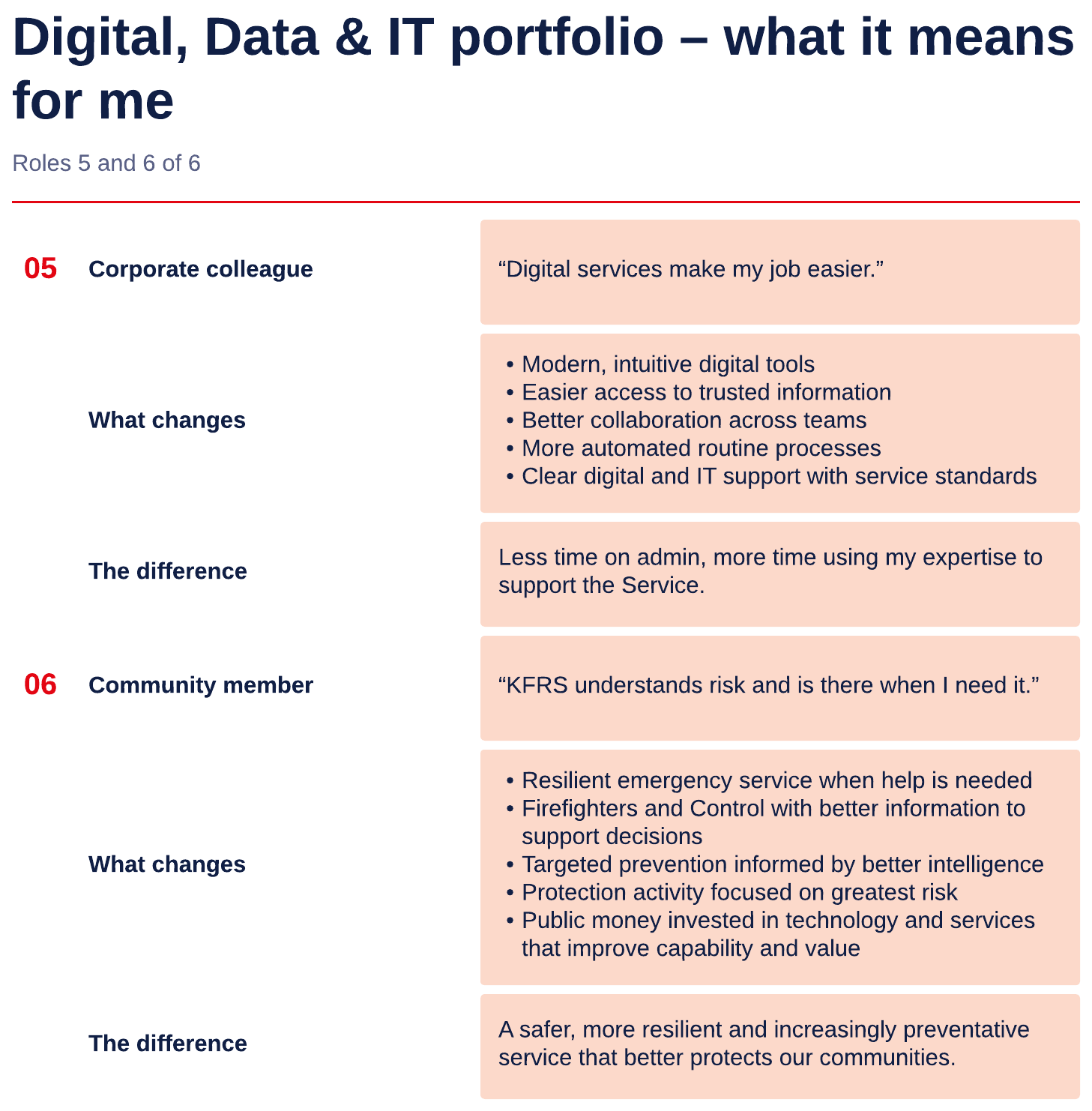
“Digital services make my job easier”
Today. Corporate processes can involve separate systems, repeated data entry, spreadsheets, manual administration and unclear ownership for support or process improvement.
The future digital workplace will make it easier to collaborate, access information and complete routine activities. Technology should increasingly remove low-value administrative effort and allow professional teams to spend more time applying their expertise.
By 2029, I can expect:
- Modern, intuitive and accessible digital tools.
- Easier access to trusted organisational information.
- Better collaboration through clearer and more consistent use of digital workplace services.
- More automated routine processes and greater self-service where appropriate.
- Clearer digital and IT support with visible service ownership and standards.
- Information captured once and reused appropriately.
- Better digital and data skills and clearer guidance on safe use of AI and automation.
- Less reliance on local spreadsheets and workarounds where enterprise services can meet the need.
- Citizen development through available Microsoft products will be appropriately governed and only used when enterprise services cannot meet the need.
The difference: Less time administering processes and more time using my professional expertise to support the Service.
Our Customers
“KFRS understands risk and is there when I need it”
Today. Communities are unlikely to see individual IT systems or data platforms. What matters is whether the Service understands risk, responds effectively, protects information and uses public money well.
The community experience of the strategy will be indirect but important. Better information should improve risk understanding and targeting. More resilient technology should support reliable emergency response. Better evidence should support stronger investment decisions and greater public value.
By 2029, I can expect:
- A resilient emergency service when I need help.
- Firefighters, Incident Commanders and Control with better information to support their decisions.
- Prevention activity is increasingly targeted towards people and places at greatest risk.
- Protection activity is informed by better intelligence and evidence.
- Emerging risks identified earlier through better use of information.
- Public information managed securely and responsibly.
- Investment in digital capability demonstrates measurable operational or organisational value.
The difference: A safer, more resilient and increasingly intelligence-led Fire and Rescue Service that uses information and technology to better understand and reduce community risk.
4. Our Six Digital Ambitions
The future-state experience is brought together through six ambitions. These are deliberately broader than individual technology programmes. They describe the enduring organisational outcomes that Digital and Data must enable.
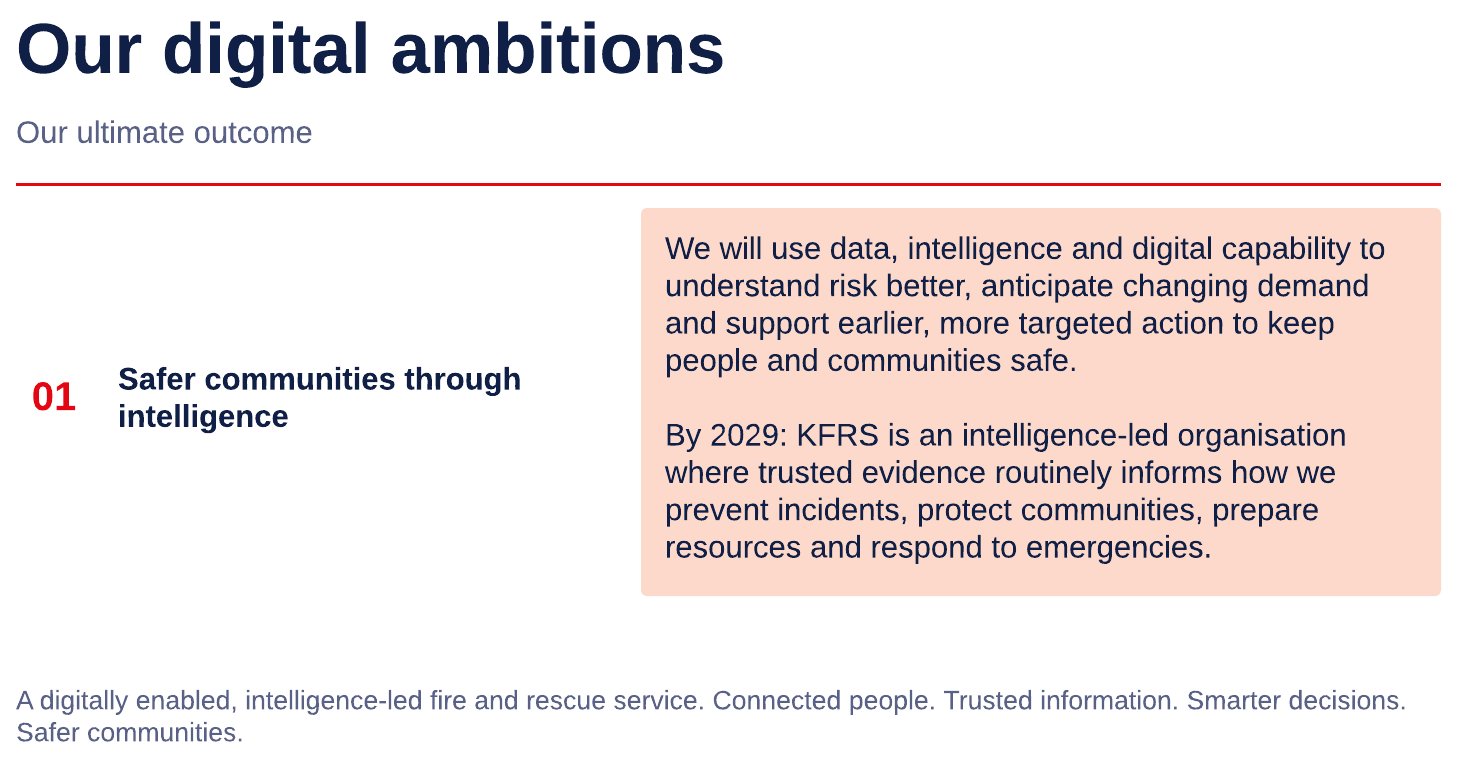
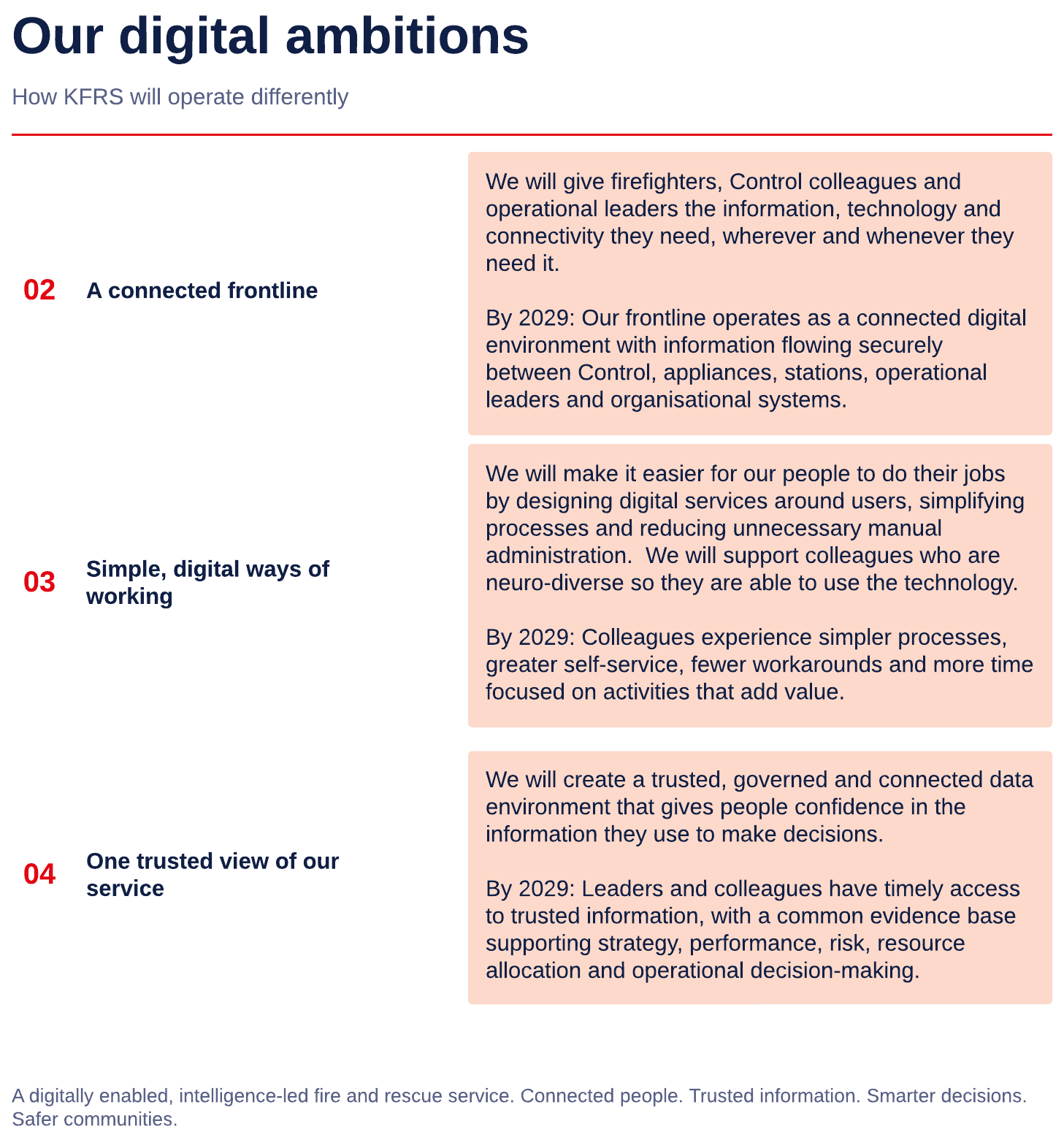
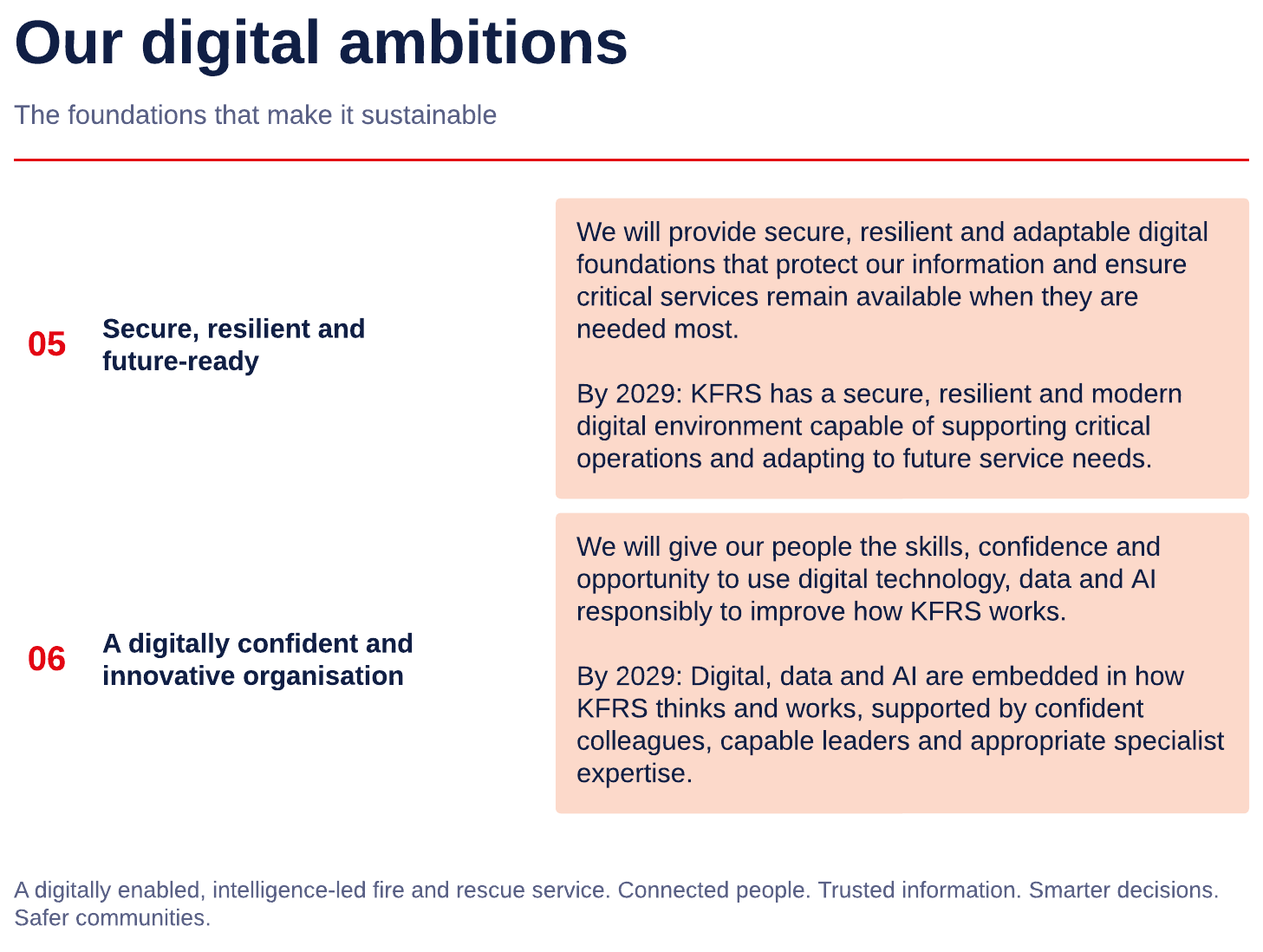
The graphic places safer communities through intelligence as the ultimate outcome. A connected frontline, simple digital ways of working and one trusted view of the service describe how work will change. Security and resilience, together with digital confidence and innovation, form the supporting foundations. The six ambitions are described in the following sections.
2029: KFRS is an intelligence-led organisation where trusted evidence routinely informs how we prevent incidents, protect communities, prepare resources and respond to emergencies.
4.1 Safer Communities Through Intelligence
We will use data, intelligence and digital capability to understand risk better, anticipate changing demand and support earlier, more targeted action to keep people and communities safe.
We will bring together information from across the Service and turn it into trusted, timely intelligence that supports decisions at every level.
Firefighters, Control, Prevention, Protection and organisational leaders will increasingly have access to a common picture of risk, demand and performance.
Better use of analytics, geospatial capability, forecasting and, where appropriate, Artificial Intelligence will help us move from understanding what has happened towards understanding why it happened, what may happen next and where intervention can have the greatest impact.
This is not about replacing professional judgement. It is about strengthening judgement with better evidence and making that evidence available earlier.
4.2 A Connected Frontline
We will give firefighters, Control colleagues and operational leaders the information, technology and connectivity they need, wherever and whenever they need it.
Digital technology should make operational work easier and safer, not add complexity.
We will connect operational systems and information so colleagues can access relevant information from stations, appliances, Control and approved mobile services.
Modern Command and Control, improved operational communications, operational mobility, telematics and integrated risk information will progressively create a more connected operational environment.
The focus is on an integrated operational ecosystem rather than pursuing technology for its own sake.
By 2029: Our frontline operates as a connected digital environment with information flowing securely between Control, appliances, stations, operational leaders and organisational systems.
4.3 Simple Digital Ways of Working
We will make it easier for our people to do their jobs by designing digital services around users, simplifying processes and reducing unnecessary manual administration. We will support colleagues who are neuro-diverse so they are able to use the technology.
Technology should remove friction rather than create it.
We will progressively reduce duplicate data entry, unnecessary spreadsheets, manual workarounds and disconnected processes.
Automation will be used where it can reduce repetitive activity, improve consistency or release capacity for higher-value work.
The objective is not to digitise inefficient processes. We will redesign how work is done and then use technology to enable it.
By 2029: Colleagues experience simpler processes, greater self-service, fewer workarounds and more time focused on activities that add value.
4.4 One Trusted View of Our Service
We will create a trusted, governed and connected data environment that gives people confidence in the information they use to make decisions.
Data will be managed as an organisational asset, with clear ownership, common definitions and active quality management.
Microsoft Fabric will progressively bring together priority operational, workforce, financial and corporate information.
Governed semantic models will provide consistent business logic and reusable measures across enterprise reporting.
We will move beyond reporting individual measures towards understanding relationships, trends, causes, variation and emerging risks.
By 2029: Leaders and colleagues have timely access to trusted information, with a common evidence base supporting strategy, performance, risk, resource allocation and operational decision-making.
4.5 Secure, Resilient and Future-Ready
We will provide secure, resilient and adaptable digital foundations that protect our information and ensure critical services remain available when they are needed most.
As KFRS becomes increasingly dependent on technology and data, digital resilience becomes operational resilience.
Cyber security, information assurance, networks, identity, backup and recovery, enterprise architecture, business continuity and technology lifecycle management will be treated as core organisational capabilities.
We will progressively modernise legacy technology, reduce technical debt and improve integration.
Investment decisions will consider whole-life cost, security, interoperability, supportability and strategic value rather than simply solving immediate requirements.
By 2029: KFRS has a secure, resilient and modern digital environment capable of supporting critical operations and adapting to future service needs.
4.6 A Digitally Confident and Innovative Organisation
We will give our people the skills, confidence and opportunity to use digital technology, data and AI responsibly to improve how KFRS works.
Digital transformation cannot be delivered by IT or data teams alone.
Leaders need to be intelligent customers of technology and information; managers need to use evidence effectively; and colleagues need confidence in the tools available to them.
We will strengthen digital and data literacy, build specialist capability where required and create governance that allows responsible experimentation with automation and AI.
Innovation will be driven by organisational problems and opportunities rather than technology itself. We will test ideas, evaluate value and scale only those that improve outcomes.
By 2029: Digital, data and AI are embedded in how KFRS thinks and works, supported by confident colleagues, capable leaders and appropriate specialist expertise.
5. What We Are Building
The six ambitions describe the experience and outcomes we want to create. Beneath them sit four connected enabling areas. Each has a distinct role, but none is sufficient on its own.
5.1 Digital & Technology
Digital & Technology provides a secure and resilient environment in which the rest of the strategy operates. It covers the digital workplace, networks and cloud platforms, identity and access, connected frontline services, operational technology, cyber resilience, enterprise architecture, service management and technology lifecycle.
The future technology function will be more proactive. Rather than waiting for individual projects to define the technology landscape, it will maintain enterprise roadmaps, understand lifecycle risk, set architecture standards, identify emerging capability and work with the business to shape investment before technology becomes a constraint.
Major transformation programmes such as Command and Control, Time and Attendance, ESN, operational mobility, device refresh, network replacement and cloud-enabled systems will therefore be treated as contributors to wider enterprise capabilities rather than as isolated technology deliveries.
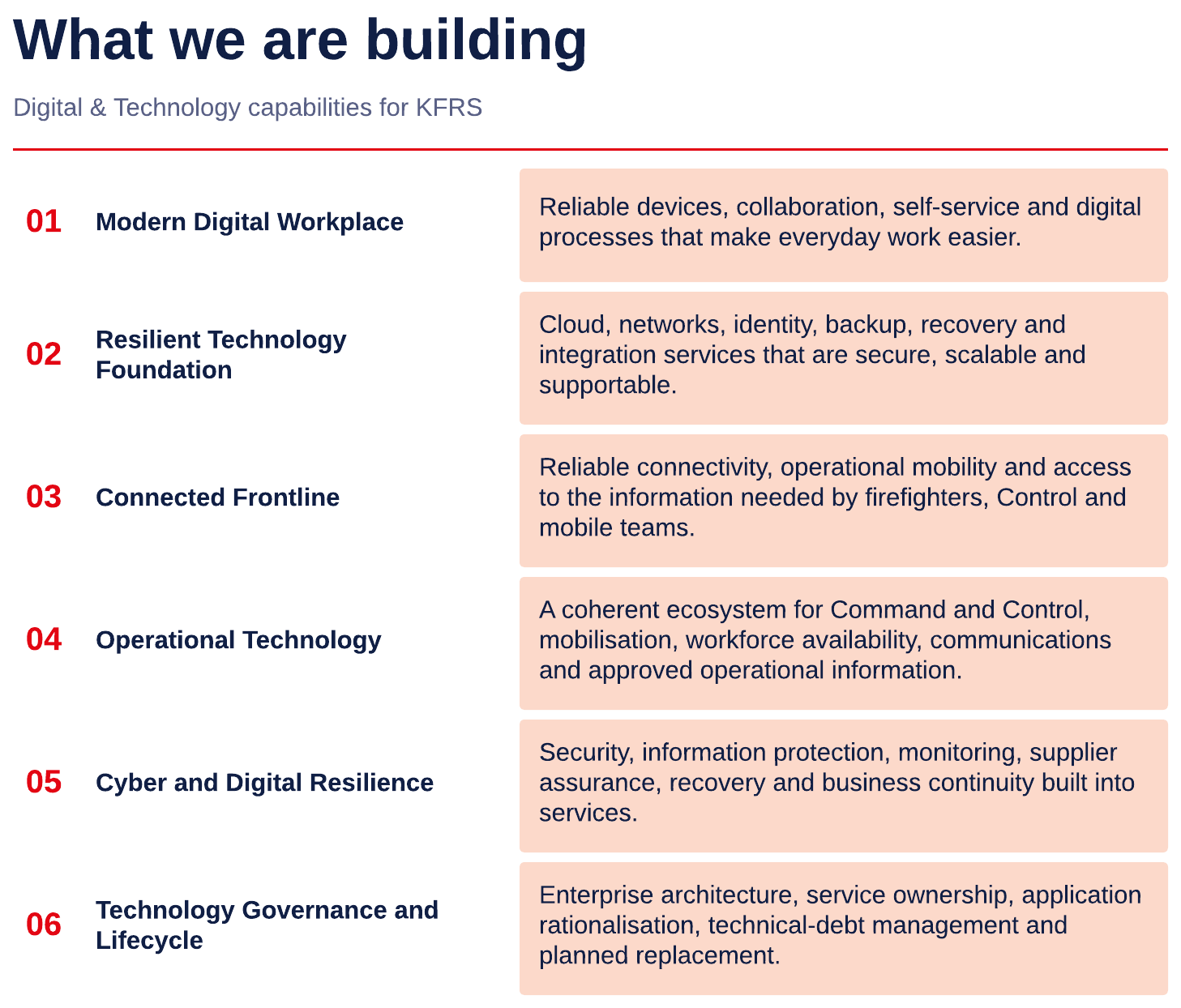
IT1 | Create a Modern Digital Workplace | Provide colleagues with secure, intuitive and well-governed digital services, devices and collaboration tools that simplify work, support flexible working and reduce unnecessary administration. | Colleagues have current, secure devices and consistent digital services; routine processes are simpler; collaboration and self-service improve; manual workarounds and duplicate tools reduce. |
|---|---|---|---|
IT2 | Build a Resilient Technology and Cloud Foundation | Provide secure, scalable and supportable network, cloud, identity, integration, backup, power-resilience and platform services that underpin operational and corporate technology. | Critical services operate on resilient, supportable platforms; networks, cloud, identity, integration, backup and recovery are managed as enterprise capabilities with clear lifecycle and resilience standards. |
IT3 | Create a Connected Frontline and Mobile Workforce | Ensure firefighters, Control and mobile colleagues have reliable connectivity, current devices and secure access to the operational and corporate information they need wherever they work. | Operational and mobile colleagues have reliable connectivity and fit-for-purpose devices; degraded connectivity is safely managed; mobile services are secure, consistent and support frontline productivity. |
IT4 | Modernise and Integrate Operational Technology | Deliver and integrate agreed operational technology programmes—principally Command & Control/CAD, ESN, workforce availability interfaces, operational mobility, GIS and operational information—using common architecture, data, security and resilience standards. | Control, mobilisation, workforce availability, operational communications and approved operational information work as a coherent ecosystem; integrations are resilient, secure and supportable. |
IT5 | Strengthen Cyber, Information Security and Digital Resilience | Embed cyber security, information protection, identity and access, supply-chain assurance, business continuity and recovery into technology design and operation, proportionate to operational risk. | KFRS demonstrates increasing cyber maturity, effective information protection, tested recovery, secure suppliers and resilient critical technology services. |
IT6 | Establish Enterprise Technology Governance and Lifecycle Management | Manage the technology estate strategically through enterprise architecture, application rationalisation, service ownership, technology roadmaps, asset/lifecycle management and disciplined investment decisions. | KFRS understands its technology estate, coordinates project and lifecycle investment, reduces unsupported/duplicate technology and manages services through clear ownership, standards, roadmaps and architecture governance. |
5.2 Data Governance
Data Governance creates the trust foundation. KFRS cannot become intelligence-led if critical information has unclear ownership, inconsistent definitions or unknown quality. Data governance is therefore not a technical control; it is an organisational capability.
Information Asset Owners and data stewards will increasingly understand the data for which they are responsible. Critical Data Elements will be identified. Common definitions and quality standards will be established. Data flows, dependencies and authoritative sources will become visible. Privacy, information lifecycle and ethical use will be integrated into the way data is managed.
Over time this should change the culture of reporting. Instead of asking the Data team to reconcile inconsistent numbers after the facts, the organisation will address the causes through ownership, standardisation and quality management at source.
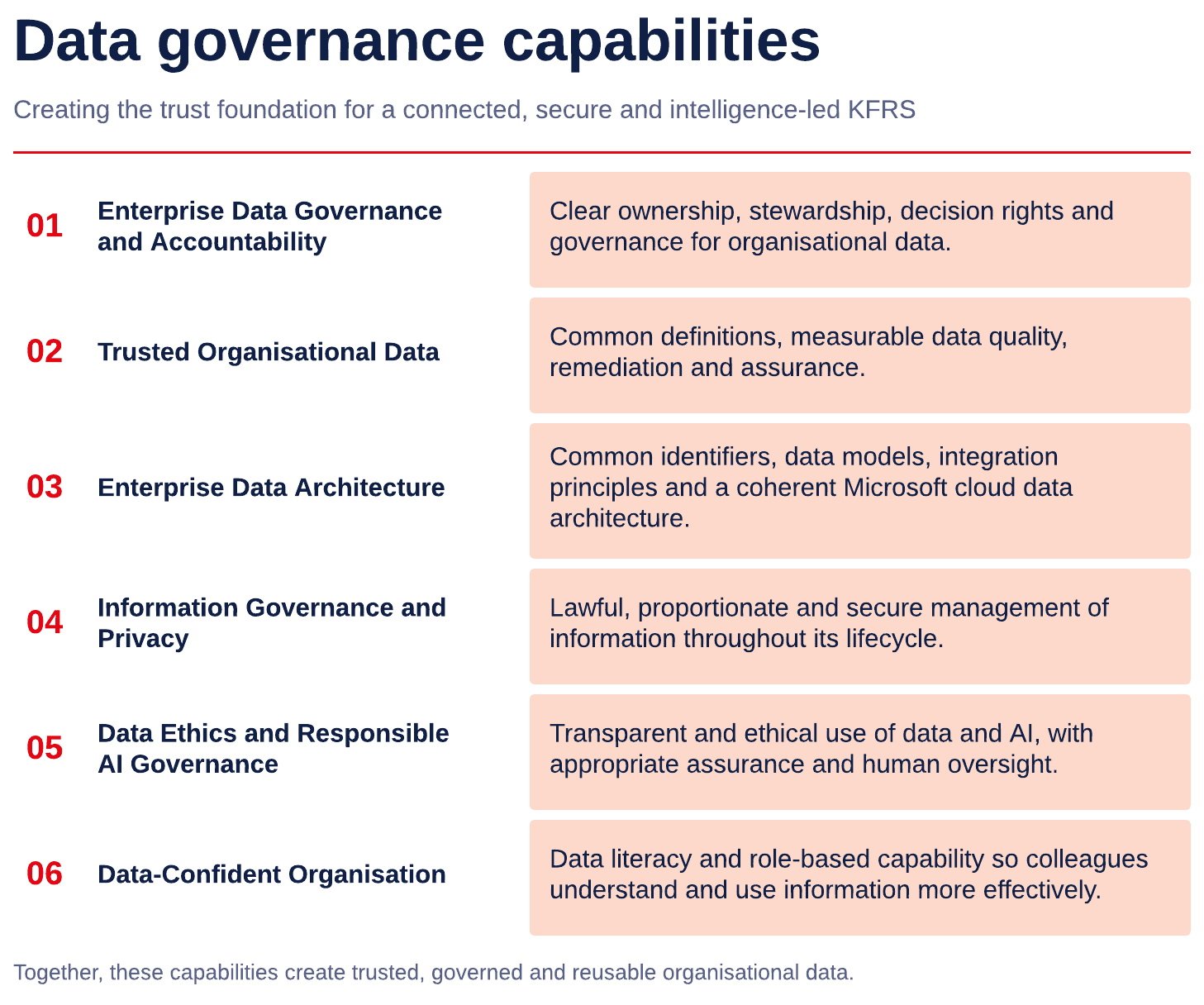
Ref | Strategic commitment | What this means | What success looks like by 2029 |
|---|---|---|---|
DG1 | Establish Enterprise Data Governance and Accountability | Establish a consistent enterprise model for how data is owned, governed and assured across KFRS. Information Asset Owners and data stewardship responsibilities will be clearly defined, supported by effective governance through the Data Governance Steering Group. | Clear ownership exists for priority organisational data; governance decisions are transparent; data risks and issues are routinely managed through organisational governance. |
DG2 | Create Trusted Organisational Data | Introduce common standards for data definitions, quality and assurance so that colleagues can rely on information used for operational, management and strategic decisions. KFRS will progressively adopt sector standards, including NFCC approaches, and establish consistent organisational data-quality expectations. | Priority datasets have agreed definitions and quality standards; data quality is visible and actively managed; material discrepancies between organisational reports are progressively eliminated. |
DG3 | Build Enterprise Data Architecture | Establish how organisational data is structured, connected and reused across operational and corporate systems. Common identifiers, agreed definitions and enterprise data models will support interoperability and reduce duplicated data capture. | KFRS understands its data estate and information flows; priority systems use common standards and identifiers; information is captured once and reused wherever appropriate. |
DG4 | Strengthening Information Governance, Privacy and Responsible Data Use | Ensure personal, operational and organisational information is managed lawfully, proportionately and securely throughout its lifecycle. Privacy, retention, records management, information sharing and information rights will be embedded into organisational processes and change governance. | Information governance is embedded by design; regulatory obligations are routinely considered within projects and services; data sharing, retention and disposal arrangements are understood, controlled and auditable. |
DG5 | Embed Data Ethics and Responsible AI Governance | Establish governance that allows KFRS to use data, analytics and AI responsibly. Decisions will consider legality, fairness, transparency, proportionality, bias and public trust, with appropriate human oversight where automated or AI-supported decisions are introduced. | Data and AI initiatives are subject to proportionate ethical and governance review; colleagues understand the boundaries for responsible use; innovation is supported without compromising public trust. |
DG6 | Build a Data-Confident Organisation | Develop the skills, behaviours and leadership capability required to manage and use data effectively. Different levels of capability will be developed for leaders, information owners, managers, analysts and the wider workforce. | Leaders are confident consumers of evidence; IAOs and data stewards understand their responsibilities; analysts have the skills required for modern analytics; colleagues understand their role in creating and maintaining trusted data. |
5.3 Business Intelligence & Organisational Intelligence
Business Intelligence will evolve from producing reports towards providing enterprise information and organisational intelligence. Reporting remains essential, but the strategic capability is the organisation's ability to understand performance, risk and the likely effect of intervention.
A trusted enterprise reporting environment will reduce conflicting outputs and manual reconciliation. Certified semantic models will provide reusable definitions and business logic. Power BI will become the principal visualisation and reporting tool, but the capability will not be limited to dashboards.
As the data foundation matures, KFRS will expand diagnostic analysis, Statistical Process Control, geospatial analysis, forecasting, scenario modelling and data science using industry standard capabilities. Advanced analytics will begin where data is sufficiently governed; it will not wait for every data domain to be integrated.
Trusted Enterprise Information | Consistent information based on governed data, common definitions and reusable analytical models. |
|---|---|
Enterprise Performance Intelligence | Integrated insight across strategy, operations, workforce, finance, risk, portfolio and benefits. |
Operational and Community Risk Intelligence | Incident, geographic, demographic, prevention and protection data used to improve risk understanding and resource decisions. |
Workforce and Organisational Intelligence | Integrated insight into availability, capability, competence, recruitment, wellbeing and future workforce need. |
Financial, Investment and Resource Intelligence | Connected finance, investment, portfolio and benefits information supporting prioritisation and value. |
Advanced Analytics and Predictive Intelligence | Diagnostic, statistical, geospatial, forecasting and predictive capability supporting earlier intervention. |
Ref | Strategic Commitment | What this means | What success looks like |
|---|---|---|---|
BI1 | Create Trusted Enterprise Information | Create a consistent enterprise information capability so colleagues use agreed, trusted information based on governed data, common business definitions and reusable analytical models rather than reconciling multiple reports and local versions of the truth. | Priority information is trusted, consistently defined and easy to find; common business logic is reused across reporting; access is proportionate and controlled; conflicting reports and manual reconciliation are materially reduced. |
BI2 | Build Enterprise Performance Intelligence | Bring strategy, operational performance, workforce, finance, risk, portfolio and benefits information together so leaders understand what is happening, why it is happening and where intervention is required. | Leadership has a coherent enterprise view; performance discussions focus on causes, variation, emerging risk and intervention rather than reporting history. |
BI3 | Develop Operational and Community Risk Intelligence | Turn incident, operational, geographic, demographic, building, prevention and protection data into intelligence that improves CRMP planning, operational learning, resource deployment and local risk understanding. | Operational and prevention/protection leaders have timely, localised intelligence that supports risk reduction, deployment, learning and evidence-based intervention. |
BI4 | Develop Workforce and Organisational Capability Intelligence | Create an integrated view of workforce availability, capability, competence, learning, wellbeing, recruitment, diversity and succession so KFRS can understand current capability and plan future workforce requirements. | Leaders can see workforce capability, availability and emerging people risks in one trusted view and increasingly forecast future workforce needs. |
BI5 | Develop Financial, Investment and Resource Intelligence | Connect financial, procurement, capital, MTFP, portfolio and benefits information so investment and resource decisions are based on a common evidence base and whole-organisation value. | Leaders can connect spend, investment, delivery, benefits and organisational outcomes; forecasting, prioritisation and resource allocation are increasingly evidence-led. |
BI6 | Build Advanced Analytics and Predictive Intelligence | Develop the specialist capability to move beyond descriptive reporting into diagnostic, statistical, geospatial, predictive and prescriptive analysis that supports earlier intervention and better decisions. | KFRS routinely explains why performance changes, anticipates risk and demand, evaluates likely future scenarios and uses advanced analysis to target interventions. |
5.4 Artificial Intelligence
Artificial Intelligence is a strategic capability for the later stages of the strategy, but KFRS is starting from an immature position. The immediate priority is not to industrialise AI. It is to create responsible foundations and build data and analytical maturity that make future AI credible.
The existing policy for generative AI use will be strengthened into a proportionate governance framework. KFRS will build a simple register of AI-enabled tools and use cases, establish clear accountability and human oversight, and develop organisational awareness.
As data governance, Microsoft Fabric and advanced analytics mature, KFRS will be better placed to develop an enterprise AI strategy and identify where AI adds genuine value over conventional automation or statistical methods. Initial use cases should be controlled, low-risk and evidence-led. High-impact use cases will require stronger privacy, ethical, equality and operational assurance.
Responsible AI Foundations | Proportionate policy, governance, accountability, risk assessment and human oversight. |
|---|---|
AI-Ready Data and Analytics | Trusted enterprise data, analytical skills and model assurance before AI dependency. |
Enterprise AI Strategy and Roadmap | A clear organisational direction developed once the foundations and maturity are sufficient. |
AI Literacy and Leadership Capability | Role-based awareness and skills for colleagues, leaders, analysts and digital specialists. |
Controlled Use Cases | Small pilots that compare AI with simpler options and scale only where value is evidenced. |
Business-as-Usual AI Assurance | AI risk, privacy, supplier, ethical and model assurance embedded into normal organisational governance. |
Ref | Strategic commitment | What this means | What success looks like by 2029 |
|---|---|---|---|
AI1 | Establish Responsible AI Foundations | Put in place the minimum governance, principles and controls required for safe organisational use of AI. Build on the existing AI-use policy and progressively establish clear accountability, risk assessment, human oversight and assurance arrangements. | KFRS has proportionate governance for AI use; colleagues understand acceptable use; material AI risks and use cases are visible and controlled. |
AI2 | Build AI-Ready Data and Analytical Foundations | Ensure future AI development is based on governed, trusted and sufficiently mature enterprise data. AI capability will build on data governance, data quality, Fabric, semantic models and advanced analytics rather than operating as a separate technology stream. | Priority data domains are sufficiently governed and trusted to support advanced analytics and future AI use cases; AI initiatives use approved enterprise data rather than uncontrolled datasets. |
AI3 | Develop an Enterprise AI Strategy and Roadmap | Once foundational governance, data and capability are sufficiently mature, define where AI can create organisational value, what risks KFRS is prepared to accept and which capabilities should be developed over the remainder of the strategy period. | KFRS has an approved AI strategy linked to organisational priorities, data maturity, workforce capability, governance and investment planning. |
AI4 | Build Organisational AI Literacy and Leadership Capability | Develop understanding of AI appropriate to different roles, starting with responsible use and progressing to leadership, analytical and technical capability as organisational maturity grows. | Colleagues understand responsible use; leaders can make informed decisions about AI; specialist staff can evaluate and support appropriate use cases. |
AI5 | Explore and Evaluate AI Use Cases Responsibly | Identify organisational problems where AI may add value and test them through small, controlled pilots. Use cases should only progress where the data is sufficiently mature, benefits are demonstrable and governance requirements can be met. | KFRS has a small portfolio of evaluated AI use cases; unsuccessful ideas are stopped early; proven use cases are scaled only where benefits and risks are understood. |
AI6 | Embed AI Assurance into Business-as-Usual Governance | Over time, integrate AI risk, supplier assurance, privacy, ethics, transparency, security and model oversight into procurement, project governance, data governance and organisational assurance rather than operating separate AI bureaucracy. | AI assurance becomes part of normal organisational governance and procurement; relevant systems and suppliers are subject to proportionate controls. |
6. How It All Connects
The strategy works because the capabilities reinforce one another. IT provides secure platforms and integration. Data Governance makes information trustworthy. Analysis turns trusted data into useful information and intelligence. Advanced analytics builds deeper diagnostic and predictive capability. Artificial Intelligence can then be introduced selectively where it adds value.
The enterprise information flow
1. Source systems | Operational, workforce, finance, prevention, protection, asset and corporate systems create the underlying data. |
|---|---|
2. Microsoft Fabric | The enterprise data platform progressively ingests, stores, integrates and manages priority organisational data. |
3. Governed data products | Ownership, data quality, metadata, common identifiers and controlled transformation create trusted domain data. |
4. Semantic models | Governed business logic, measures, relationships and reusable dimensions create a common interpretation layer. |
5. Information and intelligence | Power BI, intelligence products and enterprise dashboards provide trusted information for operational, tactical and strategic decisions. |
6. Advanced analytics | Python, R, geospatial tools, statistics and Fabric notebooks support deeper diagnosis, forecasting and scenario modelling. |
7. Selective AI | AI and machine learning use governed data and approved analytical environments where they provide additional value and meet assurance requirements. |
This architecture is important because it reduces the risk that KFRS creates multiple parallel data estates. Reporting, advanced analytics and future AI should increasingly use the same governed enterprise information rather than exporting uncontrolled copies into local spreadsheets or bespoke analytical environments.
Operational and corporate systems also need to connect
The same principle applies to transactional systems. Command and Control, Time and Attendance, workforce systems, finance, fleet, property and other platforms should not be treated as self-contained procurements. Their identity, integration, data, cyber, resilience and lifecycle requirements must be considered as part of the enterprise architecture.
This means Digital & Technology and Data & Intelligence need to be involved early enough to shape options, not simply being asked to integrate a solution after a project has selected it. It also means projects need to leave behind a sustainable service: clear ownership, support, documentation, data interfaces, security controls, lifecycle funding and measurable benefits.
7. Our Journey to 2029
The strategy will not arrive as one large transformation event. Colleagues will experience a sequence of connected improvements as foundations are strengthened, major systems are delivered, trusted data expands and analytical capability matures.
Capability area | 2025 to 2027 | 2027 to 2028 | 2028 to 2029 | 2029 |
|---|---|---|---|---|
Connected frontline and operational technology |
|
|
|
|
Modern digital workplace and workforce services |
|
|
|
|
Resilient technology and cloud foundation |
|
|
|
|
Cyber security and digital resilience |
|
|
|
|
Trusted data performance and insight |
|
|
|
|
Technology governance architecture and lifecycle |
|
|
|
|
Responsible automation and AI |
|
|
|
|
2025-2027 | Stabilise and establish foundations
The first phase is about confidence and control. KFRS will strengthen enterprise architecture, cyber and technology resilience, improve visibility of the technology estate and lifecycle risk, progress priority infrastructure and operational-system work, and establish clearer service ownership. Device and network lifecycle activity should make the digital environment more reliable for colleagues.
For data, the priority is governance and the first trusted enterprise domain. Incident data will be used to prove the end-to-end model: ownership, quality, Fabric ingestion, governed transformation, semantic models, access controls, trusted reporting and initial advanced analysis. Responsible AI foundations and awareness will be established, but AI deployment will remain deliberately limited.
2027-2028 | Connect and integrate
The second phase extends the enterprise model. Workforce and HR information will become the next major data domain, allowing KFRS to build a more integrated view of people, availability and capability. Priority systems will be connected through clearer integration patterns and architecture. Managers and leaders should begin to experience more consistent enterprise reporting and better access to trusted information.
Specialist analytical capability will also grow. Our data and Intelligence teams will strengthen diagnostic, statistical, geospatial and forecasting skills so the organisation can answer more complex questions rather than simply produce more reports. This is the point at which KFRS should be mature enough to develop its enterprise AI strategy and roadmap.
2027-2029 | Simplify and optimise
The third phase focuses on reducing friction and making better use of the foundations already built. More manual processes should be redesigned or automated, legacy reporting and applications progressively rationalised, and further enterprise data domains prioritised according to organisational value and readiness.
Enterprise intelligence should become more sophisticated. Cross-domain analysis, geospatial insight, forecasting, scenario modelling and selected predictive methods will increasingly support performance, community risk, workforce planning and resource decisions. Carefully selected AI use cases may be piloted where data, governance and benefits are sufficiently clear.
2028-2029 | Intelligence and selective adoption
By the final phase, intelligence and advanced analytics should be increasingly embedded in normal planning and decision processes. Leaders should be able to draw on a coherent evidence base and more forward-looking insight. Technology lifecycle, cyber assurance, data quality and analytical governance should increasingly operate as business-as-usual enterprise capabilities rather than transformation activity.
AI adoption will remain selective rather than becoming the default answer to organisational problems. Use cases that demonstrate clear benefits and acceptable risk can be scaled; those that do not should be stopped or redesigned. The organisation should have the confidence and governance to distinguish innovation from novelty.
8. How We Will Work Differently
Delivering to the future state requires a change in how the Service interacts with digital technology and data ensuring they work together. The strategy is not achieved by giving the IT and Data teams a longer project list. It requires a more proactive, enterprise and user-centred operating model.
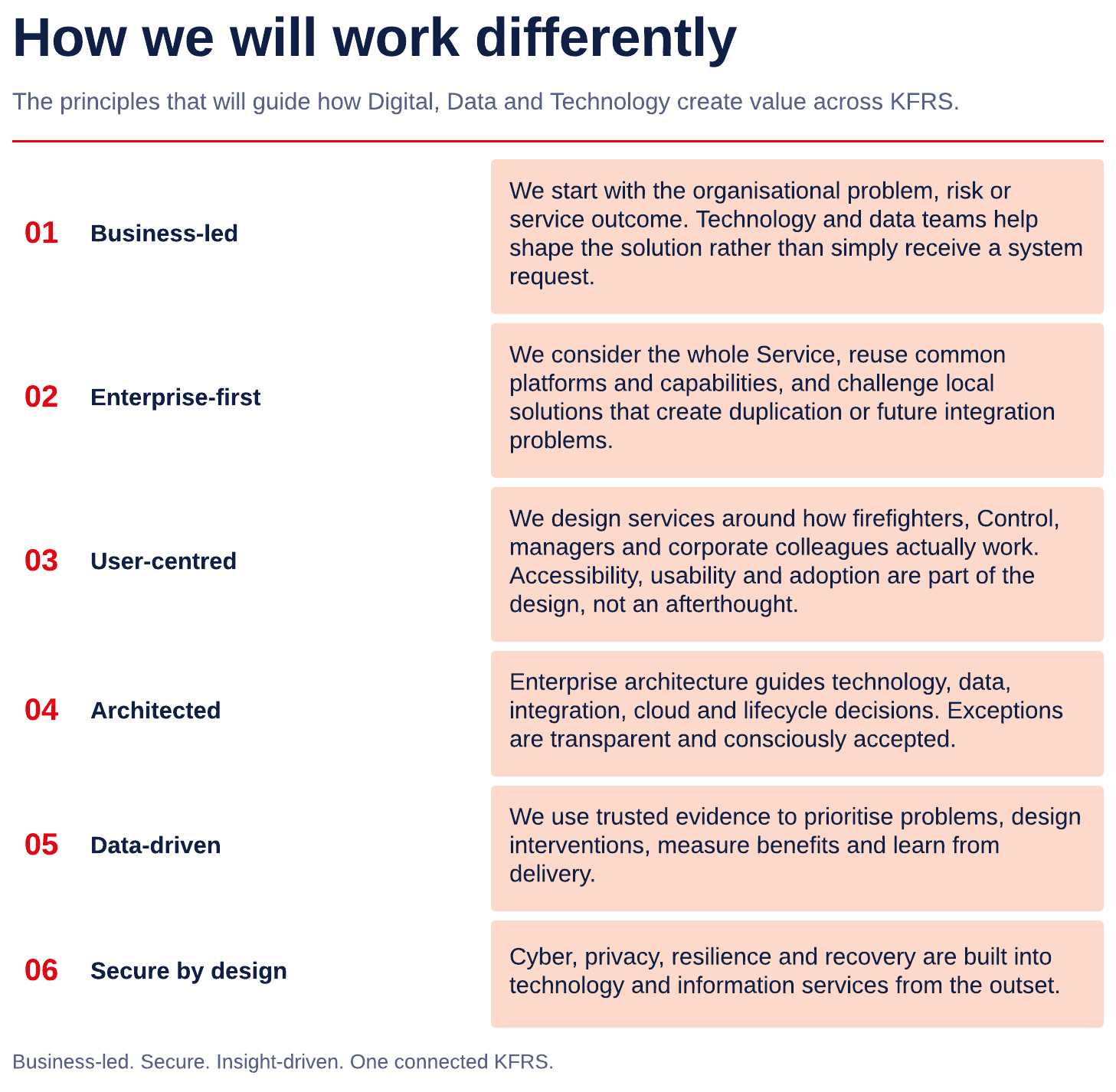
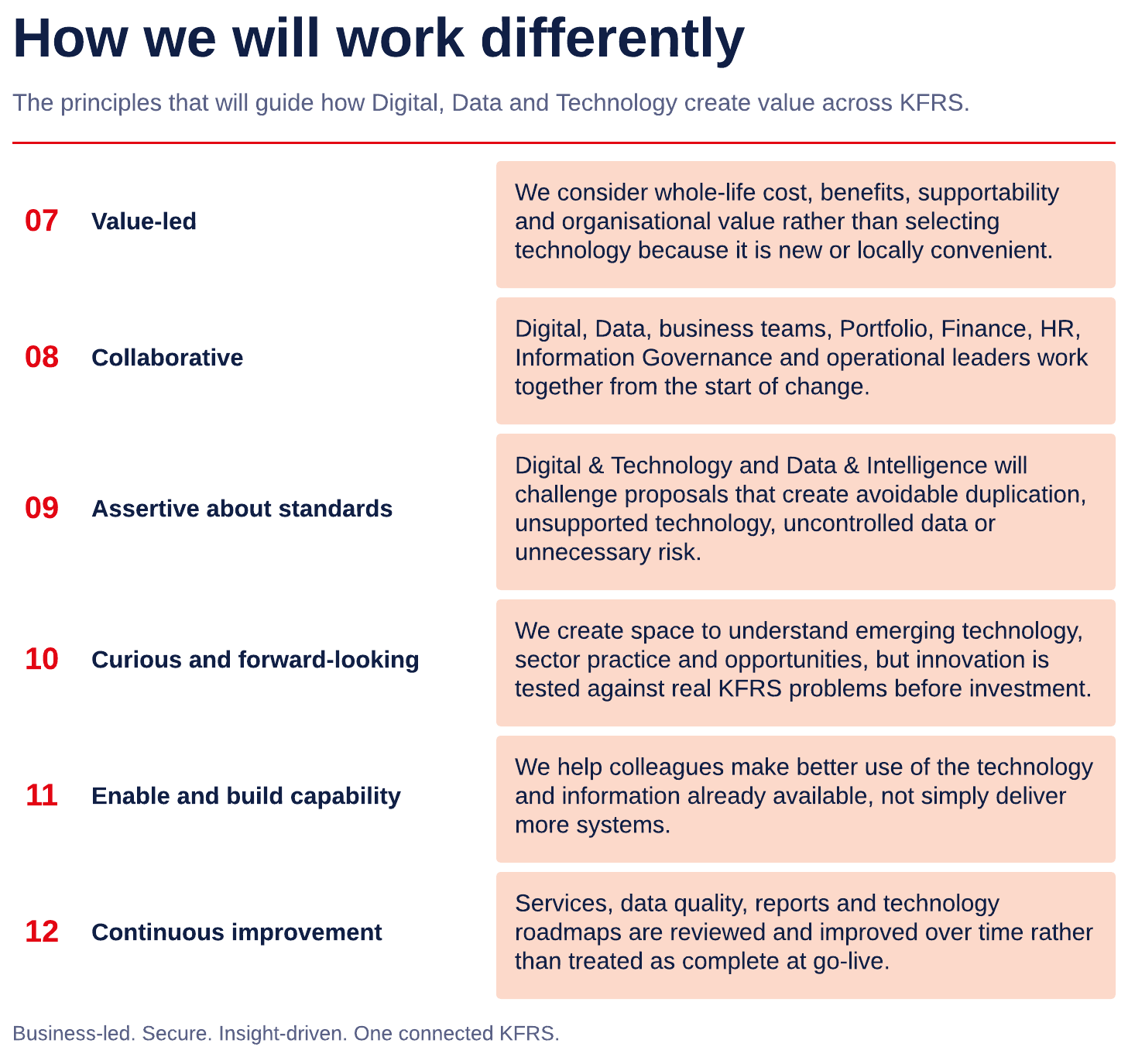
Text description: Figure 8 – How we will work differently
Business-led We start with the organisational problem, risk or service outcome. Technology and data teams help shape the solution rather than simply receive a system request.
Enterprise-first We consider the whole Service, reuse common platforms and capabilities, and challenge local solutions that create duplication or future integration problems.
User-centred We design services around how firefighters, Control, managers and corporate colleagues actually work. Accessibility, usability and adoption are part of the design, not an afterthought.
Architected Enterprise architecture guides technology, data, integration, cloud and lifecycle decisions. Exceptions are transparent and consciously accepted.
Data-driven We use trusted evidence to prioritise problems, design interventions, measure benefits and learn from delivery.
Secure by design Cyber, privacy, resilience and recovery are built into technology and information services from the outset.
Value-led We consider whole-life cost, benefits, supportability and organisational value rather than selecting technology because it is new or locally convenient.
Collaborative Digital, Data, business teams, Portfolio, Finance, HR, Information Governance and operational leaders work together from the start of change.
Assertive about standards Digital & Technology and Data & Intelligence will challenge proposals that create avoidable duplication, unsupported technology, uncontrolled data or unnecessary risk.
Curious and forward-looking We create space to understand emerging technology, sector practice and opportunities, but innovation is tested against real KFRS problems before investment.
Enable and build capability We help colleagues make better use of the technology and information already available, not simply deliver more systems.
Continuous improvement Services, data quality, reports and technology roadmaps are reviewed and improved over time rather than treated as complete at go-live.
A proactive Digital & Technology function
Digital & Technology should increasingly know what the organisation is likely to need before a project formally asks for it. This requires an enterprise view of the technology estate, lifecycle and end-of-support dates, vendor roadmaps, cyber risk, capacity, integration patterns and emerging capability.
It also requires stronger business partnering. The function should work with directorates to understand operational problems and opportunities, identify where digital capability can improve outcomes and translate those needs into coherent roadmaps. Individual projects then become delivery vehicles for that direction rather than the primary way in which the technology landscape is designed.
A proactive Data and Intelligence function
Data & Intelligence should similarly move beyond responding to requests for reports. It should understand the enterprise information landscape, maintain data governance and architecture, identify recurring decision needs, develop reusable information products and actively look for analytical opportunities that improve risk understanding and organisational performance.
This does not mean analysts decide business priorities in isolation. It means they work with leaders and subject-matter experts to turn organisational questions into evidence, challenge weak measures, identify data gaps and progressively build analytical maturity.
9. Governance, Investment and Delivery
The strategy will be delivered through the same enterprise system used to prioritise wider organisational investment. This is essential if KFRS is to move away from a technology landscape driven primarily by individual project requests or end-of-life events.
The strategic hierarchy
CRMP and corporate strategy | Defines the organisational outcomes, risk and service priorities that Digital and Data must enable. |
|---|---|
Digital and Data Enabling Strategy | Sets the future state, strategic direction, principles and enduring capabilities through 2029. |
Capability delivery plans | Translate the strategy into detailed IT, Data Governance, BI/Intelligence and AI workstreams that can be refreshed as circumstances change. |
Strategic Investment Model | Tests strategic need, non-discretionary requirements, risk, affordability and value before investment is committed. |
Enterprise portfolio | Prioritises and sequences projects, manages dependencies and delivery capacity, and tracks benefits and financial commitments. |
Programmes and projects | Deliver specific changes such as Command and Control, Time and Attendance, network replacement, data-platform capability and system modernisation. |
Service transition and benefits | Ensures projects leave sustainable operational services, clear ownership and measurable outcomes rather than simply reaching go-live. |
Decision and assurance roles
Corporate Management Board provides strategic direction and investment decisions. Portfolio governance provides visibility of delivery, capacity, dependencies and benefits. Enterprise Architecture assures the coherence of business, application, data, integration, cloud, security and lifecycle design. Data Governance provides ownership, quality, information lifecycle and ethical oversight. Cyber and Information Governance provide security, privacy and resilience assurance.
Business owners remain accountable for the operational or corporate outcome enabled by technology. Digital & Technology is accountable for technical assurance, integration, cyber, resilience, service transition and lifecycle. Data & Intelligence is accountable for data governance, semantic and analytical standards, trusted enterprise information and organisational intelligence.
Detailed delivery remains separate
This strategy intentionally does not contain the detailed project plan. IT, Data Governance, BI/Intelligence and AI delivery plans sit beneath it and contain the specific actions, owners, milestones, dependencies and evidence of completion. The enterprise portfolio roadmap holds the funded projects and sequencing.
Keeping these layers separate allows delivery details to change without constantly rewriting the strategy. It also prevents the strategic direction from becoming a catalogue of systems.
10. How We Will Measure Success
Success will not be measured by the number of technology projects completed. It will be measured by whether KFRS has created the capabilities and outcomes described in this strategy and whether colleagues genuinely experience a better way of working.
Capability outcome | Outputs and capabilities delivered | Short-term outcomes | Longer-term outcomes | Strategic benefit |
|---|---|---|---|---|
Connected frontline and operational technology |
|
|
|
|
Digital workplace and workforce services |
|
|
|
|
Trusted data and performance intelligence |
|
|
|
|
Resilient technology and cloud foundation |
|
|
|
|
Service management and technology lifecycle |
|
|
|
|
Architecture portfolio and investment governance |
|
|
|
|
Cyber security and digital resilience |
|
|
|
|
Data governance information rights and ethics |
|
|
|
|
Frontline confidence | Firefighters and Control have greater confidence in the availability, reliability and usability of critical digital services and operational information. |
|---|---|
Less administrative friction | Colleagues experience fewer manual workarounds, less duplicate entry and less time spent on avoidable administration. |
Information trust | Managers and leaders increasingly rely on agreed enterprise information, with fewer conflicting measures and less manual reconciliation. |
Better decisions | Decision-makers can access relevant information sooner and spend more time discussing causes, options and interventions than validating data. |
Risk understanding | Operational, community and organisational risk is identified earlier and supported by stronger analytical and forecasting capability. |
Technology maturity | Critical services become more resilient, lifecycle compliance improves, unsupported technology and technical debt reduce, and recovery is tested. |
Cyber resilience | Cyber maturity, information protection, supplier assurance and organisational awareness improve through demonstrable assurance and regular testing. |
Data maturity | Critical datasets have accountable owners, quality is measured, common definitions expand and data issues are remediated systematically. |
Intelligence maturity | Performance conversations increasingly use diagnosis, variation, forecasting and evidence of intervention rather than only historic measures. |
Digital and data confidence | Colleagues and leaders better understand the tools and information available to them and use digital, data and AI capabilities responsibly. |
Benefits and value | Investment demonstrates measurable improvements in productivity, resilience, operational effectiveness, workforce experience, decision quality or financial value. |
11. The 2029 Future State
By 2029, Digital and Data should no longer feel like separate corporate functions that colleagues need to navigate. They should feel like part of how Kent Fire and Rescue Service works.
Firefighters and Control will be supported by resilient operational technology and trusted information. Managers will spend less time finding and reconciling data and more time leading. Senior leaders will have a coherent view of performance, risk, workforce, finance, investment and delivery. Corporate teams will use simpler digital services and more automated workflows.
Information will be managed as a strategic organisational asset, with clear ownership, common definitions and measurable quality. Microsoft Fabric and enterprise data governance will allow priority operational, workforce, financial and corporate information to be brought together within a trusted environment. Performance reporting will evolve into organisational intelligence.
KFRS will increasingly understand not only what has happened, but why it happened, what is likely to happen next and where intervention could have the greatest effect. Advanced analytics will support forecasting and planning. AI will enhance rather than replace professional judgement and will be adopted only where governance, data maturity and evidence justify it.
Technology will be more resilient, integrated and deliberately managed through architecture and lifecycle planning. Legacy and technical-debt risks will be visible. New technology will be considered in the context of the enterprise rather than as an isolated purchase. Projects will be assessed by the capability and benefits they create, not simply whether a system was implemented.
The end state is simple: better information, less friction, more reliable technology, stronger decisions and more time focused on protecting communities.