
Customer enabling strategy 2025-2029
Our customers are the reason we exist.
Built around our Customer Promise.
Assessed against the KFRS Customer Excellence Maturity Model.
Reviewed and revised in 2026, following the 2025 inspection and the introduction of our five customer families. Next full review in 2027 as part of the annual planning cycle.
This strategy draws together the customer facing elements of our other plans.
- Community Risk Management Plan 2025 to 2029.
- Prevention, Protection and Engagement Strategy 2025 to 2029.
- Response and Resilience Strategy 2025 to 2029.
- Rural Plan 2025 to 2029.
It is driven by our commitment to fulfilling our Vision, Objectives, and Customer Promise.
It also draws on our Equality of Access documents; our People Impact Assessments and the 2025 HMICFRS inspection. Benchmarking comes from other fire and rescue services and from organisations outside our sector.
View diagram: KFRS strategic relationships
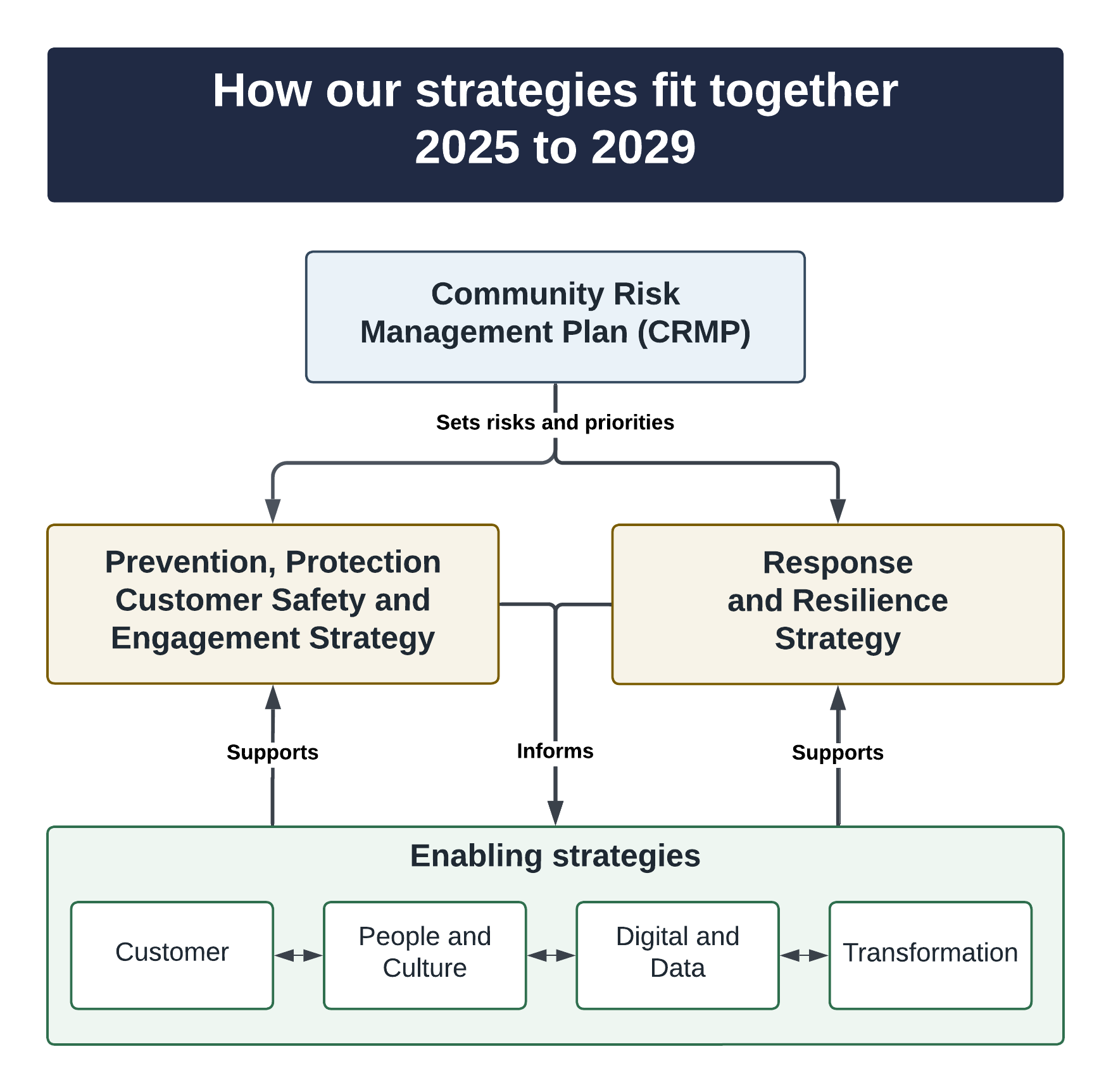
The Community Risk Management Plan sets risks and priorities for the service strategies. The service strategies inform the four enabling strategies, which support delivery of both service strategies. The enabling strategies are Customer, People and Culture, Digital, Data, Technology and AI, and Transformation.
1. Our approach to customer
1.1 Serving our customers
In a single day we will answer emergency calls and answer the phone at reception. We will visit people in their homes, stand in a school hall and inspect a building. We will comment on a planning application and reply to a request for information. We will publish a safety message, run a workshop, take a stand at a county show and ask someone what they thought of the service they received. We will respond to deal with emergencies our customers are facing. All of it results in a customer forming a view of us.
1.2 Why we say customer
We use the word customer rather than public, resident or service user. It is a deliberate choice, and it means three things.
- The person in front of us has a say. What they think of what we did is evidence of our performance, not opinion, and it is worth as much as our own account of how it went.
- Their needs are theirs alone and are not defined by the average of others. A good countywide customer performance figure tells us nothing about the household that had the worst experience.
- They are owed a standard we can be held to. A customer can expect something, ask why it did not happen and complain when we fall short.
Customer describes the standard we set ourselves. It does not describe a transaction. Nobody buys what we do, and most people never choose it. Some of the people in this strategy would much rather we were not there at all. But that does not mean that we shouldn’t treat them as a customer.
Our customers are:
- The people who live in Kent and Medway.
- The people who work here, visit, and the people who travel through.
- The businesses who employ them.
- The responsible persons who keep buildings safe.
- The partners who stand alongside us at incidents and in communities.
- The bodies who hold us to account on the public’s behalf.
Most of them will never need us in an emergency.
1.3 One team, one experience
Our service strategies describe a One Team approach to reducing risk. This strategy applies the same idea to the experience of receiving what we do.
More detail: 1.3 One team, one experience
A customer does not see prevention, building safety, response, resilience or engagement. They see Kent Fire and Rescue Service, not its component parts. If they have to explain their circumstances twice, we are not getting this right. The same is true if they get a different answer depending on how they make contact or who with.
This is the reason the strategy exists as a separate document. The Customer Strategy is one of four enabling strategies (People and Culture, Digital and Data, Transformation). It underpins and supports our two service strategies - Protection and Prevention, Response and Resilience and ultimately our CRMP by ensuring the organisation has the right people, systems, skills, culture and capability to deliver against the risks identified in our Assessment of Risk. This is a four-year rolling strategy, reviewed annually alongside our revision of the CRMP.
This customer strategy is about the joins between them, the information we share, and whether the person on the receiving end experienced the consistent level of excellent customer service they should expect from us.
1.4 Everyone here contributes to the customer experience
Customer experience is delivered by every part of the Service. That includes:
- Fire Control and our crews.
- Fire safety inspectors and Safe and Well officers.
- Education officers and volunteers.
- Data analysts and the colleagues who answer reception.
- The colleagues who draft our policies and publish our information.
- The people who support the front line.
The customer does not distinguish between our teams, so this strategy does not either. Wherever it sets a standard, that standard applies to whichever part of the Service the customer meets.
Colleagues are also customers of each other and that internal experience is carried in the People and Culture Enabling Strategy rather than restated here. The two are connected. To deliver an outstanding service to our customers across Kent and Medway we must deliver a great customer experience to one another.
1.5 Our vision, aim and objectives
Our vision is a future where no one is killed or seriously injured by a fire or other emergency.
Our aim is to work together with our customers to save lives and reduce harm. Our four service objectives are set out in the Community Risk Management Plan.
- Responding effectively in times of need.
- Promoting behaviours to help everyone stay safe and well in their home.
- Encouraging safer behaviours on the roads and near inland water.
- Supporting businesses to keep their buildings safe and comply with legislation.
Those objectives describe what we do. This enabling strategy describes how we consider people we deliver those services to.
1.6 Our Customer Promise
Our Customer Promise is published, and it already says what our customers are entitled to expect. Four commitments:
- To provide excellent services.
- To provide personalised and accessible services.
- To maintain your trust.
- To work with you to keep improving.
This strategy does not restate the promise, and it does not replace it. It is the working structure underneath it. Everything that follows is here because one of those four commitments cannot be kept without it.
What our promise should sound like at the point of contact
- You should be able to find what you need from us without knowing how we are organised.
- Once you have told us something, you should not have to tell us again.
- We will ask what you need rather than assume we know.
- We will explain things in words that make sense, and check that they did.
- When you call us in an emergency we will answer, and we will stay with you until help arrives.
- When we come to your home, your business or your land, we will treat it as yours.
- When something is over, we will not simply disappear.
- If we get it wrong, we will say so, put it right where we can, and change what we do next time.
1.7 What customer means in an emergency service
Some of what good looks like is universal. Answering quickly, being clear, being kind, not making people repeat themselves. Some of it belongs to us alone.
More detail: 1.7 What customer means in an emergency service
We are a service that mostly succeeds when nothing happens. The best experience a customer can have of us is a smoke alarm that never had to sound, a fire risk inspection that meant a shop stayed open or a stretch of river where nobody drowned. Prevention and building safety work is customer service, even though the customer rarely knows it took place.
But if an emergency does occur, customer service is measured in inclusive service to all, competence, composure, and compassion. It is the steady voice on a 999 call, a crew acting quickly to deliver help fast, and the compassion shown after the fire is out. It is the ability to keep the customer at the centre of our thinking during moments of crisis.
We also hold information about people at the point when they are most vulnerable. Hoarding, a mobility impairment, a child with an unusual interest in fire. We handle that information with care. We share it only where it makes someone safer and we don’t ask someone to explain it twice. That is a customer commitment as much as a data one.
We cannot always give people what they want. We enforce, we prohibit, and we sometimes must tell a business owner that they must close. Being a good regulator and being good to customers are the same discipline done honestly. That is why our protection work is based on compliance through engagement. Our guidance should be clear enough to act on before enforcement is ever needed.
1.8 People, places and spaces
Our Risk Based Intervention Programme organises risk into people, places and spaces, and identifies the greatest harm where risk in two or more of those elements overlap. Customer experience follows the same shape. A customer is rarely only a person, only an occupant or only a road user. The person with limited mobility living on the seventh floor is a customer of three teams at once. Our prevention teams, our building safety inspectors, and our crews if an emergency occurs. Our job is to make sure they experience one service rather than three.
2. Our five customer families
Customer experience runs through everything we do, and most of it happens when nothing is on fire. We have five broad customer families.
The families are not defined by who somebody is. They are defined by how the contact begins and what gives us the right to be there. That question drives how we reach people and what tone to take. It drives what consent looks like, how long we have, and how we judge whether we did well. Nobody is outside the five, including the bodies that scrutinise us.
View diagram: The five customer families
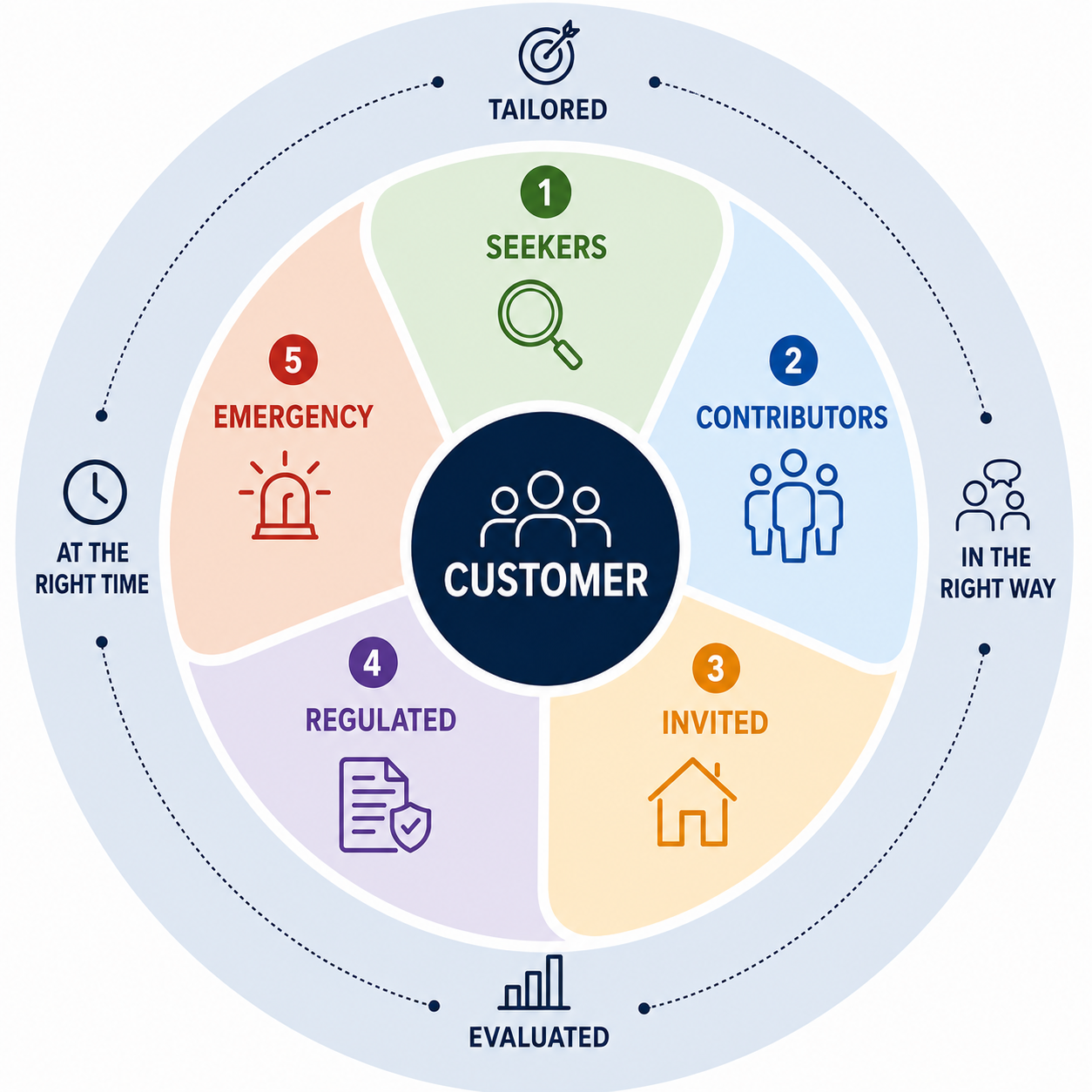
The customer sits at the centre of the five families. The surrounding principles are tailored service, at the right time, in the right way, and evaluated. The following table describes the families, how contact begins, who they include and what we owe them.
Explore table: Customer families: how contact begins, who is included and what we owe them
Family | How contact begins | Who this includes | What we owe them |
|---|---|---|---|
Seekers | They come to us wanting something | Anyone asking us for information, advice, a decision, a record, redress or evidence | To be accessible to all, findable, understandable and answerable without them needing to know how we are organised |
Contributors | They come to us offering something | Cadets, volunteers, consultees, community groups, partners, research participants, people who give us feedback | To make it worth their time and to show them where their contribution landed |
Invited | We go to them with an offer- which they can refuse | People at higher risk who have not asked for us, young people, schools, households we reach through partners, people after an incident | To be worth letting in, to arrive already knowing what we know, to leave them better off, and to respect their decision if they do not want our offer |
Regulated | We go to them with the law behind us | Responsible persons, building owners, landlords, event organisers, licensed premises, care and hospitality providers | Clarity, proportionality, consistency and a real route to challenge us |
Emergency | The event brings us together | People calling 999, people at an incident, casualties, families, neighbours, businesses and others affected who may not even be present | Competence, dignity, plain information under pressure, and not leaving before the customer has what they need and we have included work to help them recover as much as we can |
2.1 Moving between families
These are states rather than labels. The same household can be an emergency customer on a Tuesday night. They are an invited customer for the weeks that follow. They move into the regulated category if they are responsible for an affected building, and a seeker when they ask for reports and information.
More detail: 2.1 Moving between families
That movement is where most of our risk sits. Handovers between families mean handovers between teams and between systems that need to work to talk to each other. That is where things can get missed or people are asked to explain themselves again.
It also follows that we cannot measure every customer family the same way, and that being good with one does not make us good with another.
2.2 Customer family one: Seekers
Who they are
Seekers come to us because they would like something. They have already decided we are the right place to ask, which is a vote of confidence we should not waste. They are usually not in danger and they have time, though not unlimited patience. What they want might be information, a form, a decision, a record, an explanation, or an answer to a complaint.
The defining feature of this family is that they started the conversation and can end it just as easily. A seeker who cannot find what they need rarely tells us. They may give up, and we never learn that it happened. That makes seekers the family who are quietest and easiest to miss if we do not deliver what they need.
Not every seeker is calm or has time. Some are asking about a fire that has just happened to them. Some ask a routine question that turns out to be a risk we need to act on today. Recognising that, in a channel built for ordinary enquiries, is part of being an emergency service.
Where we meet them
- Our website, our published safety information and our social media channels.
- Reception, the Safe and Well line, business safety enquiries or the press office.
- Email, web forms and social media messages.
- Requests for an incident record, a fire investigation finding or a copy of a document, including from people who were caught up in the incident themselves.
- Freedom of information requests.
- Complaints, compliments and reports of alleged fire safety risk.
- Businesses, landlords and event organisers asking what a new legal duty means for them.
- Journalists, insurers, solicitors, researchers and students.
- Unplanned encounters on the street, at events, or knocking on the door of a fire station.
Those who require answers from us
A small group of seekers do not simply want an answer. They are entitled to one and can compel it. Coroners, HMICFRS and the Local Government and Social Care Ombudsman ask us for evidence. So do our own Fire Authority, government departments and external auditors. These timescales are not ours to set.
Where we are now
For most people in Kent and Medway our website and social media are the only part of Kent Fire and Rescue Service they will ever meet.
We answer building consultations within fifteen working days. We treat requests for information as a service rather than an administrative task. We answer the question that was asked, within the statutory period.
What we cannot yet do is describe the experience. We hold no measure of how much effort it took a customer to get an answer. We have no first contact resolution figure for external customers, and no thematic analysis of what complaints are telling us. Complaint handling is the weakest dimension in every sector measured nationally. That makes it the least likely thing for us to be quietly good at without checking. We can say how quickly we replied. We cannot say how easy we were to deal with, or how many people gave up before they reached anyone at all.
Where we strive to be
- A customer reaches the right part of the Service without knowing how we are organised and gets an answer at first contact wherever possible.
- Where we cannot resolve it there and then, the customer leaves the conversation knowing who has it and when they will hear back.
- Everything we publish is written so that the person it affects can read and understand it and hold us to account with it.
- Statutory and inspection requests are owned, tracked and answered on time as a matter of routine rather than effort.
What good looks like
Explore table: Seekers: what good customer service looks like
Quality test | What we would expect to see |
|---|---|
Inclusive | It can work for everyone. |
Findability | People asked to complete real tasks on our website succeed without help, tested with customers and colleagues, including people using assistive technology |
Effort | A customer effort baseline across the main seeker journeys, falling year on year. Satisfaction scores only capture the people who persisted |
Right first time | A first contact resolution measure for external customers, improving year on year. Right first time is the strongest single driver of satisfaction in every national benchmark |
Timeliness | Building consultations within fifteen working days, freedom of information requests within twenty working days, and enquiries about new legal duties answered within published timescales |
Quality of the answer | A sample of responses checked against a written standard for accuracy, tone and readability, not only for whether they went out on time |
Learning from the pattern | A review each year of what people most often could not find, and what we changed on our website as a result |
Nobody lost | Abandoned calls, unanswered messages and dead ends actively looked for and counted |
2.3 Customer family two: Contributors
Who they are
Contributors give us something. Their time, their views, their energy, their local knowledge, and in some cases years of unpaid commitment. They are not asking us for a service. They are helping us run one or giving information that should be used to determine how it should be run.
Nothing obliges them to stay. They can walk away at any point and the only thing holding them is whether it feels worth doing.
Where we meet them
- Fire cadets, their families and the schools and youth settings around them.
- Volunteers, including the Volunteer Response Team.
- People responding to consultations.
- People taking part in Equality of Access/ CRMP research or in consultations carried out as part of a People Impact Assessment.
- Community groups, faith groups, parish councils and residents’ associations who host us or open doors we could not open ourselves.
- Partners at incidents and in communities, including health, housing, adult social care, police, local authorities and the voluntary sector.
- Neighbours at incidents offering support, facilities, and kindness.
- Businesses working with us through Primary Authority arrangements and Safety Advisory Groups.
- Anyone who answers a post incident survey, gives us community insight on a station, or tells us what worried them.
Where we are now
We consult before we decide, early enough for the answer to still be capable of changing.
More than 1,800 people responded to our last risk assessment consultation. Around ninety per cent agreed with our reading of the risks facing Kent and Medway. Sixty per cent supported measuring response times separately for rural and urban areas.
We host a multi-agency team that brings together contributors from across the emergency response sector and provides a focal point for voluntary sector.
Volunteer structure and support is applied inconsistently, which limits both what volunteers can achieve and the experience they have with us.
Where we strive to be
- We publish what we heard and what changed within a defined period of every consultation closing.
- We know who contributed and who did not. We go looking for the voices that are missing, rather than reporting the volume of responses we happened to get.
- Cadets and volunteers are supported to a defined standard wherever they are based, with a clear route to raise a concern.
- Partners experience a single effective route into the Service, and information moves both ways.
- Community insight gathered on stations reaches the people who plan services, rather than staying where it was collected.
- Contributing feels like a relationship rather than a transaction, and we can show people the difference they made.
What good looks like
Explore table: Contributors: what good customer service looks like
Quality test | What we would expect to see |
|---|---|
The loop closes | A published account after every consultation, within a set period of closing. It covers what we heard, what we did, and what we decided not to do and why |
Who we heard from | The profile of consultation and research participants compared against the profile of the county, with deliberate action where a community is absent |
Asked properly | Consultation meeting the Gunning Principles, evidenced through the People Impact Assessment framework rather than assumed |
Volunteer and cadet experience | A consistent support standard across the county, with retention and reasons for leaving tracked and acted on |
Partner route in | Partners report effective routes into the Service and can name who to contact |
Insight used | Community insight, debrief findings, feedback and consultation held as one picture rather than several, with examples of what it changed leading to continuous improvement |
Contributions are valued | A process for understanding who has helped and providing feedback and thanks for the support contributors give us. Contributors should be provided with the knowledge that they made a difference. Making sure we have the widest base of contributors, so we hear different voices. |
2.4 Customer family three: Invited
Who they are
We start this conversation, not them. Invited customers may not know they need us and may not want what we are offering. Nothing compels them to say yes, and we are there because of our own judgement that they are at risk.
That makes this the family where our conduct matters most and where our standing is weakest. Everything rests on whether we are worth the time we have asked for, whether that is at somebody's front door, in a classroom, at a workshop, on a stand at a county show or in a conversation arranged by somebody they already trust. It rests on whether the person feels in control of what happens next, and on whether what we delivered was shaped around them or around our process. It is also the family where the person who most needs us is often the one least likely to accept the offer.
Post incident support sits here too, because once the emergency is over, we are choosing to go back. The household is not calling us anymore. We are the ones knocking.
Where we meet them
- Home Fire Safety Visits and Safe and Well visits. These matter most for people with co-existing vulnerabilities, such as those over 65, people living alone, people living with dementia and people with mobility limitations. We regularly re-assess the most vulnerable people.
- Fire setter interventions and youth work, including work to keep young people out of derelict buildings and away from deliberate fire setting.
- Early years, primary and secondary school sessions, learning resources and safety talks to community groups.
- Workshops and talks for community groups, carers, care providers, faith groups and employers, and training that helps partners recognise risk and refer people to us.
- Prevention campaigns e.g. cooking, smoking, batteries, chimneys, bonfires, water safety and road safety.
- Online and telephone safety checks, self-assessment tools and printed information for customers who do not want or do not need a visit.
- Response Assessment Visits and other work where we arrive at a property to gather or share risk information.
- Post incident contact, the Volunteer Response Team, rehousing and business recovery support and community reassurance after a serious fire.
- Safeguarding referrals and onward referrals into health, housing and social care.
- Open days, station events, county shows and the invitation to visit us.
- Households reached through the people communities already trust, when that person is not us.
- Specific research on issues where we seek further data and intelligence.
Where we are now
This is the family where our underlying work is strongest and our evaluation is improving. Our understanding of risk is a recognised strength. Our Equality of Access research and People Impact Assessments give us a detailed picture of who is under served. That picture was developed with charities, research bodies and the communities themselves.
Independent inspection has told us that quality assurance of prevention activity needs to improve. It also found that our People Impact Assessments need clearer consideration of protected characteristics, stronger consultation and better assurance. Both findings point the same way. We can describe who we should be reaching. We need to continue to improve how we reach them consistently, to the same standard, or that it made any difference. We count visits, sessions and events delivered. We are far less able to say whether risk fell.
The evidence base is strong. What is missing is proof that the barriers are coming down rather than a description of what they are.
Where we strive to be
- We identify who is missing from each of our services and go to them. We give extra weight to customers who are further from help by geography, language, health, income or trust.
- Whoever knocks arrives already knowing what we know, so nobody is asked to explain their circumstances to us twice.
- We work through the people communities already trust when we are not that person ourselves.
- We act early, before a risk becomes an emergency, particularly with young people, with households whose circumstances have just changed and with communities after a serious incident.
- Prevention is designed with customers rather than for them, involving people from the communities affected in our customer journey mapping.
- What we deliver is shaped around the person in front of us, whether that is a home visit, a school session, a workshop or a conversation at an event. That may mean more time, a different way of communicating, or additional support.
- We give more support, and earlier, to customers who are further from help or need additional support, because prevention matters most where the fire engine is furthest away or people are more at risk.
- When something is over, we do not simply disappear, and an emergency does not cause a second round of harm.
What good looks like
Satisfaction is the wrong headline measure for this family. The person most relieved that we have left may well be the one who needed us most. What follows measures reach, consistency and whether anything changed.
Explore table: Invited customers: what good customer service looks like
Quality test | What we would expect to see |
|---|---|
Reach against risk | The profile of customers receiving our services moving closer to the profile of customers our risk model identifies, reported by district and by rurality |
Refusals understood | Refusal and no access rates recorded with the reasons behind them, and a different approach tried where a group refuses more often than others |
Consistency of delivery | A written quality standard covering visits, sessions, workshops, events, campaigns and support after an incident, applied through assurance checks and peer review, so the experience does not depend on who turned up |
Did it change anything | Activity evaluated on outcome rather than volume, with a clear view of whether risk fell or behaviour changed |
Education and early intervention | School and youth sessions, fire setter work and community workshops evaluated for what changed, with teachers, partners and families telling us whether what we left behind could be used |
Nobody dropped at handover | Safeguarding and partner referrals tracked to completion. Our Dynamics system holds data about customers which is accessible to all our teams. |
2.5 Customer family four:
Regulated
Who they are
Regulated customers meet a version of us that carries legal authority. Some are willing and confused, wanting to do the right thing but unable to work out what it is without paying somebody to tell them. Some are resistant. A few are deliberately non-compliant. Most sit somewhere in the middle and are running a business with fire safety as one of many things on the list.
This is the family where being liked and being right come apart. We enforce, we prohibit, and we sometimes must tell an owner that they must close. A duty holder can be treated impeccably and still be very unhappy with us, and that is not a failure. What would be a failure is being unclear, inconsistent, disproportionate, or impossible to challenge. Our work here is built on compliance through engagement, with guidance clear enough to act on long before enforcement is ever needed.
Where we meet them
- Fire safety audits and inspections, and the responsible persons who receive them.
- Building regulation, licensing and planning consultations
- Alterations notices, enforcement notices, prohibition notices, prosecutions and appeals.
- Primary Authority arrangements and Safety Advisory Groups.
- Landlords, care providers, the hospitality sector and event organisers, reached through seminars, workshops, webinars, business events and published guidance.
- Hazardous sites and premises subject to notification and marking requirements.
- Building safety investigation, engagement and enforcement following an incident.
- New duty holders created by the Fire Safety (Residential Evacuation Plans) (England) Regulations 2025, from April 2026.
- Premises and event organisers covered by the Terrorism (Protection of Premises) Act 2025, known as Martyn’s Law.
Where we are now
Our regulatory work is one of our strongest areas and has been recognised as such by independent inspection. We answer building consultations within fifteen working days, and we run an engagement first approach. We publish guidance and deliver seminars for responsible persons, landlords, care providers and the hospitality sector.
Two pressures are building. New duties from 2026 bring a significant new group of responsible persons and event organisers to us with questions.
Many are small organisations with no fire safety expertise and no budget to buy any. Our channels were designed for a smaller and better-informed audience.
Where we strive to be
- Any customer facing a new legal duty can find out what is required of them without needing specialist knowledge or paid advice.
- Expectations are clear before we arrive, the reason for our action is explained in plain language, and what we require is proportionate to the risk.
- The same premises with the same risk gets the same outcome whichever inspector attends and whichever district it sits in.
- A real route to challenge us is open, well signposted and used without anybody fearing the consequences of using it.
- Our channels are designed for the volume and type of enquiry that new duties will bring. New demand is not absorbed into arrangements built for something else.
- Where a business is trying to comply, the experience of dealing with us makes that easier rather than harder.
What good looks like
Quality in this family means fairness that can be evidenced.
Explore table: Regulated customers: what good customer service looks like
Quality test | What we would expect to see |
|---|---|
Inclusive | Ensuring minority ethnic businesses and small businesses are supported. |
Consistency | Audit and enforcement decisions peer reviewed and sampled across inspectors and districts, with variation investigated rather than explained away |
Proportionality | Action tested against the Regulators’ Code and our published enforcement policy, with the reasoning recorded |
Clarity | Guidance and notices tested for readability with the people who receive them, particularly small businesses with no specialist support |
Predictability | Published timescales met for consultations, audits and responses, so a business can plan around us |
Time to compliance | How long it takes premises to become compliant after we first raise something, and whether that compliance is still there when we return |
Route to challenge | Appeals, representations and complaints from duty holders analysed as evidence about us, not only as disputes to win |
New duties handled | Enquiries arising from the 2026 duties answered within published timescales, with take up of guidance measured rather than assumed |
Support before enforcement | The balance between engagement and formal action tracked over time, with enforcement as the exception it is intended to be |
2.6 Customer family five:
Emergency
Who they are
Nobody in this family chose to be here. The contact begins with the event, it happens in minutes rather than months, and they may not be prepared. They may be injured, frightened, in shock or entirely unable to take in what we are telling them. Some of them never called us at all and simply looked up to find us on their street.
This family is wider than the person we are helping. It includes:
- The person on the phone, and the person in the building.
- The family standing outside the cordon.
- The neighbours who have been evacuated.
- The building, business or landowner.
- The road user.
The word customer sits least comfortably here, and we should be honest about that rather than pretend otherwise. We use it deliberately in this strategy, because the standard a person is owed should not fall away at the exact moment their circumstances become hardest. However, we will not openly refer to casualties, or those that have lost their lives, at a scene as a customer. Their humanity and grief come first. But behind the scenes, holding ourselves to the discipline of customer service ensures we never take their trust for granted. It means treating every casualty, bereaved family, and traumatised bystander with the utmost dignity, urgency, and unconditional care.
Where we meet them
- 999 calls, fire survival guidance and everything a caller hears from Fire Control while they wait.
- Callers who do not speak English, deaf callers using British Sign Language or emergency SMS, and callers who cannot safely speak at all.
- An emergency response anywhere, including in a home, a business, a farm, a road or the water.
- People rescued or treated at the scene, and the families, neighbours and people around them.
- Businesses and residents evacuated or affected nearby.
- Road traffic collisions, water rescue, animal rescue, flooding and major incidents.
- Warning and informing a community while something is still happening.
- The first hours afterwards, including handover, safeguarding and the point at which we leave.
Where we are now
This is where we have the strongest culture of customer care and it is the family we have invested in more than any other. Our crews understand the concept of customer and delivering great customer service, for example, appointing dedicated customer liaison officers at the scene.
Following the Grenfell Tower and Manchester Arena inquiries we made four changes.
- A fully digital fire survival guidance system.
- More than thirty exercises proving the effectiveness of our fire survival guidance process.
- Training for Kent Police colleagues who may take survival guidance calls during periods of high demand.
- Designation of the officer in charge in Fire Control as our Initial Incident Commander.
During this strategy period we will introduce a new command and control system, shared with our Networked Fire Service Partnership partners. It will mean 999 calls can overflow to another fire and rescue service able to mobilise our appliances directly.
Speed of arrival remains what customers tell us they value most, and geography shapes the rest. Our response standard is nine minutes in urban areas and fifteen minutes in rural areas, on at least 75% of occasions. For non-emergency incidents it is thirty minutes. Around 85% of Kent and Medway is rural, and one in three people live in a rural community. 40% of our businesses are in rural locations, about a third of our incidents happen there. On Call availability is instrumental in serving these areas and has been identified as needing to improve in the daytime.
A fire in the home is one of the largest single increases in household vulnerability there is. Care after an incident remains inconsistently defined and inconsistently measured. We do not yet apply one standard for what happens next.
Where we strive to be
- When somebody calls us, we answer and take the right details to send the most appropriate response.
- People are involved in what is happening using words they can take in during a very stressful time, and somebody checks that they understood.
- When we come to a home, a business or a piece of land, we treat it as theirs.
- We warn and inform quickly and clearly when something affects a community, through channels that reach people who do not follow our usual ones.
- A defined standard of care after an incident applies everywhere in the county. The handover to whoever comes next is completed.
- The customer view forms part of how we learn from incidents, alongside the operational one.
- We place customer need at the centre of our thinking when it comes to operational policies, procedures and guidance, using People Impact Assessments and Equality of Access research to shape our thinking.
What good looks like
Explore table: Emergency customers: what good customer service looks like
Quality test | What we would expect to see |
|---|---|
Getting and giving the right information | Call handling quality assured against the Fire Control standard, including the information we took from the caller and how we used it |
Understood, not just told | Post incident feedback on whether people understood what was happening and what they were asked to do |
Dignity | Customers asked whether they were treated with respect and whether their home, business or land was treated as theirs |
The handover focused on recovery | Referrals to housing, health, social care and support organisations tracked to completion, with a named point at which responsibility passed |
Learning includes the customer | Incident debriefs routinely including the whole incident, including activity carried out before, during and after the incident. This should include what the experience was like for the people involved, not only how well procedures were applied. |
3. What we will do
Our focus areas are grouped by the four commitments in our Customer Promise. Each one is something we can be held to, and each applies across all five customer families unless it says otherwise.
3.1 To provide excellent services
- Give every customer “One” Kent Fire and Rescue Service to deal with. What they tell one part of the organisation is known by every part that needs it and by nobody that does not.
- Aim to resolve what a customer needs at the first point of contact. Where we cannot, tell them who is picking it up and when.
- Give more, and earlier, to customers who are further from help or are vulnerable, because prevention matters most where the help is furthest away or people are at more risk of harm.
- Act early, before a risk becomes an emergency, particularly with young people, with households whose circumstances have just changed and with businesses facing a new legal duty.
- Stay with customers after an incident and hand over properly, so that an emergency does not cause a second round of harm.
- Make it simple for businesses to do the right thing, with guidance clear enough to act on without specialist knowledge.
3.2 To provide personalised and accessible services
- Use plain language, avoid jargon, and share information through more than one channel so that customers who are not online are not excluded.
- Provide key information in a way that can be understood for those who do not have English as a first language.
- Meet accessibility standards on key information we publish.
- Adapt how we deliver visits, sessions, events and appointments when someone needs more time, a different way of communicating or additional support.
- Go to customers rather than waiting for them. Use incident data, health data, demographic profiling and partner intelligence to find the households least likely to contact us.
- Work through the people communities already trust when we are not that person ourselves.
- Offer customers the range of ways they will accept, including education in schools, youth and fire setter work, workshops, community events, campaigns, online information and telephone advice, rather than assuming a home visit is the answer.
- Design services with customers rather than for them, involving people from the communities affected in our customer journey mapping.
- Make sure any customer facing a new legal duty can find out what is required of them without needing specialist knowledge.
3.3 To maintain your trust
- Publish how we are performing, including where we fall short of our own standards. We were the first service to sign the Charter for Bereaved Families which promises transparency when things go wrong.
- Consult before we decide and publish what we heard and what changed as a result.
- Explain our regulatory decisions in plain language and keep a clear route open for customers to challenge us.
- Treat what customers tell us as held in trust, share it only where it makes someone safer, and be able to explain why we did.
- Take safeguarding seriously in every contact, whoever is making it and wherever it happens.
- Warn and inform quickly and clearly when something affects a community. Use channels that reach people who do not follow our usual ones.
- Answer requests for information as a service and review the pattern of questions telling us what people cannot find.
- Keep the customer experience dependable throughout periods of organisational change, including reform of local government structures.
3.4 To work with you to keep improving
- Find out independently what it is like to be our customer and compare it with organisations outside the fire and rescue sector.
- Bring feedback, complaints, community insight, debrief findings, evaluation and consultation responses into one picture.
- Measure whether our work changed anything, not only how much of it we did.
- Keep learning from other fire and rescue services, from national guidance and from organisations that do this well.
Everything set out here is delivered within the statutory framework and the national standards at Appendix 2.
4. External evidence and maturity assessment
4.1 What independent inspection told us
The 2025 HMICFRS inspection recognised real strengths. These included how well we understand the risk of fire and other emergencies in Kent and Medway. They also included how we protect the public through fire regulation. Inspectors highlighted our Response Assessment Visit Intelligence process. They called it an innovative way of gathering risk information and getting it to the people who need it. They also praised our prevention work in schools for pupils with special educational needs.
More detail: 4.1 What independent inspection told us
The inspection also made three findings that go to the heart of this strategy. That our People Impact Assessments require clearer consideration of protected characteristics, stronger consultation and improved assurance. That daytime On Call fire engine availability needs to improve. And that quality assurance of prevention activity needs to improve.
In customer terms those are the same finding three times. We are strong at understanding risk and less strong at proving that what follows from it reaches everybody, consistently, and to the same standard. We have already responded with a People Impact Assessment process, capability building, further training and an evidence library. This strategy carries the customer half of that work.
The pattern is not ours alone. Across the sector, the areas most often criticised are the ones customers feel most directly. Whether prevention activity is quality assured, whether it reaches the intended groups, and whether a fire engine is available.
4.2 What we already know about who is under served
Our Equality of Access research and People Impact Assessments give us a detailed picture, developed with charities, research bodies and community organisations. Two distinct groups emerge and they need different responses.
Customers at higher risk of harm include:
- Older people, and people living alone.
- People living with dementia.
- People with mental health conditions.
- People with physical disabilities and mobility limitations.
- People who smoke.
- People facing financial hardship.
- Young adults and young families.
Nationally, 72% of people who died in dwelling fires in 2024 to 25 lived in single occupancy homes (Home Office Fire Statistics).
Customers we need to do further work with to fully understand their needs:
- Gypsy, Roma and Traveller communities.
- Black and Asian communities.
- LGBT+ communities.
- Autistic and neurodiverse people.
- Jewish communities.
- Digitally restricted residents.
- Veterans and the armed forces community.
- Seasonal agricultural workers.
These customers are not always overrepresented in incident data. They are underrepresented in who receives our help. That is a different problem needing a different answer.
The evidence base is strong. What inspection told us is that we now have to show the barriers are coming down, not only that we have described them.
4.3 What the wider evidence tells us about customer service
The UK Customer Satisfaction Index, published twice a year by the Institute of Customer Service, is the national benchmark. It is based on around 15,000 consumers and 59,500 customer experiences per wave. Scores cover 26 measures in five dimensions. Those dimensions are experience, complaint handling, customer ethos, emotional connection and ethics.
More detail: 4.3 What the wider evidence tells us about customer service
The July 2026 index stands at 78.3 out of 100. Local public services score 74.0, below the national average and below every commercial sector measured. Previous benchmarking (2021) of our performance by the Institute of Customer Service rated KFRS’ Customer Satisfaction Index score as 95.3, far exceeding the average of any UK sector and outperforming the fire and rescue sector by 18.5 points. However, we are mindful that that was a snapshot in time and we want to continue to strive for improvements.
The strongest single driver of satisfaction is whether the organisation got it right first time. More than a third of customers now say they would rather have excellent service than the cheapest option.
Three of the five dimensions, customer ethos, emotional connection and ethics, are areas where a fire and rescue service starts from an unusually strong position.
The organisations at the top of that index share three habits. They resolve things at the first contact. They remember the customer, so nobody has to repeat themselves. And they make it easy to complain, then visibly act on what they hear. None of that is expensive and all of it is transferable to us.
Energy and water companies run priority services registers. These show how a vulnerability can be recorded once and shared between organisations, with the customer’s consent. The customer does not have to disclose it separately to each body. Health and social care use the Accessible Information Standard to record and meet a communication need once, at the point of first contact. Both are directly relevant to Safe and Well visits, building safety consultations and post incident support and are areas that we are working with partners to improve.
4.4 Where we stand
We assess ourselves using the KFRS Customer Excellence Maturity Model. It is the same five level model used in the Prevention, Protection and Engagement Strategy and the Response and Resilience Strategy.
Explore table: Customer Excellence Maturity Model: the five levels
Level | What this means |
|---|---|
Level 1 Initial (Reactive) | Processes absent, ad hoc or inconsistent. Activity depends on individuals. No systematic approach. |
Level 2 Developing (Repeatable) | Processes exist but are inconsistently applied. Basic standards beginning to emerge. |
Level 3 Established (Embedded) | Processes consistently applied, documented and assured. Aligned to national standards. |
Level 4 Advanced (Outcome driven) | Processes drive measurable improvements. Evidence based, data led and externally benchmarked. |
Level 5 Leading (Innovative and validated) | Sector leading. KFRS contributes to national doctrine. Independently validated excellence. |
The table below is our assessment of each customer family. It draws on published evidence, the 2025 inspection and the self-assessments already made in our service strategies. The full five level range for each family is set out at Appendix 1. This assessment should be formally benchmarked alongside the maturity assessments already made elsewhere.
Explore table: Customer families: current maturity, 2029 ambitions and evidence of success
Customer family | Where we are | Where we want to be by 2029 | How will we know we are getting this right? |
|---|---|---|---|
Seekers | Level 2 Developing | Level 4 Advanced | A worried neighbour reporting a hoarded flat, a landlord asking what a new duty means and a bereaved family asking for the report on a fire in their home all reach the right person first time and are answered by someone who understands what they are asking for. Where a routine enquiry turns out to be urgent, or carries a risk we should act on today, we recognise it rather than log it. Nobody has to know how we are organised, explain themselves twice or chase us. We will know we are getting this right when customers need less effort to get help and more enquiries are resolved at first contact. We will check our responses for accuracy and tone, as well as whether they are sent on time. We will also have a clearer picture of how many people give up trying to contact us before reaching anyone. |
Contributors | Level 3 Established | Level 4 Advanced | A clear cadet career pathway. Volunteers are clear what they are there to do and are thanked for doing it. A partner has a named contact, receives information as well as being asked for it, and can reach us at three in the morning as easily as on a Tuesday afternoon. Somebody who answered a consultation, sat in a research group, hosted us at their community centre or gave us their views after an incident can see what changed as a result. We will know this is right when we can point to what contributions altered, when we know whose voice was missing and went looking for it, and when the people who help us stay. |
Invited | Level 3 Established | Level 4 Advanced | A child leaves a school session able to say what to do, and the teacher can use what we left behind. A young person setting fires gets help early, with their family around them, rather than after something serious happens. Somebody at a county show, an open day or a community workshop goes home having done something about their own risk. A household that let us in is safer for it, and one that said no is treated with respect and offered another way. Whoever arrives already knows what we know about that person and what we learn is there for the crew if we are ever called back to the address. We will know this is right when the people we reach match the people our risk picture points to, when refusals and no access are understood rather than counted, when referrals are followed through to completion, and when we can show risk fell rather than how much activity we delivered. |
Regulated | Level 3 Established | Level 5 Leading | A village hall committee, a small care home and a landlord with three properties can each work out what the law now asks of them without paying somebody to tell them. The same premises with the same risk gets the same answer whichever inspector attends and wherever it sits in the county. An owner served with a notice understands why, what will put it right, and how to challenge us without fearing the consequences of doing so. Where our crews find something at an incident, the responsible person deals with one Service rather than several. We will know this is right when published timescales are met, when decisions sampled across inspectors and districts stand up to scrutiny, and when premises reach compliance and are still compliant when we return. |
Emergency | Level 3 Established | Level 4 Advanced | The caller hears a calm voice that supports them, stays with them until help arrives, when necessary, whether they are speaking English, using British Sign Language, using emergency SMS or barely able to speak at all. The crew arrives in the time we said it would, with the right equipment and with what we already knew about the person and the building. The family outside the cordon is told what is happening in words they can take in, and somebody checks that they understood. A community affected by smoke, flooding or a closed road hears it from us quickly, through channels that reach people who do not follow ours. Nobody is left standing in the street at the point we leave, and the farm, the flat or the business is treated as theirs throughout. We will know this is right through our response standards, quality assurance of how calls are handled, whether what we held about a customer reached the crew that attended, and a defined standard of care after an incident applied everywhere in the county. |
Two things run across all five families. The first is external benchmarking. We compare ourselves with organisations outside the fire and rescue sector as well as inside it, because customers judge us against every other organisation they deal with. The second is that what a customer needs from us differs according to where they live, what they are dealing with and who they are. What matters is whether what we provided was tailored to the person in front of us.
No family sits above Level 3 and that is a fair reading of where we are. We can describe our services in detail. We cannot yet describe, independently and family by family, what receiving them is like. The Institute of Customer Service benchmarked us in 2021, and we have not repeated the exercise since. That gap is the direct counterpart of HR analytics in the People and Culture Enabling Strategy, and of organisational learning and assurance in the Prevention, Protection and Engagement Strategy.
Seekers and invited customers sit at Level 2 for different reasons. With seekers the work is happening, and we cannot describe the experience, because we hold no measure of the effort it takes to get an answer from us and no first contact resolution figure. With invited customers the evidence base is strong and the assurance is not. The inspectorate found that our People Impact Assessments need clearer consideration of protected characteristics, stronger consultation and better assurance and that quality assurance of prevention activity needs to improve. In both cases the foundations of a Level 4 position already exist. What is missing is the assurance that closes the loop.
Contributors, regulated and emergency customers sit at Level 3 with one weaker element inside each. Volunteer and cadet support is applied inconsistently. Our channels for regulated customers were designed for a smaller and better-informed audience than the 2026 duties will bring. Care after an incident is not yet held to one standard across the county. Those three are where most of the movement to Level 4 has to come from.
We are strong where the fire and rescue sector has traditionally been strong, which is understanding risk and responding to it. That is why the regulated and emergency families sit highest. The distance between where we are and where we want to be lies in the connective tissue. Joining up what different teams already know, making it easier to deal with us, and proving that what customers tell us changes what we do.
5. Customer governance and measurement
5.1 Who owns what
Explore table: Customer governance: responsibilities by role and team
Element | Role |
|---|---|
A named customer owner on the Corporate Management Board | One named member of the Board is accountable for the customer experience. That mirrors how named individuals are accountable for finance, culture or operational assurance. Customer stops being everybody’s job and therefore nobody’s. |
Data Intelligence Team | Owns delivery, data quality and the annual publication cycle, and leads the measurement approach below. |
Community Intelligence and Partnerships | Owns customer insight and research, the Equality of Access research, community safety partnership relationships and the partner route in. |
Engagement, Content and Digital, Communications and Marketing | Own warn and inform, campaigns, events, press, volunteering and the accessibility of everything we publish. |
Response Assurance | Owns complaints and compliments and feeds what they contain into organisational learning. Provides assurance on what and how fire service activity is delivered through layered routes of assurance which includes internal audit. |
Equality, Diversity and Inclusion Delivery Group | Oversees People Impact Assessments at policy and project level and the actions arising from them. |
Every team | Owns the customer experience of its own service, receives its own customer data and is supported to act on it. |
6. How this strategy sits with our other plans
This strategy carries the customer. It does not restate the delivery activity; the workforce commitments or the operational capability work that belong elsewhere.
Explore table: Customer strategy: relationships and boundaries with other plans
Strategy/Plan | What it carries | The boundary |
|---|---|---|
Prevention, Protection and Engagement Strategy 2025 to 2029 | The Risk Based Intervention Programme, people, places and spaces, the Equality of Access research, the People Impact Assessment framework, prevention and regulatory delivery | That strategy decides who we go to and what we do. This strategy is about what the experience is like when we get there, and whether it reached everyone it was meant to |
Response and Resilience Strategy 2025 to 2029 | Response standards, appliance availability, Fire Control, incident command, the Resourcing Review, the On Call review, fleet and systems | That strategy makes the response possible. This strategy carries the promises customers hear about it and the consultation that surrounds any change |
Rural Plan 2025 to 2029 | Rural risk, wildfire, agricultural safety, rural water supply and rural roads | The rural customer is the clearest case of a customer further from help. This plan applies the same commitments with extra weight where travel times are longest |
People and Culture Enabling Strategy 2025 to 2029 | Colleagues as internal customers, the areas of cultural focus, leadership and culture measurement | Culture is how the promise gets kept. A promise no colleague believes in is not a promise |
Transforming KFRS and Digitalisation and Data Enabling Strategies | Business change, customer journey work, systems and the single risk management platform | Those strategies build the capability. This strategy says what the customer should be able to do with it |
7. References
- Kent and Medway Fire and Rescue Authority (2024) Community Risk Delivery Plan 2025 to 2029.
- Kent Fire and Rescue Service (2026) Prevention, Protection and Engagement Strategy 2025 to 2029.
- Kent Fire and Rescue Service (2026) Response and Resilience Strategy 2025 to 2029.
- Kent and Medway Fire and Rescue Authority (2025) Rural Plan 2025 to 2029.
- Kent Fire and Rescue Service (2026) People and Culture Enabling Strategy 2025 to 2029.
- Kent Fire and Rescue Service, Our Customer Promise, published at kent.fire-uk.org.
- Kent Fire and Rescue Service (2024) Supporting the CRMP, organisational enabling strategies.
- Kent Fire and Rescue Service, Equality of Access documents and the People Impact Assessment framework.
- HMICFRS (2025) Effectiveness, efficiency and people 2023 to 2025, Kent Fire and Rescue Service.
- HMICFRS (2025) State of Fire and Rescue, the annual assessment of fire and rescue services in England 2024 to 25.
- Fire Standards Board, the published suite of Fire Standards, in particular Prevention, Protection, Fire Control, Communication and Engagement, Safeguarding and Operational Learning.
- National Fire Chiefs Council, Core Code of Ethics for Fire and Rescue Services in England.
- National Fire Chiefs Council, Person Centred Framework and Equality of Access to Services guidance.
- Ministry of Housing, Communities and Local Government, Fire and Rescue National Framework for England, and Fire Statistics 2024 to 25.
- Institute of Customer Service (2026) UK Customer Satisfaction Index, January and July 2026, and the ServiceMark accreditation standard.
- BSI, BS ISO 10002 Quality management, customer satisfaction, guidelines for complaints handling in organizations.
- NHS England, Accessible Information Standard DCB1605.
- Cabinet Office, GOV.UK Service Standard.
- Grenfell Tower Inquiry, Phase 1 and Phase 2 reports. Manchester Arena Inquiry reports.
- National Water Safety Forum, Water Incident Database. Department for Transport, STATS19.
- Merseyside Fire and Rescue Service (2024) Communications and Engagement Strategy 2024 to 27.
- Nottinghamshire Fire and Rescue Service (2025) Annual Statement of Assurance 2024 to 2025.
- Lancashire Fire and Rescue Service (2022) Prevention Strategy 2022 to 2027.
- Buckinghamshire Fire and Rescue Service (2025) Annual Delivery Plan 2025 to 2026.
Appendix 1. Customer maturity descriptors by customer family
This appendix describes what each level of the KFRS Customer Excellence Maturity Model looks like for each customer family. The descriptors are deliberately clean. They set out what a level is, not where we sit against it, so that the standard stays stable even as our position changes. Our current assessment and our 2029 ambition are in section 4.
A1.1 Seekers
They come to us wanting something
Explore table: Seekers: maturity descriptors by level
Level | Descriptor |
|---|---|
Level 1 Initial (Reactive) | People have to know how the Service is organised before they can get an answer. Enquiries are dealt with by whoever happens to receive them, with no common standard, no record of what was asked and no way of telling whether an answer was ever given. Urgency in a routine enquiry is spotted only by chance. |
Level 2 Developing (Repeatable) | Each way in works in its own way. Statutory deadlines are met and complaints are logged, but the channels are not joined up, customers are passed between teams, and there is no measure of how much effort it takes to reach us or of how often we resolve something at the first contact. |
Level 3 Established (Embedded) | One standard applies however the customer arrives, whether that is the website, the phone, a form, social media or somebody at the door of a station. Published timescales are met, what we send back is checked for accuracy, tone and readability, published information meets accessibility standards, and an enquiry that carries risk or urgency is recognised and acted on wherever it lands. Complaints are handled against recognised external expectations. |
Level 4 Advanced (Outcome driven) | Customer effort and first contact resolution are measured and improving. Abandoned contacts and dead ends are looked for and counted rather than assumed away. Complaints and repeated questions are analysed as evidence about the Service and visibly change what we publish. Requests from bodies entitled to compel an answer are met as routine rather than effort, and performance is benchmarked outside the sector as well as within it. |
Level 5 Leading (Innovative and validated) | Anything a customer needs from us can be found and resolved without knowing anything about how we work, including by people who are not online and by people contacting us about the worst day of their lives. The approach is independently validated as sector leading and shared as national practice. |
A1.2 Contributors
They come to us offering something
Explore table: Contributors: maturity descriptors by level
Level | Descriptor |
|---|---|
Level 1 Initial (Reactive) | Contribution depends on individual relationships. Consultation happens once decisions are effectively made, volunteers and cadets are supported according to who is available locally, and nobody is told what their input changed. |
Level 2 Developing (Repeatable) | Consultation, volunteering and partnership arrangements exist but are applied inconsistently. There is no common standard of support, no shared view of who took part and who did not, and what people tell us at an event, on a station or after an incident rarely reaches those who plan services. |
Level 3 Established (Embedded) | Consultation is structured, carried out early enough for the answer to still change a decision, and evidenced against the Gunning Principles. Partnership arrangements are established at strategic level and at incidents, cadets and volunteers are supported to a defined standard with a clear route to raise a concern, and what we heard and what changed is published after every consultation. |
Level 4 Advanced (Outcome driven) | The profile of those who contribute is compared with the profile of the county, with deliberate action where a community is absent. Consultation, research, community insight, debrief findings and feedback are held as one picture, and the influence of a contribution can be traced. Volunteers’ retention and reasons for leaving are tracked and acted on, partners report a single effective route in with information moving both ways, and contributions are acknowledged. |
Level 5 Leading (Innovative and validated) | Contributing to the Service is a relationship rather than a transaction, sustained with communities’ other organisations struggle to reach, and people can point to what their involvement changed. The approach is independently validated as sector leading and contributes to national guidance on engagement and volunteering. |
A1.3 Invited
We go to them with an offer they can refuse
Explore table: Invited customers: maturity descriptors by level
Level | Descriptor |
|---|---|
Level 1 Initial (Reactive) | Prevention, education and engagement activity reaches whoever is easiest to reach. There is no systematic view of who is under served, activity is recorded by volume alone, and what happens after a contact depends on who delivered it. |
Level 2 Developing (Repeatable) | Those most at risk are identified and activity is planned around them, but delivery against that picture is uneven. Quality varies with who turns up, referrals are made without being followed through, and success is judged by how much was delivered rather than what changed. |
Level 3 Established (Embedded) | A written quality standard covers every kind of contact, including home visits, school and youth sessions, fire setter and other early intervention work, workshops, community events, campaigns and support after an incident, and is assured through checks and peer review. Protected characteristics and consultation are evidenced in impact assessments to a documented standard, refusals are recorded and safeguarding and partner referrals are tracked to completion. |
Level 4 Advanced (Outcome driven) | The profile of people receiving our services moves measurably closer to the profile of risk, reported by district and by rurality. Refusal and no access rates are understood rather than counted, and a different approach is tried where one group refuses more often than others. What we learn at a visit, session or event is recorded once and available to whoever meets that customer next, including a crew attending an emergency. Activity is evaluated on whether risk fell or behaviour changed. |
Level 5 Leading (Innovative and validated) | The people furthest from help receive the most, activity is designed with the communities it is meant for, and its effect on risk can be shown over time. The approach is independently validated as sector leading and contributes to national guidance on equality of access and person-centred practice. |
A1.4 Regulated
We go to them with the law behind us
Explore table: Regulated customers: maturity descriptors by level
Level | Descriptor |
|---|---|
Level 1 Initial (Reactive) | Regulatory decisions depend on the individual inspector. Guidance is limited, timescales are not published, and there is no clear route for a duty holder to challenge us. |
Level 2 Developing (Repeatable) | An enforcement policy and published timescales exist but are applied inconsistently. Guidance assumes knowledge the reader may not have, the balance between engagement and formal action is not managed deliberately, and there is little evidence that comparable premises receive comparable outcomes. |
Level 3 Established (Embedded) | Consultations, audits and responses are answered within published timescales and an engagement first approach is applied. Guidance, seminars and workshops are provided for the sectors we regulate, the reason for our action is explained in plain language, and a route to challenge us is published and signposted. |
Level 4 Advanced (Outcome driven) | Audit and enforcement decisions are peer reviewed and sampled across inspectors and districts, with variation investigated. Action is tested against the Regulators' Code with the reasoning recorded, guidance is readability tested with the small organisations that receive it, time to compliance and whether it holds are tracked, and channels are sized for the volume and type of enquiry that new duties bring. What crews find at incidents informs regulatory activity, and what inspectors find is available operationally. |
Level 5 Leading (Innovative and validated) | Anyone facing a legal duty can act on our guidance without specialist knowledge or paid advice, whatever the size of their organisation. Compliance is reached through engagement in almost every case, the route to challenge us is open, used and visibly acted on, and the approach is independently validated as sector leading. |
A1.5 Emergency
The event brings us together
Explore table: Emergency customers: maturity descriptors by level
Level | Descriptor |
|---|---|
Level 1 Initial (Reactive) | What a customer experiences depends entirely on which crew or officer attends. What we hold about a person or a building does not reach those responding, and the customer view forms no part of how we learn from incidents. |
Level 2 Developing (Repeatable) | Good individual practice exists but is not defined or measured. Call handling quality is not consistently assured, warning and informing is reactive, and care after an incident and handovers to housing, health and social care vary and are not tracked. |
Level 3 Established (Embedded) | Response standards are published and met, and call handling is quality assured against a defined standard. Fire survival guidance arrangements are in place and regularly exercised, callers can reach us whatever their language or communication needs, people at the scene are kept informed and treated with dignity, and communities are warned and informed while an incident is still happening. |
Level 4 Advanced (Outcome driven) | Risk, access and communication needs recorded anywhere in the Service are available to the crew that attends. One standard of care after an incident applies across the county, referrals are tracked to a named point at which responsibility passed, and the customer experience forms part of every debrief alongside the operational view, including for people affected who were never at the scene. |
Level 5 Leading (Innovative and validated) | Everyone caught up in an emergency receives the same standard of care wherever and whenever it happens, including those who never called us, and the difference that care made to their recovery can be shown. The approach is independently validated as sector leading and contributes to national doctrine on fire survival guidance, on warning and informing, and on support after an incident. |
Appendix 2. Statutory requirements and national standards
Our customer facing activity is underpinned by the following legislation and national standards.
Explore table: Customer service: statutory requirements and national standards
Area | Legislation or standard |
|---|---|
Core duties and provision of services | Fire and Rescue Services Act 2004, sections 6 to 11. Sections 7(2)(d) and 8(2)(d) place the duty to gather and maintain risk information used in planning our response. |
Community risk management and accountability | Fire and Rescue National Framework for England. Duty to produce a Community Risk Management Plan, to be transparent and accountable to communities, and to consult meaningfully. |
Emergency preparedness, warning and informing | Civil Contingencies Act 2004. Category 1 responder duties to co-operate, share information and to warn, inform and advise the public. Joint Emergency Services Interoperability Principles. |
Building safety and regulation | Regulatory Reform (Fire Safety) Order 2005, as amended. The amendments include the Fire Safety Act 2021, the Fire Safety (England) Regulations 2022 and the Building Safety Act 2022. Building Act 1984 and County of Kent Act 1981 consultations. Housing Act 2004. Fire Safety (Residential Evacuation Plans) (England) Regulations 2025, in force from 6 April 2026. Terrorism (Protection of Premises) Act 2025, known as Martyn’s Law. |
Licensing and events | Licensing Act 2003. Marriage (Approved Premises) Regulations 1995 as amended. Civil Partnership Act 2004. Safety Advisory Groups. |
Hazardous sites | Dangerous Substances (Notification and Marking of Sites) Regulations 1990. Explosives Regulations 2014. Joint working arrangement with BASIS. |
Equality and equality of access | Equality Act 2010 and the Public Sector Equality Duty. Reasonable adjustment duties. Delivered through our four levels of People Impact Assessment and our Equality of Access documents. |
Digital and communication accessibility | Public Sector Bodies (Websites and Mobile Applications) (No. 2) Accessibility Regulations 2018, WCAG 2.2. NHS Accessible Information Standard DCB1605 adopted as a reference where we work with health partners. |
Information, data and transparency | Data Protection Act 2018 and UK GDPR. Freedom of Information Act 2000. Environmental Information Regulations 2004. |
Consultation and value for money | Local Government Act 1999 best value duty to consult those who pay for and use our services. Gunning principles for consultation. Nolan principles for conduct in public life. |
Safeguarding | Care Act 2014. Children Act 1989 and Children Act 2004. Local multi agency safeguarding arrangements. |
Collaboration | Policing and Crime Act 2017 duty to collaborate with other emergency services where it improves efficiency or effectiveness. |
Roads, water and the open environment | Road Traffic Act 1988 and Road Safety Act 2006. Water Resources Act 1991. Environmental Protection Act 1990. Vision Zero Kent and Medway. Road Safety Strategy 2026. |
Professional standards | The Fire Standards used across our service strategies. These include Prevention, Protection, Fire Control, Operational Competence, Operational Preparedness and Operational Learning. They also include Safeguarding, Emergency Preparedness and Resilience, Emergency Response Driving and Fire Investigation. The Fire Standard for Communication and Engagement underpins our warn and inform duty. Core Code of Ethics, first principle putting our communities first. |
National guidance | NFCC Person Centred Framework. NFCC Equality of Access to Services guidance. NFCC guidance on risk in the built environment and highest risk occupancies. National Operational Guidance. Regulators’ Code. |
Independent inspection | HMICFRS inspection framework 2023 to 2025 and its successors. |
Voluntary standards adopted as benchmarks | Institute of Customer Service ServiceMark and the UK Customer Satisfaction Index. BS ISO 10002 complaints handling. Local Government and Social Care Ombudsman complaint handling expectations. GOV.UK Service Standard. |
Every activity in this strategy is delivered in compliance with the Public Sector Equality Duty. Where appropriate it is supported by a People Impact Assessment, at the level appropriate to the decision.
Two changes alter the customer position most during this strategy period, and both land on the regulated family. The Fire Safety (Residential Evacuation Plans) (England) Regulations 2025 create a new group of residents and responsible persons. They will come to us with questions from April 2026. Martyn’s Law brings a further group of premises and event organisers to us for advice, as well as internal considerations. Both represent an increase in our operational workload as well as our statutory obligations.