
People and culture enabling strategy 2025-2029
View diagram: KFRS strategic relationships
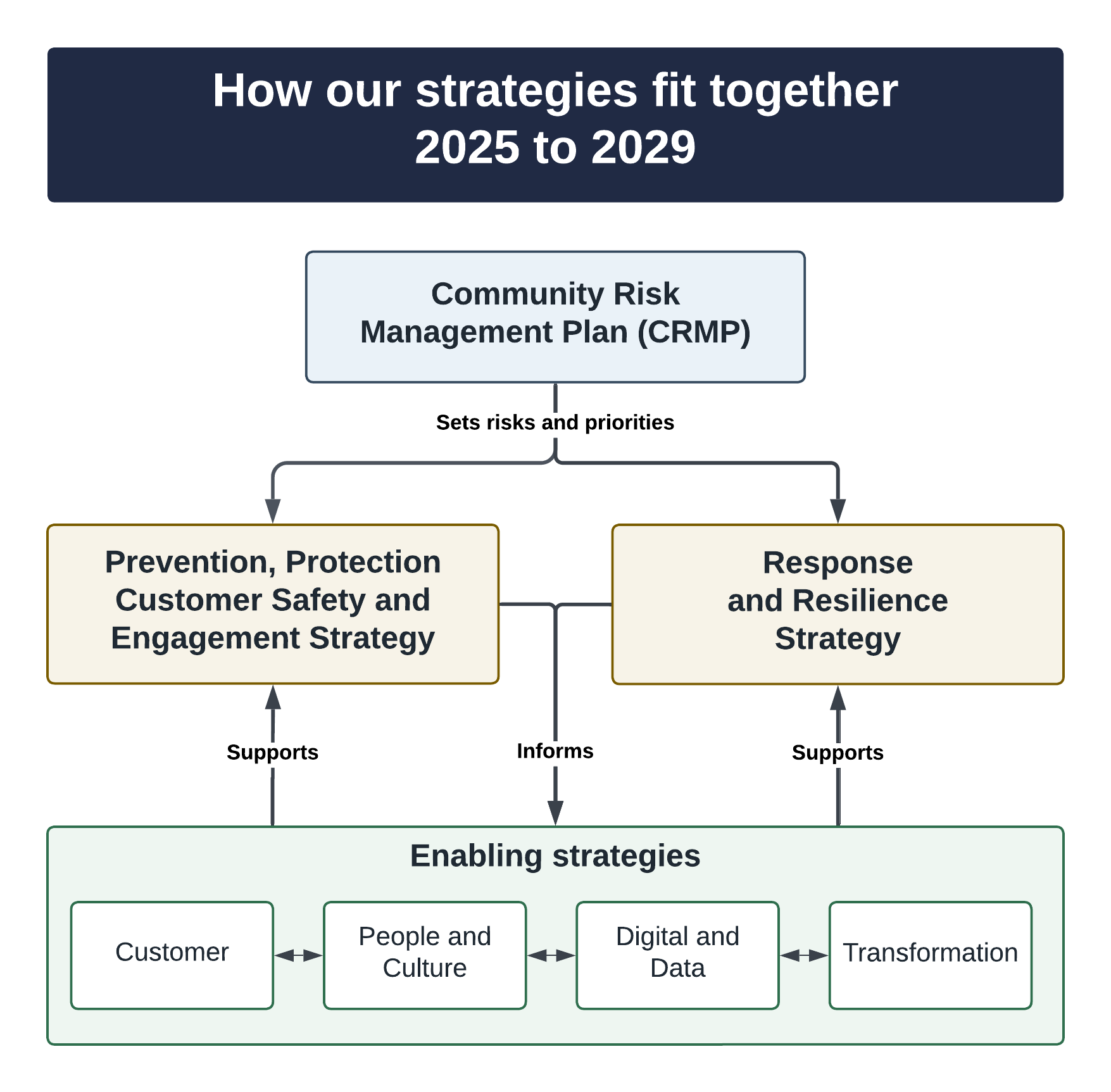
The Community Risk Management Plan sets risks and priorities for the service strategies. The service strategies inform the four enabling strategies, which support delivery of both service strategies. The enabling strategies are Customer, People and Culture, Digital, Data, Technology and AI, and Transformation.
There is no greater challenge and no greater honour than to spend your working life making a difference to the world.
People Maturity Levels benchmarked September 2024
Revised and enhanced July 2026 - incorporating CIPD and Deloitte 2026 strategic workforce research, HMICFRS 2025 inspection findings, the Employment Rights Act 2025, an independent global best-practice gap review, and a new benchmark review against the UK’s leading employer and culture frameworks (The Sunday Times Best Places to Work / WorkL, Great Place to Work UK, Top Employers Institute, Investors in People and the Lloyd’s of London Culture Strategy).
Setting out our Areas of Cultural Focus and our Leadership and Cultural Development Framework.
Introduction
Serving our people
We recognise that our people are Kent Fire and Rescue Service - 1,400 of us make up a service which serves 1.9 million people. It is essential that we support everyone to the best of our ability so that, together, we can serve and protect the communities of Kent and Medway. Whilst we work closely with local authorities, other blue light organisations, fire and rescue services nationally, and a wide range of external partners, none of this is possible without our people being able to give their best performance.
More detail: Serving our people
This People and Culture Enabling Strategy sets out our strategic ambition for people-related actions for the period 2025-2029. It builds on the principles agreed in our Community Risk Management Plan (CRMP) and on feedback gathered from colleagues across the Service, and brings together the work of our HR, Learning and Professional Development, and Health and Safety teams into a single, integrated strategy.
Our colleague surveys and continuous dialogue data consistently show that local line managers are trusted and respected. This Strategy is therefore focused on creating an environment where local managers are given the tools, data and support to make effective decisions for their team backed by a strong and responsive centre.
We want to create a real sense of belonging and an environment where all our colleagues can thrive and feel valued every day. We are all customers to each other. The journey starts with this strategy, but it is executed, and made real, by all our colleagues. It also incorporates our Areas of Cultural Focus, which have been developed in consultation with all colleagues and are set out in full in Section V, and our Leadership and Cultural Development Framework, set out in Section VI.
Community Risk Management Plan (CRMP)
Kent Fire and Rescue Service's vision is of a future where no-one is killed or seriously injured by a fire or other emergency. How we achieve that is set out in our Community Risk Management Plan (CRMP), produced in accordance with the requirements of the Fire and Rescue National Framework for England.
More detail: Community Risk Management Plan (CRMP)
The People and Culture Strategy is one of four enabling strategies (Customer, Digital and Data, Transformation). It underpins and supports our two service strategies - Protection and Prevention, Response and Resilience and ultimately our CRMP by ensuring KFRS has the right people, systems, skills, culture and capability to deliver against the risks identified in our Assessment of Risk. This is a four-year rolling strategy, reviewed annually alongside our revision of the CRMP.
Our ambition for our colleagues is built on five connected themes: performance, customer, inclusive culture, leadership and safety. Together they set out how we work, who we work for, and how we look after each other while we do it.
Performance
Striving for excellence in everything we do, taking an evidence-led approach to decision-making, and driving transformation and continuous improvement.
Customer
Putting our customers and the communities we serve at the centre of every decision, so our people's efforts translate into a genuinely better experience for them.
Inclusive Culture
Living our values and professional standards and building an environment colleagues are proud to be part of.
Leadership
Expecting every colleague to lead, whether as a manager or as a professional in their field, to own culture and support others.
Safety
Embedding a safety-first culture that protects the health, safety and psychological wellbeing of our colleagues and the communities we serve.
We will:
- Continue to improve our culture by holding all colleagues accountable for living our values, supported by clearly communicated professional standards.
- Continue to listen and act on feedback from colleagues, taking an evidence-led approach to identify where we need transformation and where a continuous improvement approach is right.
- Develop an Employer Value Proposition (this is the unique set of benefits, rewards, and cultural experiences an organisation offers to colleagues in exchange for their skills, time, and dedication) that recognises the needs of the communities we serve and attracts talent from across Kent and Medway, so that our workforce is representative of, and connected to, the people we serve.
- Become an employer of choice by attracting and developing the best talent for every role in the organisation.
- Provide leadership training for all colleagues and a programme for line managers in core people-management skills, to build understanding and confidence.
- Embed a safety-first culture that balances effectiveness, efficiency and safety in a high-risk operating environment, through continuous feedback and learning loops.
- Take a holistic view of health, safety and wellbeing, recognising the interdependence of mental and physical health and the impact of a psychologically safe working environment.
- Build a better understanding of our colleague's lifecycle through process mapping and data analysis, to improve workforce planning across recruitment, training, development, talent management and promotion.
- Embed inclusion learning organisation-wide and ensure equality impacts are always actively considered in governance and decision-making.
- Work with colleagues’ networks and representative bodies, and engage external partners, to design people-related services that are logical, user-friendly and accessible to all.
- Adopt a formal, evidence-based approach to strategic workforce planning aligned to CIPD's six-stage model (baseline, supply, demand, gap analysis, action planning, monitoring), so workforce plans are refreshed on a rolling basis rather than as a point-in-time exercise.
- Treat culture explicitly as organisational infrastructure rather than a 'soft' add-on, in line with Deloitte's 2026 finding that neglecting culture during periods of rapid change accumulates 'culture debt' which later slows transformation and erodes trust.
- Measure our culture against external, independently validated benchmarks rather than only against ourselves, so that "employer of choice" is an evidenced claim and not an aspiration.
- Make culture a named leadership accountability: every leader, will carry explicit, assessed objectives for the culture their team experiences, reported through a published Culture Dashboard (action L11 and Section VI).
- Invest in our leaders at all levels as the primary carriers of culture, recognising that for most colleagues the performance and approach of their immediate leader is the primary way they experience the organisation (action L12).
Our values and behaviours
Our Behaviour and Skills Framework provides a clear 'why' for what we do, not just a 'how'. It is the responsibility of every colleague to build these behaviours into daily work by living our values, recognising colleagues who role-model them, challenging behaviours that don't fit the culture we want, and championing the Service as a great place to work.
Our approach to culture and learning is underpinned by the principles of Black Box Thinking (Matthew Syed), which we continue to embed through repeated messaging, conferences and training materials:
- Understanding the logic of failure and supporting people to try new ideas without fear
- Confronting complexity
- Learning through small steps and giant leaps
- Moving beyond the blame game
- Creating a growth culture
Statutory requirements and national standards
Our people-related activity is underpinned by the following legislation and national standards:
Explore table: People and culture: statutory requirements and national standards
Area | Legislation / Standard | |
|---|---|---|
Recruitment and Promotion | Fire and Rescue Services Act 2004; Equality Act 2010; Fire and Rescue National Framework for England (2018) | |
Training and Development | Fire and Rescue Services (Emergencies) (England) Order 2007; NFCC Fire Standards; National Operational Guidance (NOG) | |
Management and Leadership | Human Rights Act 1998; Fire and Rescue National Framework for England (2018); NFCC Leadership Framework and Core Code of Ethics (adopted as the reference standard for Section VI) | |
Health, Safety and Wellbeing | Health and Safety at Work etc. Act 1974; Management of Health and Safety at Work Regulations 1999; Building Regulations Access to and use of buildings: Approved Document M, ISO 45003:2021 Psychological health and safety at work (adopted as a benchmark standard — see action W10) | |
Harassment and Third-Party Conduct | Worker Protection (Amendment of Equality Act 2010) Act 2023 - employers have a positive duty (from October 2024) to take reasonable steps to prevent sexual harassment of workers, including by third parties. | |
Employment Rights and Terms | Employment Rights Act 2025 (Royal Assent Dec 2025) - phased 2026-2027. Directly relevant duties include mandatory gender equality and menopause action plans; day-one paternity and other family leave rights; Statutory Sick Pay from day one; restrictions on 'fire and rehire' (from Jan 2027); extended employment tribunal time limits (3 to 6 months); guaranteed-hours and shift-notice rights for zero/low-hours and casual workers, relevant to On-Call contractual design. | |
Crosscutting | NFCC HR Analytics Maturity Model; NFCC EDI Maturity Model; HR data and analytics standards; Public Sector Equality Duty | |
Suicide prevention, intervention and postvention | BS 30480:2025 Suicide and the workplace - Intervention, prevention and support for people affected by suicide (BSI) — not statutory but adopted as the Service’s reference standard for suicide-specific policy, line manager practice, and postvention response (action W13). | |
Voluntary employer standards | These are not statutory but are adopted as external benchmarks: The Sunday Times Best Places to Work / WorkL engagement framework; Great Place to Work UK Trust Index; Top Employers Institute certification; Investors in People; Disability Confident; Armed Forces Covenant Employer Recognition Scheme; Kent and Medway Wellbeing Award. | |
Every activity set out in this Enabling Strategy is delivered in compliance with the Public Sector Equality Duty and, where appropriate, is supported by a thematic or standalone People Impact Assessment.
The Employment Rights Act 2025 changes the compliance landscape for this Strategy period more than any single piece of legislation since the Equality Act 2010. HR have completed a gap analysis against the Act's provisions during 2026, with the mandatory gender equality and menopause action plans and the enhanced sexual harassment duty treated as immediate priorities (see actions W9 and T6 below).
Strategic Context Check: What External Evidence Tells Us (2026 Update)
HMICFRS 2025 inspection: where we stand
In its Round 3 assessment published in August 2025, HMICFRS rated Kent Fire and Rescue Service 'outstanding' in three of eleven areas (protecting the public through fire regulation, understanding community risk, and future financial affordability), 'good' in five areas, including 'promoting the right values and culture', where inspectors described a positive working culture and 'adequate' in three areas. Inspectors also highlighted the need to increase On-Call fire engine availability during daytime hours, noting the Service had already begun taking steps to address this.
This confirms that our cultural foundations (Objective III) are sound and independently verified as good practice, but that On-Call workforce availability remains a live risk that this Strategy's workforce planning actions (Objective II) need to address explicitly and measurably, rather than as a general aspiration.
Employment Rights Act 2025
The Employment Rights Act 2025 received Royal Assent in December 2025 and is being implemented in phases through 2026 and 2027. For this strategy, the most significant provisions are the new mandatory duty to publish gender equality and menopause action plans, an enhanced duty to take all reasonable steps to prevent sexual harassment including by third parties, day-one family leave and Statutory Sick Pay rights, guaranteed-hours and shift-notice protections relevant to casual and On-Call-type working patterns, and restrictions on dismissal-and-re-engagement ('fire and rehire') from January 2027. These have been added to the statutory requirements table above and translated into actions W9 and T6.
CIPD: strategic workforce planning and the changing employment landscape
CIPD guidance recommends a six-stage strategic workforce planning cycle, establishing a baseline, assessing workforce supply, analysing workforce demand, conducting a gap analysis, agreeing actions and monitoring progress, run on a rolling three-to-five-year horizon rather than as a one-off exercise. CIPD's 2026 guidance for people professionals also stresses using the current wave of employment law reform as an opportunity to lead on future-ready, resilient workforce planning, rather than treating it purely as a compliance exercise.
Deloitte: human capital trends for 2026
Deloitte's 2026 Global Human Capital Trends report finds that organisations are under sustained strain from the pace of change: roughly a third of workers report experiencing fifteen or more major changes in the past year, yet only around a quarter of organisations manage change effectively. The report's central message is that culture should be treated as core infrastructure, organisations that neglect it while pursuing speed and AI adoption accumulate 'culture debt' that later slows transformation.
More detail: Deloitte: human capital trends for 2026
It also highlights the need for intentional, human-centred design of how people and AI-enabled tools work together, with clear governance, decision rights and psychological safety built in from the outset, rather than layering technology onto legacy processes.
For Kent Fire and Rescue Service, this reinforces two things already in this strategy; the emphasis on change-resilience workshops and the ambition to raise HR Analytics maturity from Level 1 and adds a note of caution: any move into AI-enabled HR or learning tools (see action T7, and the AI Ethics and Governance safeguards in action T8) should be led by clear human governance and by our existing culture-first principles, not by the technology itself.
Independent global best-practice gap review (July 2026)
Alongside the sources above, we have benchmarked this strategy against wider global research on workplace transformation, performance management and culture change (Gartner; Deloitte 2026; ISO 45003; Harvard Business School; McKinsey; HBR; CIPD 2026; EHRC). We found the strategic direction to be sound but identified five areas where stated intentions needed firmer, operational mechanisms rather than general aspiration. The table below summarises the findings; each is now built into the relevant Objective as a new or expanded action.
Explore table: People and culture: best-practice gaps and the actions addressing them
Area | Global evidence base | What was missing | Where it is now addressed |
|---|---|---|---|
AI governance & digital ethics | Gartner / Deloitte 2026: adopting AI-enabled analytics without ethics governance, role-impact mapping and psychological-safety guarantees creates workforce anxiety and stifles adoption. | Algorithmic bias audits (a systematic, independent evaluation of an automated decision-making system); a digital upskilling pathway for operational and Green Book colleagues; a data ethics policy governing health, attendance and performance data. | Action T8 (expands T7) |
Psychological safety & speaking up | ISO 45003 / Harvard Business School: psychological safety in high-risk sectors needs operationalised, safe and anonymous reporting, backed by protection against retaliation. | A recognised psychological-safety standard; an independent Freedom to Speak Up Guardian route; structured active bystander training. | Action W10 |
Outcome-based performance management | HBR / CIPD: legacy annual-conversation reinforces proximity bias; leading organisations use continuous, outcome-based feedback. | A 360-degree continuous feedback loop; clearly differentiated metrics for Green Book vs Grey Book roles. | Action T9 |
Inclusion infrastructure | Equality and Human Rights Commission / Diverse Executive Coaching: strategies often state intentions without mandatory adjustment budgets or standardised adjustment passports. | A centralised reasonable adjustments budget; a retrofitting timeline for existing stations alongside new-build inclusive design. | Action W11 (expands W2) |
Best-employer and culture-programme benchmarking (July 2026)
A further review benchmarked this strategy against the frameworks used to identify the UK's best employers. The purpose was not to chase awards, but to test the strategy against externally validated definitions of what a great place to work looks like from the colleague's side of the conversation.
More detail: Best-employer and culture-programme benchmarking (July 2026)
The Sunday Times Best Places to Work (conducted by WorkL). The UK's principal best-employer listing is decided entirely by an independent, all-employee survey, no self-nomination, no submission of a case by the employer, assessed across six drivers of engagement: reward and recognition, information sharing, empowerment, wellbeing, job satisfaction, and instilling pride.
It also produces a flight risk measure and an employee net promoter score and publishes separate lists for the best places to work for women, disabled employees, ethnic minority employees, LGBTQ+ employees, younger and older workers, and for wellbeing overall.
Relevance to KFRS: four of the six drivers (wellbeing, pride, empowerment, information sharing) are already strong themes in this strategy.
Two areas are less developed: reward and recognition, our second-lowest maturity area at Level 2; and systematic measurement of flight risk and colleague advocacy. We currently identify critical roles but need to do more to understand and plan for retention risks in those roles. The demographic sub-lists also align directly with the disproportionality work in action T6, challenging us to understand whether the experience of being led here is equally positive for everyone, not just positive on average.
Great Place to Work UK (Trust Index). The Trust Index model defines a great workplace as one where colleagues trust the people they work for, take pride in their work, and enjoy the people they work with, assessed across five dimensions: credibility, respect, fairness, pride and camaraderie. Three of these (credibility, respect, fairness) measure leadership behaviour directly. Critically, the model's "For All" principle holds that the experience must be consistent for every colleague regardless of who they are, what they do or where they work - a workplace is not great if it is only great for some.
Relevance to KFRS: "For All" is the single most useful idea in the best-employer literature for a fire and rescue service. We are an organisation of very different colleague populations, Wholetime, On-Call, Control, Protection, Prevention, Green Book internal services teams, working different hours, in different buildings, under different terms. A Service-wide average score can mask an On-Call population, a Control room, or a single team having a materially worse experience. All colleague-experience reporting under this strategy will therefore be disaggregated by colleague group, station/team and protected characteristic (action W12).
Lloyd's of London Culture Strategy. Following an independent investigation into behaviour in the Lloyd's market in 2019, Lloyd's built what has become the most transparent culture-change programme in the UK. Its features are directly transferable to a fire and rescue service, and several of them answer risks HMICFRS has identified across our own sector:
- Five published culture principles against which progress is reported: Leadership Focus, Behaviour, Speaking Up, Diversity and Inclusion, and Data Collection.
Relevance to KFRS: three elements are new to this strategy and are now added as actions. First, publishing our culture data rather than only reporting it internally to CMB (action L11). Second, an independent advice line and named guardian for concerns, which reinforces action W10. Third, external benchmarking, comparing our results against a wider comparator group, not just against our own previous year (action W12). We already have a Cultural Dashboard; what we do not yet have is the discipline of publishing it, benchmarking it externally, and holding named leaders to account against it.
Summary of what this benchmarking added
Explore table: People and culture: additions arising from external benchmarking
Area | Evidence base | What was missing | Where it is now addressed | |
|---|---|---|---|---|
Independent, benchmarked measurement of colleague experience | Sunday Times Best Places to Work / WorkL; Great Place to Work Trust Index; Lloyd's external benchmarking against sector | We have used external organisations to measure culture and will continue to balance that with our culture measurement We need a flight-risk or advocacy measure; no disaggregation guarantee ("For All") | Action W12 | |
Reward, recognition and Employer Value Proposition | Work 'reward and recognition' driver; Top Employers Institute; KFRS maturity level 2 for colleague recognition | EVP referenced as an aspiration; no structured recognition framework, Limited Total Reward statement | Actions T11 and T12 | |
Named leadership accountability for culture, publicly reported | Lloyd's five culture principles (esp. Leadership Focus); GPTW credibility/respect/fairness dimensions | The named lead for Culture is the CEO, but we all collectively own the creation of an inclusive culture We are now introducing culture objectives in leader dialogue | Action L11 and Section VI | |
Development of first-line leaders as culture carriers | GPTW: the majority of trust variance sits with the immediate manager; HMICFRS findings on inconsistent local practice | Leadership offering strong at development-centre level, thinner for Watch/Team Managers at the point of promotion | Action L12 | |
BS 30480:2025 — Suicide and the Workplace. July 2026
BSI published the UK’s first British Standard specifically addressing suicide in the workplace in November 2025. It sets out a three-pillar model; Awareness (tackling stigma, understanding risk factors, recognising warning signs), Intervention (asking directly, individual safety plans, managing confidentiality) and Support after a suicide/postvention (compassionate response, safe communication, return to work) and recommends organisations name a senior leader accountable for suicide prevention, equip line managers and HR with a practical toolkit, and self-evaluate periodically against the standard.
Fire and rescue are a recognised higher-risk occupational group for suicide, given cumulative trauma exposure, shift and rest disruption, and stigma around disclosure linked to fitness-for-duty concerns. This strategy already carries relevant elements, PTSI work (W6), psychological safety (W10), a single postvention bullet, but treats none of them as a named, owned, BS 30480-aligned programme. Action W13 closes this gap.
Where We Are Starting From: People Maturity Levels
The table below sets out our People Maturity Levels, benchmarked in September 2024, and our aspiration for the end of this Strategy period. Full detail is provided at Appendix 1.
Figure 1: People Maturity Levels — starting position vs. end-of-Strategy aspiration, by area
Explore table: People maturity levels: baseline, 2024 re-evaluation and end-of-strategy aspirations
Maturity area | Starting position | 2024 re-evaluation and refocus | Aspiration: end of Strategy period | |
|---|---|---|---|---|
Recruitment (levels 1-4) | 3 | 3 (2 original score) | 4 | |
Leadership development (levels 1-4) | 3 | 3 (2- original score) | 4 | |
Learning organisation (levels 1-4) | 2 (moving towards 3) | 3 (moving towards 4) (2 original score) | 3 (4) | |
Blended learning (levels 1-5) | 1 | 3 (2 original score) (moving towards 4) | 3 | |
Performance management (levels 1-4) | 2 (consolidating into 3) | 2 (consolidating into 3) | 4 | |
Colleague recognition (levels 1-4) | 2 | 2 (moving towards 3) | 4 | |
Succession Management and High Potential Strategy (levels 1-4) | 2 (moving towards 3) | 2 (moving towards 3) | 4 | |
Equality, Diversity and Inclusion (levels 1-4) | 2 (moving into 3) | 2 (moving into 3, some 4) | 4 | |
Wellbeing (levels 1-4) | 3/4 (close to 4) | 3/4 (close to 4) | 4 | |
HR Analytics (levels 1-4) | 1 | 1 moving to a 2/3 | 3 (4) | |
HR Analytics remains the lowest-maturity area on this table (Level 1, unchanged since the 2024 re-evaluation) and, per the Strategic Context Check above. It is treated as a standalone priority risk in Section IV and given dedicated actions (T7 and T8).
Note added July 2026 — the second priority on this table. After HR Analytics, colleague recognition is the weakest area (Level 2, aspiration Level 4) and it is also one of the six drivers that determines performance in the UK's leading best-employer listing. Recognition is the cheapest and fastest moving of all the engagement drivers, and the one most within the gift of local leaders. It is given a dedicated action for the first time in this revision (T12). Performance management (Level 2, aspiration Level 4) is addressed by T9, and leadership development (Level 3, aspiration Level 4) by L11, L12 and Section VI.
People Enabling Strategy (2025-2029)
This strategy is structured into six integrated objectives, each with its own key actions and measures of success, plus three further sections:
- Colleague Wellbeing and Inclusive Culture
- People Systems and Talent Management
- Professional Standards, Learning and Assurance
- Priority Gaps and Risk Register for 2026-2029
- Areas of Cultural Focus
- Leadership and Cultural Development Framework
I. Colleague Wellbeing and Inclusive Culture
I.1 YOU Matter - our approach to wellbeing
Our wellbeing pillars are:
- Mental wellbeing: promoting resilience, stress management, and psychological health.
- Physical wellbeing: encouraging healthy habits, nutrition, and fitness.
- Financial wellbeing: supporting financial stability through resources and education.
- Social wellbeing: building meaningful connections and a sense of belonging.
- Helping colleagues manage change positively.
Objective: To create a psychologically safe, inclusive, and high-performing culture supported by a comprehensive, proactive, and preventative wellbeing programme.
I.2 Key Actions
Explore table: Colleague wellbeing and inclusive culture: key actions
Ref | Action description | Aligned / related actions | |
|---|---|---|---|
W1 | Embed a Proactive, Preventative Wellbeing Programme: Implement a four-pillar wellbeing strategy (Mental, Physical, Financial, Social (MPFS)) with a focus on prevention. This includes proactive resilience training, annual conferences, Physical Training Instructors (PTIs) on station, research into ageing/contaminants, and mental health first aid/suicide prevention training, aligned to BS 30480:2025 (see action W13 for the full suicide prevention framework). A focus on change resilience workshops |
| |
W2 | Prioritise Attendance and Effective Case Management: Implement a productive wellbeing and management programme focused on reducing short-term absence and better managing long-term absence. Develop and implement enhanced rehabilitation offerings to facilitate quicker, safe returns to duty. Formalise support for colleagues with complex needs (e.g. neurodiversity, disability, caring responsibilities) via a 'Workforce Needs' approach and dedicated systems (e.g. Neurodiversity/Disability Passports, reasonable adjustment tracking). |
| |
W3 | Embed a Psychologically Safe and Restorative Culture: Promote the right values and culture using the Cultural Dashboard and the revised Behaviours Framework. Continue to implement a Restorative Healing Practice for the early and constructive resolution of behavioural and cultural misalignments, focusing on awareness and resolution over punishment where appropriate. |
| |
W4 | Develop and Support Leaders in Inclusive People Management: Review and refresh the leadership offering to support culture, ethics, and behaviours, extending its reach to all colleagues for informal learning. |
| |
W5 | Establish an Addiction/Mental Health Recovery-Friendly Workplace (RFW): Implement a comprehensive RFW strategy with senior buy-in, ensuring supportive policies, access to specialist recovery coaching, and manager training. |
| |
W6 | PTSI - prevention of long-term PTSI and trauma strategies for supporting people. Implement a trauma-informed approach to wellbeing to prevent re-traumatisation of colleagues and customers. |
| |
W7 | Physical Fitness Programme: Implement a new Physical Fitness Policy and Procedures giving clear direction to check and improve operational colleagues' fitness. |
| |
W8 | Operational Welfare and Wellbeing: food, noise, contaminants, showering, and rest after breathing apparatus wear. |
| |
W9 | Comply Early with Statutory Gender Equality, Menopause and Anti-Harassment Duties: Publish the Employment Rights Act 2025's mandatory gender equality and menopause action plans ahead of their statutory deadline and refresh sexual harassment risk assessments and reporting routes to meet the enhanced duty to prevent harassment by third parties (contractors, members of the public, partner agencies). Use this as an opportunity, not just a compliance exercise: link the menopause action plan to the existing 'Supporting women's needs during menopause, maternity and monthly cycle' work under Early Intervention, and link the harassment duty to the Restorative Healing Practice and Behaviours Framework (W3). |
| |
W10 | Adopt a Modern Psychological Safety Standard and Independent Speaking-Up Route: Benchmark our approach to psychological health and safety against ISO 45003, the international standard for psychological health and safety at work, going beyond general aspiration to a measured standard. Establish an independent Freedom to Speak Up Guardian (FTSUG) route, separate from the local chain of command, for colleagues to raise systemic concerns, and introduce structured Active Bystander Training so peers are equipped to interrupt problematic behaviour — bullying, harassment, discrimination — in the moment, not only after the fact. Following the Lloyd's market model, back the Guardian route with a 24/7 independent advice line, promoted so visibly that no colleague can say they did not know where to go, and run a periodic #SpeakUp campaign with clear, plain-English guidance on what happens after a concern is raised. |
| |
W11 | Establish Centralised Inclusion Infrastructure: Create a centrally managed Reasonable Adjustments process through the ER team fund so that team managers are supported when approving adjustments identified through the Neurodiversity/Disability Passport (W2). Commit to a rolling retrofit programme for existing fire stations — alongside the inclusive design already planned for new builds such as Ashford — covering all-gender facilities and sensory/neurodivergent-friendly adjustments. |
| |
W12 | Measure Our Culture through cultural mapping for every team in the service and Workforce Behaviour surveys twice during this Strategy period and adopt the resulting drivers as a standing part of our reporting: reward and recognition, information sharing, empowerment, wellbeing, job satisfaction and pride (WorkL), alongside credibility, respect, fairness, pride and camaraderie (Trust Index). Introduce flight risk and colleague net promoter score as new retention indicators we do not currently hold. Apply the Great Place to Work "For All" principle to every colleague-experience report: results disaggregated by colleague group (Wholetime, On-Call, Control, Protection, Prevention, Green Book), by station/team, and by protected characteristic, so that a good average can never hide a poor local experience. |
| |
Explore table: Colleague wellbeing and inclusive culture: key actions continued
Ref | Action description | Aligned / related actions |
|---|---|---|
W13 | Adopt BS 30480:2025 as the Service's Suicide Prevention Framework: a senior leader accountable for suicide prevention (paired with, or held by, the culture owner in L11) and have a published strategy, actions and reporting line. Conduct a suicide-specific risk assessment recognising factors known to affect emergency-service colleagues — cumulative trauma and PTSI exposure (W6), shift and rest disruption, isolation in On-Call and rural postings, and reluctance to disclose distress for fear of fitness-for-duty consequences. Build a line manager and HR toolkit covering recognising warning signs, holding a direct and sensitive conversation, developing individual safety plans, and managing confidentiality — distinct from, and more specific than, general mental health first aid (W1). Introduce private, non-judgemental check-ins for colleagues identified as at risk, run separately from attendance or performance management, with clearly signposted internal and NHS crisis pathways. Expand the existing postvention protocol into a full Crisis Response Team model: immediate response and family liaison, safe and sensitive internal/external communication (including media handling and safe-messaging guidance to avoid contagion risk), considered approaches to memorialisation, and a structured return-to-work pathway following a death by suicide or a suicide attempt. Set clear boundaries in policy for where the Service's role ends and NHS crisis or statutory safeguarding responsibility begins. Quality-assure any external suicide-prevention training provider against BS 30480's commissioning guidance before engagement. Self-evaluate annually against BS 30480 and report progress through the Culture Dashboard (L11). |
|
I.3 Why these matter
Actions W10 and W11 respond directly to the independent global best-practice review: psychological safety and inclusion policies only change behaviour when they are backed by a recognised standard, an independent route to raise concerns, and funding that does not depend on local budget decisions.
More detail: I.3 Why these matter
Action W12 responds to the best-employer benchmarking. Every organisation believes its culture is better than its colleagues experience it to be; the only reliable corrective is an independent survey, externally benchmarked, and broken down far enough to see the parts of the Service having the worst experience. HMICFRS rated our culture 'good' in 2025 — W12 is how we find out, ourselves and continuously, whether that is true for a Control operator on nights and an On-Call firefighter at a rural station as much as it is true on average.
Action W13 responds to BS 30480:2025. Fire and rescue colleagues face recognised occupational risk factors for suicide, cumulative trauma exposure, disrupted shift patterns, and fear that disclosing distress could affect fitness-for-duty status. General wellbeing provision is necessary but not sufficient: BS 30480 is clear that organisations need a named owner, a specific line-manager skillset, individual safety planning, and a tested postvention response, not just good intentions distributed across other programmes.
I.4 Key links to organisational goals
- Reduce absenteeism
- Improve return to work after surgery/illness
- Reduce stigma of mental health and ensure focus on mental health
- Ensure people are aware of support during a mental health crisis
- Improve long-term fitness
- Create psychological safety in meetings, debriefs, feedback and team dynamics
- Improve resilience and ownership of physical and mental health
- Continue to pursue Black Box Thinking principles of high accountability and a no-blame culture
- Meet the new statutory duty to prevent sexual harassment, including by third parties, and publish gender equality and menopause action plans (Employment Rights Act 2025).
- Benchmark psychological safety against ISO 45003 and provide an independent speaking-up route (action W10).
- Benchmark colleague engagement and wellbeing externally and report it 'For All' — by colleague group, location and protected characteristic (action W12).
- Adopt BS 30480:2025 as the Service’s suicide prevention framework, with a named lead, manager toolkit and tested postvention response (action W13).
I.5 Our three levels of wellbeing
Prevention, early intervention and post-intervention
In this strategy period we will test each of the following actions, and whether cohesively they support effective wellbeing, prevention of PTSI, and suicide prevention.
I.6 Prevention
Stopping strain before it builds
Policy, flexibility and pay
- Life/work balance - flexibility, agility and leave policies (see also action T10 on flexible working for operational/shift roles)
- Hybrid working guidance
- Remote working hub for managers and colleagues
- Enhanced rest breaks for internal services colleagues
Physical health and fitness
- Physical activities, yoga, functional fitness, breathwork, walk and run clubs
- PTIs on station; completion of the ParQ+ questionnaire at fitness testing
- Start-of-shift physical warm-up/body activation
- Nutrition guidance for operational roles during incidents
- Sleep hygiene awareness campaigns, diet, nutrition, smoking cessation
- Raising awareness of prostate/bladder cancer (UCLan project)
- Research into ageing factors (hearing loss, hormone changes, MSK injuries, cardiovascular events)
- Monitoring the drug and alcohol testing programme
- Routine medicals every three years, with review of sleep hygiene monitoring
Mental health and psychological support
- MBSR (Mindfulness-Based Stress Reduction) strategies for resilience, stress, anxiety and chronic pain
- Provision of a duty Wellbeing Support Officer, 24/7
- Wellbeing Forum involving Champions and mental health support
- Tools to help identify stress, low mood and anxiety before 'cups overflow'
- Workplace and individual stress risk assessment
- Mental health awareness training for all operational colleagues, including Control
- Resilience training and workshops
- Annual resilience and wellbeing conference
- Training on intersectionality and comorbidity of mental health and other factors
- Regular messaging reinforcing 'it's ok to not be OK'
Culture, equity and safety
- Statutory sexual-harassment risk assessment refresh (including third-party conduct) and publication of the mandatory menopause and gender equality action plans
- Active Bystander Training rolled out as standard (action W10)
- Independent 24/7 speaking-up advice line promoted on every station and in every team (action W10)
- Focus on neurodiversity and disability to ensure fair access to work and development
- Working with partner networks to identify increased risks (e.g. armed forces network)
- Extending wellbeing support to families
- Externally benchmarked engagement and wellbeing measurement, disaggregated by colleague group (action W12)
- Suicide-specific risk assessment recognising cumulative trauma, shift disruption and fitness-for-duty disclosure stigma as risk factors, aligned to BS 30480:2025 (action W13)
- Line manager and HR toolkit for recognising warning signs and holding a direct, sensitive conversation, distinct from general mental health first aid (action W13)
Environment, incidents and workplace design
- DSE equipment - home and office guidance and checks
- Designing wellbeing (noise, light, temperature) into future buildings; creating wellbeing spaces
- Improved guidance on operational/incident welfare arrangements
- Linking contaminants work with wellbeing during and after incidents
- Best-practice guidance where traumatic exposure is a necessary part of training
Financial, medical and organisational
- Financial and legal advice via EAP
- Participation in the Medical Advisory Group
- Wellbeing impact assessment for change
- Learning from other fire services and comparable organisations
- One-page 'What Good Looks Like' guides
I.7 Early intervention
Catching strain as it emerges
Financial and career support
- Financial wellbeing programme
- Retirement programme with emphasis on financial and other planning
Physical wellbeing and fitness
- Roll-out of new gym equipment and approach to fitness
- Roll-out of Strength and Conditioning to stations
Mental health, decompression and referral
- Procurement of new psychological support services
- Development of informal and formal decompression/defusing mechanisms
- Review and development of the defusing process
- Growing reflective practice across more teams
- Making it easier for managers and peers to refer colleagues for mental health support
- Mental health first aid training for managers and team members
- Suicide first aid training
- Demobilising and defusing training - recruiting more trainers
- Exploring the space between sick leave, modified duties and taking a break before burnout
- Private, non-judgemental check-ins for colleagues identified as at risk, run separately from attendance or performance management, with signposted internal and NHS crisis pathways (action W13)
Inclusion, recruitment and culture
- You Matter wellbeing awareness campaigns to reduce stigma
- Kent and Medway Wellbeing Award renewal
- Ongoing review of learning materials to ensure they are customer-focused
- Review of grey book recruitment processes for Wholetime and On-Call to maintain resource levels
- Review of recruitment communications for customer-friendliness
- Quarterly reporting of recruitment positive action campaigning to CMB
- Supporting women's needs during menopause, maternity and monthly cycle
- Female firefighter research collaboration
- Men's mental health focus
Data and early warning
- Use of flight-risk and engagement-driver data to identify teams under strain before it shows in sickness or turnover figures (action W12)
I.8 Post-intervention
Supporting recovery, loss and exit
Rehabilitation and return to work
- Occupational Health assessment
- Return-to-work action plans after long-term sickness
- Rehabilitation focus for operational colleagues
- Centre of excellence for rehabilitation and trained instructors
- Assistive technology implementation
- Workplace adjustments implementation and impact measurement
Bereavement, terminal illness and death in service
- Full support for terminally ill colleagues, including full pay maintained
- Family Support Officer provision in the event of an unplanned death in service
- Crisis Response Team model for immediate response following a death by suicide or suicide attempt, including family liaison (action W13)
- Safe, sensitive internal and external communication protocols, including media-handling and safe-messaging guidance to reduce contagion risk (action W13)
- Considered, contagion-aware approach to memorialisation (action W13)
- Structured return-to-work pathway distinct from general bereavement support, for colleagues returning after a death by suicide or a personal crisis (action W13)
- Development of a suicide postvention protocol
- Suicide bereavement support training for FSOs and WSOs
- Align bereavement-related leave and support with the Employment Rights Act 2025's extension of bereavement leave to cover pregnancy loss
- Exploring access to Family and Relationship Support Services
Retirement, offboarding and exit insight
- Pre/post-retirement wellbeing support and signposting
- Offboarding support for leavers, including EAP for 90 days after leaving
- Structured exit and 'stay' interviews, thematically analysed and reported alongside engagement data, so we learn as much from why people stay as from why they leave (links to T11)
Long-term health review
- Forensic study of ill-health retirement cases relating to PTSI, hearing loss and other long-term conditions
I.9 Addiction: building a Recovery-Friendly Workplace
Colleagues may be affected by a wide range of addictive behaviours - including alcohol, drugs, gambling, opioids, eating, shopping, excessive media use and work itself. The workplace is often the front line for recognising and supporting people struggling with addiction.
More detail: I.9 Addiction: building a Recovery-Friendly Workplace
A Recovery-Friendly Workplace (RFW) does not just reduce risk; it actively supports colleagues on their recovery journey, improves organisational culture, and enhances performance. Addiction is often misunderstood as a personal failing rather than a health condition - it is a complex hijacking of the brain, not a choice, and does not discriminate by role or seniority.
Stress and poor mental health are major drivers of addiction, and workplace culture plays a significant role. Breaking down stigma is the first step to creating a Recovery-Friendly Workplace: colleagues must feel safe to seek support without fear of punishment, job loss, or exclusion from career opportunities.
I.10 Four key elements of a Recovery-Friendly Workplace
Explore table: The four elements of a Recovery-Friendly Workplace
# | Element | What this includes |
|---|---|---|
1 | Senior and all-leadership buy-in and sponsorship | Leaders must actively promote recovery-friendly policies and practices, and be aware of their own risks, such as high job demands and pressure to socialise. Leaders should model openness by discussing mental health and addiction without stigma. |
2 | Treatment and recovery support | Access to professional recovery coaching, offering accountability, goal-setting and real-world strategies alongside lived experience; flexible policies for those in treatment and recovery; peer support networks for colleagues in recovery. |
3 | Policies and procedures that promote recovery | Confidential, supportive drug and alcohol policies that treat addiction as a health issue, not a disciplinary one; clear, non-stigmatising language; inclusive policies covering behavioural addictions such as gambling. |
4 | Preventing work-related stress | Embedding HSE Management Standards and Stress Risk Assessments; training managers to spot early signs of stress to prevent burnout; manager training and capability building on addiction and confidentiality. |
Colleague awareness and access to support
- Where to get help at work and via external specialist recovery support
- The impact of being an 'impacted other'
Note added July 2026: the Lloyd's culture survey found that around a quarter of respondents had observed excessive alcohol consumption connected to work in a 12-month period and treated the social norms around drinking as a leadership issue rather than an individual one. Our RFW work will similarly consider the culture around social and post-incident drinking, including making sure that station social life, celebrations and team building are genuinely enjoyable for colleagues who do not drink.
I.11 Healthy and safe: our health and safety framework
We are focused on creating a workplace that prevents accidents, injury and psychological harm; this is a shared responsibility across the organisation. Appendix 1 has actions for every level of the organisation.
I.12 Measures of success - Objective I
Explore table: Colleague wellbeing and inclusive culture: measures of success
Metric | Target | Reporting frequency |
|---|---|---|
Sickness Absence Rate | Reduce percentage of shifts lost to sickness by (short-term) and (long-term) from baseline | Quarterly |
Cultural Health | 20% increase in colleague satisfaction scores related to culture and managerial support | Biannually |
Early Resolution Rate | 70% of suitable colleague relations cases resolved via Restorative Healing/Early Resolution practice within 30 days | Quarterly |
Attendance Case Speed | 95% of ER process SLAs (performance management/disciplinary/sickness) met | Quarterly |
Wellbeing Participation | 60% increase in proactive wellbeing support service uptake | Annually |
Statutory Compliance | Gender equality and menopause action plans published on or ahead of the statutory deadline; sexual harassment risk assessment (including third-party) refreshed and signed off by CMB | Annually |
Psychological Safety | Achieve a defined baseline and year-on-year improvement against ISO 45003 self-assessment; Freedom to Speak Up Guardian route live and promoted Service-wide | Annually |
External Engagement Benchmark | Independent all-colleague engagement survey completed at least twice in the Strategy period; overall engagement score at or above the public-sector/blue-light comparator benchmark, improving year on year | Biennially |
'For All' Consistency | No colleague group, station or protected-characteristic group scoring more than 10 percentage points below the Service-wide engagement average without a named improvement plan | Annually |
Flight Risk | Establish a baseline flight-risk and colleague net promoter score, and reduce flight risk year on year | Biennially |
Speaking Up Awareness | 90% of colleagues able to identify at least one route to raise a concern outside their line manager | Annually |
Suicide Prevention Lead | Named senior lead in post with published strategy and reporting line | Annually |
Manager Toolkit Reach | 90% of line managers completed BS 30480-aligned warning-signs and safety-plan training | Annually |
Postvention Readiness | Crisis Response Team model tested/rehearsed at least once per Strategy period | Biennially |
BS 30480 Self-Evaluation | Annual self-evaluation completed and reported through the Culture Dashboard | Annually |
II. People Systems and Talent Management
Objective: To leverage HR systems and data analytics to streamline processes, attract diverse talent, and systematically develop a sustainable, high-potential workforce aligned with CRMP needs.
II.1 Key Actions
Explore table: People systems and talent management: key actions
Ref | Action description | Aligned / related actions | |
|---|---|---|---|
T1 | Modernise HR Systems and Data Analytics: Implement HR systems and data improvements using Lean methodologies to streamline processes and create a data-driven approach. Develop dashboards or an accessible data portal for managers. |
| |
T2 | Workforce and Talent Planning: Maintain and annually refresh live Workforce Plans aligned with CRMP needs, clearly defining required skills, knowledge and behaviours. Systematically develop and embed the employer brand and Employer Value Proposition ('Employer of Choice'), with a focus on the On-Call workforce. |
| |
T3 | Implement Diverse and Efficient Recruitment: Implement a comprehensive recruitment approach focused on attracting diverse talent pools, supported by mandatory 'Licence to Recruit' training. Develop an improved onboarding/induction programme and new probation guidance. |
| |
T4 | Enhance Career and Succession Management: Further develop Career Review Conversations (CRC) and formal succession planning for all colleague groups. Create career pathways and stage gateways, including migration from On-Call to Wholetime. |
| |
T5 | Improve Manager Capability and Policy Access: Simplify and consolidate people policies and processes using neurodivergent-friendly language. Develop manager toolkits and self-help guides. |
| |
T6 | Close the Progression and Pay-Gap Pipeline: In direct response to HMICFRS and EHRC national findings on promotion/progression fairness, and to Kent Fire and Rescue Service's own gender pay gap data showing women concentrated in lower salary quartiles, introduce structured monitoring of recruitment, promotion, and disciplinary outcomes by protected characteristic, with disproportionality flagged to CMB and remedial action tracked to completion. (Extended July 2026) Publish pay gap reporting for Disability and Race. |
| |
T7 | Raise HR Analytics Maturity from Level 1: Adopt CIPD's six-stage strategic workforce planning methodology (baseline, supply, demand, gap analysis, action, monitoring) as the operating model for T2 and evaluate AI-enabled people-analytics tools to support it — with human governance, decision rights and data-quality safeguards designed in from the start, consistent with Deloitte's 2026 guidance on human-AI orchestration. |
| |
T8 | Implement an AI Ethics and Governance Framework: Before any AI-enabled analytics tool piloted under T7 goes live, put in place: an algorithmic bias audit protocol to ensure predictive tools do not introduce structural bias into recruitment or performance management; a digital upskilling pathway so operational and Green Book colleagues can confidently adopt new AI-driven operational and back-office tools; and a data ethics policy setting out plainly how colleague health, attendance and performance data is safeguarded, so tracking is never experienced as surveillance. |
| |
T9 | Move to Continuous, Outcome-Based Performance Management: Build a structured 360-degree continuous feedback loop, peer-to-peer as well as manager-to-colleague, to sit alongside Career Review Conversations (T4) and reduce reliance on a single annual line-manager view, which research shows reinforces proximity bias. Establish clearly differentiated, objective performance metrics for Green Book (support) roles and Grey Book/operational roles, aligned to CRMP targets. |
| |
T10 | Continue to balance family friendly, flexible working wherever possible in balance with service needs |
| |
T11 | Define and Publish a Full Employer Value Proposition and Total Reward Offer: Turn 'employer of choice' from an ambition into a written, published proposition. Articulate, in colleagues' own language, what Kent Fire and Rescue Service offers and expects in return, purpose and public service, job security, pension, learning and progression, wellbeing support, flexibility, inclusion, and the experience of being part of a watch or team. Produce an annual Total Reward Statement for colleague groups, setting out the full monetary value of pay, pension employer contribution, leave, training investment and benefits, because best-employer research consistently shows that colleagues significantly under-estimate the value of what they already receive. Differentiate the proposition for each colleague group — the On-Call proposition is not the Wholetime proposition, and the Green Book proposition is different again — and use structured 'stay' interviews alongside exit interviews to test whether the proposition described is the proposition experienced. |
| |
T12 | Build a Structured Colleague Recognition Framework: Address the Service's lowest-scoring people-practice area after HR Analytics (colleague recognition, Level 2 against a Level 4 aspiration) and the driver most consistently associated with high-performing employers. Build a recognition framework with three tiers: everyday peer recognition (a simple, visible, low-friction way for any colleague to thank any other colleague, including colleagues in other teams); local leader recognition (a clear expectation that recognition is a routine part of leading a watch or team, not an annual event); and formal Service recognition (long service, awards, commendations, and nomination for national and sector recognition). Recognition must explicitly reward the behaviours in our Behaviours Framework and the Areas of Cultural Focus — including the colleague who spoke up, the team that reported a near miss, and the manager who supported someone through a difficult period, not only operational great practice. |
| |
II.2 Why these matter
Actions T8, T9 and T10 turn three general aspirations already in this Strategy, responsible AI adoption, fair performance management, and flexibility, into specific, measurable mechanisms, closing gaps identified through the independent global best-practice review.
Actions T11 and T12 close the gaps identified by benchmarking. The Strategy already committed to an Employer Value Proposition; T11 specifies what it must contain and requires it to be published and evidenced. Recognition, meanwhile, has been a stated maturity ambition since 2024 without a dedicated action behind it, despite being the fastest, cheapest and most locally controllable lever available to any leader in the Service. T12 gives it one.
II.3 Measures of success - Objective II
Explore table: People systems and talent management: measures of success
Metric | Target | Reporting frequency | |
|---|---|---|---|
Diversity Attraction | Increase in applications from diverse talent pools (by protected characteristic) | Quarterly | |
Recruitment Equity | Reduce differential experiences of recruitment and succession (by protected characteristic) | Annually | |
Data Disclosure | 95% disclosure rate of EDI characteristics by colleague group | Annually | |
Process Efficiency | 20% productivity efficiency gains with new systems/processes | Annually | |
Policy Understanding | 85% manager satisfaction/confidence score with access to, and understanding of, people policies/data | Biannually | |
Talent Retention | 80% retention rate of talent identified through succession planning | Annually | |
On-Call Availability | Measurable increase in daytime On-Call fire engine availability, tracked against the HMICFRS 2025 recommendation | Quarterly | |
HR Analytics Maturity | Progress from Level 1 to Level 3 against the HR Analytics Maturity Model | Annually | |
Progression Disproportionality | No unexplained disproportionality by protected characteristic in promotion or disciplinary outcomes, reported to CMB | Quarterly | |
AI Governance Assurance | 100% of AI-enabled HR tools passing a bias audit and data-ethics review before go-live | Per pilot / Annually | |
Continuous Feedback Reach | 50% of colleagues participating in the 360-degree feedback cycle alongside their CRC | Annually | |
EVP and Total Reward | EVP published; 100% of colleagues issued an annual personal Total Reward Statement; measurable improvement in the 'reward' engagement driver (W12) | Annually | |
Recognition Reach | 70% of colleagues report having been meaningfully recognised for their work in the past 12 months; recognition distribution shows no material disproportionality by colleague group or protected characteristic | Annually | |
Leadership Representation | Published leadership-representation ambitions on track, with annual public progress reporting | Annually | |
III. Professional Standards, Learning and Assurance
Objective: To achieve the highest maturity level as a Learning Organisation, ensuring the consistent application of sector-best standards (Fire Standards, NOG), and using a rigorous, data-driven approach to learning, assurance and competence.
III.1 Key Actions
Explore table: Professional standards, learning and assurance: key actions
Ref | Action description | Aligned / related actions | |
|---|---|---|---|
L1 | Embed and Assure Fire Standards Compliance: Continue to embed, peer-review, and ensure ongoing compliance with all published Fire Standards. |
| |
L2 | Centralise and Assure Operational Competence: Establish clear standards ('what good looks like') and create career pathways (pathway to mastery) with stage gateways, including On-Call to Wholetime migration. This is our Integrated Learning and Assurance model, and we need to keep developing and embedding its approach. |
| |
L3 | Modernise Learning Delivery and Technology: Review and enhance blended learning approaches, making full use of digital solutions. |
| |
L4 | Implement a Data-Driven Evaluation Framework (Kirkpatrick Model): Adopt and fully embed Kirkpatrick's Four-Level Training Evaluation Model. |
| |
L5 | Evolve and Formalise the Assurance and Learning Process: Evolve the Integrated Learning and Assurance Policy (ILAM). Achieve Learning Organisation Maturity Level 4. |
| |
L6 | Review and refresh the Leadership offering to support culture, ethics and behaviours, and ensure alignment with Career Review Conversations and Career support Map. |
| |
L7 | Integrate Operational/Customer Learning: Continue to draw customer insight, EDI, and access-to-services issues from debriefs/investigations. |
| |
L8 | Improve Incident Data Quality and Analytics: Oversee the implementation and integration of the new Home Office IRS system. |
| |
L9 | Enhance Collaborative Learning: Formalise collaboration with Kent Police and scrutinise learning from significant incidents and inquiry reports. |
| |
L10 | Build Formal Change Management Capability: Build a formal change-management capability beyond the existing change-curve comms and resilience workshops to support colleagues through any future restructuring, treating culture explicitly as infrastructure that must be protected, not a by-product of transformation. |
| |
L11 | Make Culture a Named, Published Leadership Accountability: Adopt the discipline that has made the most credible UK culture programmes work, measure it, name an owner, publish the result. Specifically: (a) adopt five KFRS Culture Principles — Leadership Focus, Behaviour, Speaking Up, Inclusion, and Data (adapted from the Lloyd's market model and mapped to our Areas of Cultural Focus); (b) appoint a named senior owner for culture at Service Leadership Team level, supported by an independent Culture Advisory Panel including colleague network representatives, representative bodies and at least one external member to provide genuine challenge; (c) publish the Cultural Dashboard annually, externally as well as internally, including the results we would rather not publish; and (d) write explicit, assessed culture objectives into every leadership role, from Team Manager to CMB, so that how a leader's team experiences being led is part of how that leader's own performance is judged. |
| |
L12 | Invest in First-Line Leaders as the Carriers of Culture — the New Leader Programme (NLP): Best-employer research is consistent that most of the variance in colleague experience sits with the immediate leader, not with corporate policy. For a firefighter on station or in Fire Control, the Crew Manager is the Service and the same for any other team - the Team Leader is critical. Build a structured, development programme for first-line leaders, delivered at the point of promotion and not months afterwards, covering: leading a team you were recently a peer in; holding difficult conversations early; recognising and responding to poor behaviour in the moment; spotting the early signs of poor mental health; conducting a good Career Review Conversation; giving and receiving feedback; understanding bias in selection, task allocation and recognition; and leading through change. Support it with peer action-learning sets across colleague groups (a Watch Manager, a Control Watch Manager and a Green Book manager learning together), coaching and mentoring via the NFCC portal, and a reverse-mentoring scheme pairing senior leaders with colleagues from under-represented groups. |
| |
L13 | Continue to underpin all these actions with wide understanding and application of Black box thinking – no blame, minimal viable product and learn/fail fast, marginal gains |
| |
III.2 Measures of success - Objective III
Explore table: Professional standards, learning and assurance: measures of success
Metric | Target | Reporting frequency | |
|---|---|---|---|
Compliance | 100% of learning courses compliant with Fire Standards and NOG | Annually | |
Learning Outcome Assurance (Level 3/4) | 10% increase in observed on-the-job competence application | Annually | |
Debrief Attendance | Increase successful attendance at structured debriefs from baseline to 85% | Quarterly | |
Data Quality | Reduce incidents requiring IRS record amendments from 13% to 5% | Quarterly | |
Investigation Speed | Reduce average investigation duration by 5% from baseline | Annually | |
Learning Maturity | Achieve and maintain Learning Organisation Maturity Level 4 | Biannually | |
Change Effectiveness | Colleague-reported change effectiveness score above sector benchmark during emergency cover review implementation | Biannually | |
Culture Accountability | 100% of leadership role profiles and continuous dialogue include assessed culture objectives; Cultural Dashboard published annually | Annually | |
Leadership Trust | Year-on-year improvement in the leadership-related engagement dimensions (credibility, respect, fairness) measured under W12, with no leadership tier scoring below benchmark | Biennially | |
First-Line Leader Development | 95% of newly promoted first-line leaders complete the development programme within 3 months of taking up post; measurable improvement in team-level engagement scores post-programme | Quarterly / Annually | |
Leadership Development Maturity | Progress from Level 3 to Level 4 on the Leadership development maturity scale | Annually | |
Black Box Thinking | Everyone can demonstrate understanding by the end of this strategy period | Annual check | |
IV. Priority Gaps and Risk Register for 2026-2029
This section draws together the strategic context check including the independent global best-practice gap review and the July 2026 best-employer benchmarking into a short, prioritised list, so the Service can be confident nothing material has been missed for the remainder of this Strategy period.
Explore table: People and culture: priority gaps, risks and corresponding actions
Priority gap | Why it matters | Where addressed | |
|---|---|---|---|
Statutory gender equality, menopause and anti-harassment duties (ERA 2025) | New mandatory duties with defined implementation dates through 2026-27; non-compliance is a legal and reputational risk. | Action W9 | |
On-Call daytime availability | Explicitly flagged by HMICFRS in the 2025 inspection as an area for improvement. | Action T2; new metric under Objective II | |
Progression/pay-gap pipeline for women and under-represented groups | Consistent with national HMICFRS/EHRC findings and KFRS's own salary quartile data. | Action T6 | |
HR Analytics maturity stuck at Level 1 | Unchanged since the 2024 baseline and the weakest area on the maturity table; limits evidence-based decision-making across every other objective. | Actions T7 and T8 | |
Change-management capability during the emergency cover review | Deloitte 2026 research finds most organisations manage change poorly; risks 'culture debt' at the exact time KFRS needs its good HMICFRS-rated culture to hold. | Action L10 | |
AI governance and digital ethics infrastructure | Introducing AI-enabled analytics without bias audits, upskilling and a data ethics policy risks workforce anxiety and undermines trust in T7's ambitions. | Action T8 | |
Operationalised psychological safety and speaking-up route | General cultural aspiration alone does not meet ISO 45003 good practice; colleagues need an independent, anonymous route protected from retaliation. | Action W10 | |
Flexible working limited to non-operational roles | McKinsey/CIPD evidence links station-level flexibility to recruitment and retention of women, neurodivergent and diverse operational colleagues. | Action T10 | |
Performance management still reliant on annual manager view | Legacy appraisal reinforces proximity bias; sector-leading practice uses continuous, multi-source feedback. | Action T9 | |
Centralised funding and estate readiness for inclusion adjustments | Local budget constraints can delay, or block adjustments identified through the Neurodiversity/Disability Passport | Action W11 | |
Culture measurement tools agreed | Without an independent, externally benchmarked survey we cannot evidence 'employer of choice', cannot see flight risk, and cannot detect a colleague group having a materially worse experience than the Service average. | Action W12 | |
Culture owned collectively, and therefore by no one | The most credible UK culture programmes have a named senior owner, published principles, independent external challenge and culture objectives in leaders' appraisals. We currently have none of these formally in place. | Action L11 and Section VI | |
Recognition maturity at Level 2 with no dedicated action | Recognition is one of the six drivers of best-employer performance, is the second-weakest area on our maturity table and is the lever most directly available to local leaders — yet has had no owned action behind it. | Action T12 | |
Employer Value Proposition unspecified and unpublished | 'Employer of choice' has been an ambition since 2025 without a written proposition, differentiated by colleague group, or a Total Reward Statement showing colleagues the value of what they already receive. | Action T11 | |
First-line leader development at the point of promotion | Most of the variance in colleague experience sits with the immediate leader; promoting technically excellent colleagues without timely leadership development is the single most common cause of inconsistent local culture. | Action L12 | |
Dedicated suicide-prevention framework aligned to BS 30480:2025 | Fragmented across W1/W6/W10 so now has a named owner – Assistant Director Steve Burwell to enhance line manager toolkit and test postvention response; fire and rescue is a recognised higher-risk occupational group and BS 30480:2025 is now the UK reference standard. | Action W13 | |
V. Areas of Cultural Focus
Alongside the three delivery Objectives above, this Strategy is shaped by eleven Areas of Cultural Focus, developed in consultation with all colleagues. These describe the behaviours we want to see and experience every day, in every team, at every level where an objective sets out what we will deliver, this section sets out how we want it to feel to work here while we deliver it.
Each Area of Cultural Focus is set out below with what it means in practice at Kent Fire and Rescue Service, and practical ways we will strengthen it over the life of this Strategy. Each links back to the relevant actions in Objectives I-III, so culture and delivery reinforce one another rather than running as separate exercises. Section VI then sets out the leadership framework that carries them, and the five Culture Principles under which progress against them is measured and published.
Developed together — colleagues from every part of the Service shaped these eleven areas
Our eleven Areas of Cultural Focus at a glance
Explore table: The eleven Areas of Cultural Focus: overview
# | Area of Cultural Focus | In one sentence |
|---|---|---|
1 | Focus on customer | We keep the communities of Kent and Medway, and each other as internal customers, at the centre of every decision. |
2 | Continuous improvement and innovation | We look for a better way, learn from failure without blame, and are open to new ideas and technology. |
3 | Being collaborative | We work across teams, roles, colleagues’ groups and organisations rather than in silos. |
4 | Adding your voice and speaking up | Every colleague can raise concerns, ideas and challenge safely, and knows they will be heard but also this is about positive contribution and feeling able to speak in meetings and elsewhere about ideas and challenges. |
5 | Positive leadership at all levels | Leadership is a behaviour shown by everyone, not just a role held by some. |
6 | Promoting wellbeing in you and others | We look after our own wellbeing and actively look out for colleagues. |
7 | Healthy and safe | We protect ourselves and each other, physically and psychologically, in everything we do. |
8 | Being inclusive | Everyone can be themselves, feels valued, and has fair access to opportunity. |
9 | Being professional and ethical | We hold ourselves to the highest standards of conduct, on and off duty. |
10 | Communication and engaging | We communicate openly, listen well, and keep colleagues informed and involved. |
11 | Seeking excellence in your professional technical skills | We take pride in being technically excellent at our roles and never stop developing. |
V.1 Focus on customer
Our customers are the communities of Kent and Medway who rely on us in an emergency, and each other as colleagues who rely on internal teams to deliver a good service. Focusing on customer means designing every process from a 999 call to a policy update around the person it is meant to serve.
Explore table: Focus on customer: practical actions and indicators
Ways we will strengthen this focus area | What good looks like in practice | |
|---|---|---|
Map key colleague and community journeys (e.g. recruitment, station visits, an HR query) end-to-end and remove unnecessary steps | A new recruit's onboarding feels seamless, not like separate systems | |
Publish simple 'What Good Looks Like' guides for customer-facing and colleague-facing processes (links to W8) | Every team can describe, in one page, what a great customer experience looks like | |
Use the People Survey and live PowerBI data to spot adverse trends in colleague experience early, not just in annual reviews | Issues are fixed before they show up in the next survey | |
Build community risk insight from debriefs and investigations directly into service design (links to L7) | Frontline learning visibly changes how we plan and train, not just how we record incidents | |
Treat colleague experience with the same rigour as customer experience, measured independently and benchmarked externally (action W12) | We know our colleague net promoter score as confidently as we know our community satisfaction rating | |
V.2 Continuous improvement and innovation
Building on our Black Box Thinking principles, we treat failure as data, not blame, and we actively look for better ways of working — including responsible use of new technology and AI.
Explore table: Continuous improvement and innovation: practical actions and indicators
Ways we will strengthen this focus area | What good looks like in practice | |
|---|---|---|
Run regular small-scale improvement ('Kaizen-style') in teams, not only large transformation projects | Crews and teams can point to something they changed themselves this quarter – marginal gains are reported in each One Team Update | |
Maintain a simple, visible ideas portal so any colleague can suggest an improvement and see what happened to it | No good idea disappears into a black hole | |
Pilot AI-enabled tools transparently, with the bias-audit and data-ethics safeguards in action T8 explained up front | Colleagues trust new tools because they understand how they are governed, not despite not knowing | |
Keep repeating the six Black Box Thinking principles in inductions, conferences and team briefings, not as a one-off launch | New starters can name the main ideas within their first year | |
Recognise improvement and near-miss reporting through the recognition framework, so improvement is rewarded and not just requested (action T12) | Colleagues who surface a problem are thanked as visibly as colleagues who solve one | |
V.3 Being collaborative
Collaboration means working naturally across colleagues’ groups (Wholetime, On-Call, Control, Green Book), teams, and with partner organisations like Kent Police and other blue-light services, rather than defaulting to silos.
Explore table: Being collaborative: practical actions and indicators
Ways we will strengthen this focus area | What good looks like in practice |
|---|---|
Build cross-functional project teams for major initiatives (e.g. the emergency cover review) that include Green Book, operational and Control representation | No major change lands as something 'done to' one colleagues group by another |
Strengthen the Joint Health and Safety Committee and Wellbeing Forum as genuine two-way collaboration spaces, not reporting sessions | Committee members can point to a decision they influenced, not just received |
Formalise collaborative learning with Kent Police and other partners through joint exercises and shared debriefs (links to L9) | Joint exercises produce joint action points, tracked by both organisations |
Support colleagues’ networks and representative bodies as genuine co-designers of people policy, not just consultees | Colleagues’ networks can point to specific policy wording they shaped |
Run cross-group peer action-learning sets for first-line leaders, so a Watch Manager, a Control Team Leader and a Green Book manager learn together (action L12) | Leaders across colleagues’ groups know each other by name before they need each other in a crisis |
V.4 Adding your voice and speaking up
Every colleague should feel safe raising an idea, a concern, or a challenge to the way things are done — and know that raising it will lead to a response, not a reprisal. This is where the global evidence on psychological safety translates into day-to-day behaviour.
It’s also about the positive construct of speaking up and adding value wherever possible without feeling constrained by seniority or any other barriers.
Explore table: Adding your voice and speaking up: practical actions and indicators
Ways we will strengthen this focus area | What good looks like in practice |
|---|---|
Launch the independent Freedom to Speak Up Guardian route so colleagues can raise systemic concerns outside their own chain of command (action W10) | Colleagues know exactly who to contact and trust the route is genuinely independent |
Roll out Active Bystander Training so peers feel equipped to interrupt poor behaviour in the moment (action W10) | Colleagues describe real examples of stepping in, not just knowing the theory |
Use the Restorative Healing Practice to resolve concerns through early, constructive dialogue where appropriate (action W3) | Most suitable cases are resolved within 30 days through early resolution, not formal process |
Publish 'you said - we did' updates from the People Survey and speaking-up data so colleagues see their voice change something | Survey participation rises because colleagues can see previous feedback acted on |
Back the route with an independent 24/7 advice line and a recurring #SpeakUp campaign, and publish annually how many concerns were raised and what happened (actions W10, L11) | No colleague can say they did not know where to go, and nobody believes concerns disappear |
Ensure colleagues at risk have a private, non-punitive route to disclose distress, separate from fitness-for-duty processes (action W13) | Colleagues feel safe raising a suicide-related concern, their own or a colleagues’, without fearing career consequences |
Chair meetings to encourage all to speak and promote confidence building workshops | Everyone can contribute ideas |
V.5 Positive leadership at all levels
Leadership is a set of behaviours, clarity, fairness, visibility, and developing others, shown by watch managers, team leaders, project leads and firefighters alike, not a quality reserved for senior people.
Explore table: Positive leadership at all levels: practical actions and indicators
Ways we will strengthen this focus area | What good looks like in practice | |
|---|---|---|
Extend the refreshed Leadership offering beyond formal managers to all colleagues, for informal leadership moments (action W4/L6) | A colleague with no direct reports can describe how they lead informally | |
Introduce structured 360-degree feedback so leaders receive a rounded view of their impact, not only from their own manager (action T9) | Leaders can name something they changed as a direct result of peer or subordinate feedback | |
Embed coaching as a core leadership skill, supported by the NFCC coaching portal (action L6) | Career Review Conversations routinely include a coaching, not just an appraisal, element | |
Recognise and share examples of positive leadership behaviour, good and bad, through Black Box Thinking-style storytelling | Positive leadership stories are shared as often as safety-critical learning | |
Publish the KFRS Behaviour and Skills map and hold every leader to assessed culture objectives (Section VI, action L11) | Every leader can say what is expected of them — and is measured on it | |
Develop first-line leaders at the point of promotion, not months later (action L12) | Nobody is asked to lead a team without having been prepared for it | |
V.6 Promoting wellbeing in you and others
Wellbeing is both a personal responsibility and a collective one: looking after your own mental, physical, financial and social wellbeing, and looking out for colleagues around you, especially during periods of significant change.
Explore table: Promoting wellbeing in you and others: practical actions and indicators
Ways we will strengthen this focus area | What good looks like in practice |
|---|---|
Keep the YOU Matter four-pillar approach visible and easy to access at team level, not just at conference (action W1) | Every team can name their local Wellbeing Champion or point of contact |
Extend change-resilience workshops through the emergency cover review and future restructuring (actions W1, L10) | Colleagues report feeling supported through change, tracked against a sector benchmark |
Make it easy for peers, not just managers, to refer a colleague into support | Referrals into support come from a genuine mix of self, peer and manager routes |
Continue building the Recovery-Friendly Workplace so addiction is treated as a health issue, not a disciplinary one (action W5) | Colleagues describe feeling safe disclosing a struggle without fear of career impact |
Equip first-line leaders to spot the early signs of poor mental health and to have the conversation early (action L12) | Colleagues are asked how they are by someone who notices, before it reaches crisis |
Equip line managers with BS 30480-aligned skills to recognise suicide risk and hold a direct conversation early (action W13) | Colleagues describe managers who noticed and asked directly, rather than avoiding the subject |
V.7 Healthy and safe
Physical and psychological safety go hand in hand. This focus area covers the operational health and safety framework that protects colleagues and the public, alongside the psychological safety standard adopted in action W10.
Explore table: Healthy and safe: practical actions and indicators
Ways we will strengthen this focus area | What good looks like in practice |
|---|---|
Benchmark psychological health and safety against ISO 45003 alongside existing physical H&S frameworks (action W10) | Psychological safety is reported alongside physical safety data at the same governance meetings |
Keep near-miss and accident reporting blame-free and genuinely acted on, in the spirit of Black Box Thinking | Near-miss reporting rates rise, evidence of a genuinely no-blame culture |
Continue individual PPE and face-fit assessments for colleagues outside standard sizing or with a protected characteristic | No colleague is issued PPE that has not been individually assessed as fit for purpose |
Embed operational welfare standards (rest, food, contaminant control) as a 'what good looks like' at every incident (action W8) | Crews can describe what welfare support to expect after any significant incident |
Report psychological safety publicly on the Culture Dashboard, alongside physical safety performance (action L11) | Psychological harm is treated with the same transparency as physical injury |
V.8 Being inclusive
Inclusion means every colleague, whatever their background, identity or need, can be themselves at work, is treated fairly, and has genuinely equal access to development and progression.
Explore table: Being inclusive: practical actions and indicators
Ways we will strengthen this focus area | What good looks like in practice |
|---|---|
Roll out the centrally funded Reasonable Adjustments Fund so approvals never stall on local budget (action W11) | Adjustment requests are approved on need, with funding not cited as the reason for delay |
Track recruitment, promotion and disciplinary outcomes by protected characteristic and flag disproportionality to CMB (action T6) | No unexplained disproportionality goes unaddressed for more than one reporting cycle |
Use neurodivergent-friendly language across all policies and manager toolkits (action T5) | Colleagues report policies are easy to understand regardless of neurotype |
Apply the 'For All' rule: no colleague-experience result is reported without being broken down by colleague group and protected characteristic (action W12) | A good Service average is never allowed to hide a poor experience for a particular group |
Publish time-bound leadership representation ambitions and report progress annually (action T6) | Progress on representation is visible, owned and uncomfortable to ignore |
V.9 Being professional and ethical
Professionalism means holding ourselves, and each other, to the highest standards of conduct, living our values consistently, whether on the fireground, in the office, or off duty.
Explore table: Being professional and ethical: practical actions and indicators
Ways we will strengthen this focus area | What good looks like in practice |
|---|---|
Continue to embed and peer-review compliance with all published Fire Standards (action L1) | Peer review findings are open, tracked and closed out, not filed away |
Apply the Restorative Healing Practice and revised Behaviours Framework consistently, focusing on resolution over punishment where appropriate (action W3) | Colleagues see consistent, fair outcomes for similar behaviour, regardless of role |
Address the enhanced statutory duty to prevent sexual harassment, including by third parties, through refreshed risk assessments (action W9) | Third-party harassment (contractors, public) is treated as seriously as internal conduct |
Scrutinise learning from major inquiry reports and misconduct spotlight findings to keep standards current (action L9) | Lessons from sector-wide misconduct reviews are visibly reflected in local practice |
Set out clear Standards of Conduct that state both the expectation and the consequence of falling short, aligned to our Code of Ethical Conduct | Every colleague can describe what unacceptable behaviour is, and what will happen if it occurs |
V.10 Communication and engaging
Good culture depends on colleagues feeling informed, listened to, and genuinely involved in decisions that affect them — through the Cultural Dashboard, People Survey, and everyday two-way conversation.
Explore table: Communication and engaging: practical actions and indicators
Ways we will strengthen this focus area | What good looks like in practice |
|---|---|
Use the Cultural Dashboard to share, not just collect, culture and engagement data with teams (action W3) | Teams can see their own dashboard results and what is being done in response |
Build a formal change-management communication toolkit for managers during the emergency cover review and future change (action L10) | Managers use a consistent, tested approach to communicating change, not an improvised one |
Continue quarterly reporting of recruitment and progression data to CMB in plain, accessible language | Governance reporting is understandable to colleagues outside HR, not just specialists |
Keep the HR portal and manager toolkits simple and searchable so information is easy to find (action T5) | Managers report high confidence finding the right policy or guidance quickly |
Publish the Culture Dashboard externally each year, including the findings we would rather not publish (action L11) | Colleagues and the public can see our culture data, which is what makes progress against it credible |
V.11 Seeking excellence in your professional technical skills
Every role at KFRS, front line and internal services colleagues alike, has a technical skillset worth taking pride in. Excellence means never standing still, continuing to learn, practise and be assessed against clear standards.
Explore table: Seeking excellence in your professional technical skills: practical actions and indicators
Ways we will strengthen this focus area | What good looks like in practice | |
|---|---|---|
Use the Kirkpatrick Four-Level Training Evaluation Model to check that training changes on-the-job performance, not just satisfaction scores (action L4) | Observed on-the-job competence improves, not only course completion rates | |
Create clear career pathways and stage gateways, including On-Call to Wholetime migration, so technical progression is visible (action L2, T4) | Colleagues can describe their own technical development pathway and next gateway | |
Modernise blended learning and make full use of digital and simulation technology (action L3) | Training facilities and digital tools keep pace with real operational risk | |
Support the digital upskilling pathway in action T8 so technical excellence extends to confidently using new AI-enabled tools | Colleagues at every level feel equipped, not left behind, by new technology | |
Treat people leadership as a technical skill in its own right, with its own standards, development and assessment (Section VI, action L12) | Leading people is prepared for and assessed as rigorously as any operational competence | |
VI. Leadership and Cultural Development Framework
VI.1 Why this section exists
The Areas of Cultural Focus in Section V describe the culture we want. This section describes the mechanism that delivers it.
More detail: VI.1 Why this section exists
Every credible piece of evidence on workplace culture, from the Great Place to Work Trust model, to the Sunday Times engagement drivers, to the published record of the Lloyd's market's culture programme, to HMICFRS's own spotlight reports on values and culture in our sector, points to the same conclusion: culture is transmitted by leaders, one team at a time, and it improves only where it is measured, owned by named individuals, and reported honestly. Strategies do not change culture. Leaders do, and what they are held to account for.
That is a particularly important point for a fire and rescue service. We are a highly devolved organisation. A colleague's working life is shaped overwhelmingly by their team, their Control room, their station, or their small support team — and therefore by one or two people. A Service-wide culture programme that does not reach the Watch Manager will not reach anybody. This is also why the Great Place to Work "For All" principle matters so much here: our culture is not one culture, it is sixty or seventy local cultures, and our job is to raise the floor as well as the average.
This framework has three components:
- The Leadership Pipeline — how we develop leaders at each of five levels.
- The Six Culture Principles — what we measure and publish.
- Culture Governance — who owns it, and how it is challenged.
Standards of Conduct. The Compact sets out what good leadership looks like. It sits alongside a clear statement of our Code of Ethical Conduct, that sets out unambiguously both the behaviour expected of every colleague and the consequences of falling short. The lesson from published culture programmes elsewhere is that aspiration and consequence must be stated together: colleagues judge an organisation's real standards by what it tolerates, not by what it publishes.
VI.2 The Leadership Pipeline: five levels
Leadership development is currently strongest at the development-centre and senior-officer end. This framework extends it across five levels, so that every colleague meets leadership development at the point they need it — with the heaviest new investment deliberately placed at Level 2, where the greatest number of colleagues experience it.
Explore table: Leadership pipeline: five levels, development needs and mechanisms
Level | Who | What we develop | Primary mechanism | |
|---|---|---|---|---|
Level 1: Leading self | Every colleague, from day one | Personal accountability, feedback, speaking up, active bystander skills, wellbeing self-management, understanding of values and Behaviours Framework | Induction, mandatory inclusion training, Active Bystander Training (W10), informal leadership offering extended to all (W4/L6) | |
Level 2: Leading a team (priority investment) | Watch Managers, Control Team Leaders, Station-based supervisors, Green Book team leaders | Difficult conversations; leading former peers; recognising and acting on poor behaviour in the moment; spotting early mental ill-health; running a good CRC; bias in selection, task allocation and recognition; leading through change | Mandatory first-line leader programme within 3 months of promotion, plus acting-up module; cross-group peer action-learning sets (L12) | |
Level 3: Leading leaders | Station Managers, team heads, Group Managers | Developing other leaders; consistency of standards across teams; using people data; sponsorship and succession; holding leaders to account for their team's experience | Refreshed leadership offering (L6), 360 feedback (T9), coaching qualification, team-level engagement data (W12) | |
Level 4: Leading a function | Area Managers, Heads of Service | Strategic workforce planning; culture as infrastructure; change leadership; cross-organisation collaboration; ethical decision-making under scrutiny | CIPD workforce planning method (T7), change-management capability (L10), external and cross-sector exposure | |
Level 5: Leading the Service | Service Leadership Team | Setting and publicly owning culture; visible role-modelling; independent challenge; accountability for published outcomes | Culture Principles ownership (L11), independent Culture Advisory Panel, reverse mentoring, published Culture Dashboard | |
Cross-cutting mechanisms at every level
- Reverse mentoring, senior leaders paired with colleagues from under-represented groups and from different colleagues’ groups, so the lived experience of an On-Call firefighter or a Control operator reaches the top of the Service unfiltered.
- Coaching and mentoring with an internal coaching pool drawn from every colleague’s group.
- Cross-group action learning, leaders from Wholetime, On-Call, Control, Protection, Prevention and Internal Services teams learning together, deliberately breaking the silos identified in Area of Cultural Focus 3.
- Targeted development for under-represented future leaders, following the model used successfully elsewhere to shift leadership representation and linked to the published ambitions in T6. This complements, and does not replace, open access to development for all.
- Evaluation at Kirkpatrick Levels 3 and 4 (L4), leadership development is judged by whether the leader's team reports a better experience, not by whether the leader enjoyed the course.
VI.3 The Six Culture Principles
We will report progress on culture under five published principles, adapted for a fire and rescue service. They are deliberately few, so they can be remembered, and they map cleanly onto the eleven Areas of Cultural Focus.
Explore table: Culture principles: coverage, Areas of Cultural Focus and measures
Principle | What it covers | Mapped Areas of Cultural Focus | Key measures | |
|---|---|---|---|---|
1. Leadership Focus | Leaders own culture, are visible, are developed for the job, and are assessed on the experience of their team | 5, 10 | % of leaders with assessed culture objectives; first-line programme completion; leadership engagement dimensions (credibility, respect, fairness) | |
2. Behaviour | The standards we hold each other to, how consistently they are applied, and how confident colleagues are that poor behaviour is addressed | 9, 2 | Behaviour observed and reported; consistency and timeliness of outcomes; restorative resolution rate | |
3. Speaking Up | Whether colleagues know how to raise a concern, feel safe doing so, and believe something will happen | 4, 1 | Awareness of routes; comfort raising concerns; volume, category and outcome of concerns raised; retaliation reports | |
4. Inclusion | Whether the experience of working here is equally good for everyone, and whether opportunity is fairly distributed | 8, 6, 7 | 'For All' disaggregated engagement scores; representation against published ambitions; disproportionality in recruitment, promotion and discipline; adjustments delivered | |
5. Data | Whether we know — the quality, coverage, honesty and transparency of our people data | All | EDI disclosure rates; HR Analytics maturity level; survey participation; Culture Dashboard published on time | |
6.Engagement | How we ensure everyone is involved and knows what is going on and can contribute | All | Pulse survey responses, team meeting feedback, engagement polling | |
Publication. The Cultural Dashboard will be published annually, externally as well as internally, reporting against all five principles, including results that are uncomfortable. Publishing an unflattering baseline is what makes later progress believable, both to colleagues and to inspectors. This is the single most important discipline adopted from the best-practice review and is delivered through action L11.
VI.4 Culture Governance
Explore table: Culture governance: accountable roles and responsibilities
Element | Role | |
|---|---|---|
Named SLB culture owner | A single named member of the Service Leadership Board is accountable for culture, in the same way that named individuals are accountable for finance or operational assurance. Culture stops being everybody's job and therefore nobody's. | |
Independent Culture Advisory Panel | Provides genuine external and internal challenge. Membership includes colleague network representatives, representative bodies, first-line leaders from each colleague’s group, and at least one independent external member. It sees the survey data before it is published. | |
Corporate Management Board (CMB) | Receives quarterly people and culture reporting, disaggregated per the 'For All' rule, and holds directorates to account for local action plans. | |
Health, Safety and Wellbeing Steering Group | Receives psychological safety data (ISO 45003) alongside physical safety data, at the same meeting, with the same seriousness. | |
HR | Owns delivery, data quality and the annual publication cycle; leads the culture measurement architecture set out in W12. | |
Every leader | Owns the culture of their own team, holds an assessed culture objective, and receives their own team-level engagement data with support to act on it. | |
Named suicide-prevention lead | A senior leader accountable for BS 30480:2025 implementation, the suicide prevention strategy, manager toolkit, and postvention readiness, reporting through the same governance line as the culture owner (action W13). | |
VI.5 The measurement architecture, end to end
Explore table: Culture measurement: instruments, frequency and audiences
Layer | Instrument | Frequency | Who sees it | |
|---|---|---|---|---|
Continuous listening | Continuous dialogue surveys, ideas portal, stay interviews, 'you said, we did' | Ongoing | Teams and managers | |
Internal deep dive | KFRS People Survey, Cultural Dashboard, live PowerBI people data | Annual / live | All colleagues, CMB, team level | |
External benchmark | Independent engagement survey — Sunday Times Best Places to Work (WorkL) and/or Great Place to Work Trust Index | At least twice in the Strategy period | Published; benchmarked against comparators | |
Practice audit | Investors in People / Top Employers-style external assessment of people practice; NFCC maturity models. BS 30480:2025 self-evaluation (suicide prevention framework, action W13). | Periodic | CMB, Culture Advisory Panel | |
Independent inspection | HMICFRS values and culture judgement | Per inspection round | Public | |
The point of five layers is that they cross-check each other. If our internal survey says one thing and an independent benchmark says another, that gap is itself the most valuable piece of information we will get all year.
Making and Monitoring Progress
The single most powerful driving force of our HR and Learning teams must - and will - be customer service. Our people-related teams will develop a stronger focus on colleagues as customers and deliver our responsibilities in a way that works for them.
This means ensuring inclusion is actively built into processes and policies and thinking about the accessibility of our guidance and activities - whether that is a new HR database, intranet content, or customer contact such as an interview, a training course, or a health assessment.
We will continue to build a suite of internal performance reports capturing customer service and interaction, so that adverse trends can be identified and addressed, and successes shared as continuous improvement drives better outcomes. Impact on our people will be monitored through process mapping and the intelligent use of HR data.
Our Pulse Survey outcomes will provide snapshots of colleague opinion and the opportunity to identify persistent trends, considered alongside HR data and live PowerBI reports used by managers and HR as part of business as usual.
These internal performance reports sit alongside the public-facing indicators set out in the CRMP, which we continue to measure and monitor as part of routine governance and performance management, including: number of reportable safety events; percentage of managers who have completed training against the plan; pay gaps; colleagues’ sickness; and community satisfaction ratings.
This section is also where progress against the priority gaps in Section IV, against HMICFRS's own follow-up expectations, against the eleven Areas of Cultural Focus in Section V, and against the five Culture Principles and Leadership Compact in Section VI, will be tracked, so external assurance findings, internal performance reporting, external benchmarking and cultural measurement stay aligned rather than running as separate exercises.
Added July 2026 — the annual cycle. To keep this manageable rather than continuous, the People and Culture reporting year runs as follows:
Explore table: People and culture: the annual reporting and review cycle
Quarter | Activity |
|---|---|
Q1 | People Survey / independent engagement survey fieldwork; disaggregated results prepared under the 'For All' rule |
Q2 | Results shared with teams before they are shared upwards; local action plans agreed; Culture Advisory Panel review |
Q3 | Culture Dashboard published (internally and externally); Total Reward Statements issued; annual public progress report on representation and speaking-up |
Q4 | Workforce plan refresh (CIPD six-stage cycle); maturity level re-assessment; Strategy annual review alongside the Assessment of Risk |
Quarterly reporting to CMB on disproportionality, attendance, recognition reach and On-Call availability continues throughout.
Appendix 1 - Health and Safety actions at different levels
A1.1 Service-wide actions
- Joint Health and Safety Committee
- Health, Safety and Wellbeing Steering Group
- Base-level H&S awareness training for all colleagues
- Tier 2 and Tier 3 H&S policy and guidance, continuously reviewed
- Review of every accident and near-miss report
- Review of actions and recommendations resulting from investigations
- Review of trends from other regions
- Review of vehicle-related incidents graded level 1-3
- Monitoring of proactive and reactive data, with trend reporting to CMB and CIRSG
- Ensuring H&S is captured within projects such as the new build at Ashford, new appliances, and the Contaminants project
- Monitoring and review of ARA returns
- Review of operational incident H&S actions through the debrief process
- Noise-at-work assessments
- Patient handling training across the Service
- COSHH assessments and training as required
- Review of H&S policy documents
- Participation as a Service health and safety audit member
- Assessment of H&S issues on all new projects
- Working with our Occupational Health provider
- Participation in the Medical Advisory Group
- DSE equipment home and office assessments
- Monthly H&S awareness campaigns
- Review of the current H&S accident reporting system
A1.2 In each team
- Teams seek support from the H&S team in conducting risk assessments
- Teams manage role- and task-specific risk assessments
- The H&S team maintains regular contact with teams
- Quarterly statistics and monthly returns provided to teams
- Teams seek support on equipment suitability
- The H&S team advises teams on ways of working
- Working Safely training in the induction package
- Managers complete the KFRS Managing Safely course
- Bespoke manual handling training
- Working at Height familiarisation for Fleet and Equipment Services
- H&S team proactively engages with stations and crews
- A noise reduction action plan is being developed
- H&S team assurance meetings for HS1 and T13 sign-off
A1.3 For the individual
- Reasonable adjustment processes
- Health and safety training tailored to individual needs
- Access to H&S advice and support
- Individual maternity support during pregnancy and on return to work
- Advice and assistance with DSE assessments
- Assessment of PPE suitability
- Individual face-fitting for respirators and breathing apparatus
- Individual PPE needs assessment for those outside the 95th percentile or with a protected characteristic
- Workplace hearing observations
- Advisors on-call for direct access to H&S advice
References
- Acas (2026) Employment Rights Act 2025.
- Deloitte (2026) 2026 Global Human Capital Trends: From tensions to tipping points — choosing the human advantage.
- CIPD (2023, updated) Strategic workforce planning: guide for people professionals.
- CIPD (2026) Future-focused HR: how can HR practitioners stay ahead and prepare for 2026?
- CIPD (2026) Future-focused HR: how can people professionals maximise their impact?
- Equality and Human Rights Commission (2025) Response to HMICFRS - proposed fire and rescue services inspection framework and programme 2025 to 2027.
- HMICFRS (2025) Effectiveness, efficiency and people 2023-2025: Kent Fire and Rescue Service.
- HMICFRS (2023) Values and culture in fire and rescue services.
- HMICFRS (2024) Standards of behaviour: the handling of misconduct in fire and rescue services.
- HMICFRS (2025) State of Fire and Rescue: the annual assessment of fire and rescue services in England 2024-25.
- Kent Fire and Rescue Service published Gender Pay Gap Report and Equality, Diversity and Inclusion pages (kent.fire-uk.org).
- International Organization for Standardization, ISO 45003:2021 Occupational health and safety management — Psychological health and safety at work — Guidelines for managing psychosocial risks. (July 2026)
- Gartner research on AI governance, workforce trust and technology adoption in HR. (July 2026)
- Harvard Business School / Harvard Business Review research on psychological safety and speaking-up cultures in high-risk sectors. (July 2026)
- McKinsey & Company research on flexible working models and their impact on recruitment and retention of under-represented groups. (July 2026)
- Independent global best-practice gap review of Kent Fire and Rescue Service's People and Culture Enabling Strategy. (July 2026)
- The Sunday Times Best Places to Work, powered by WorkL — awards methodology and six engagement drivers (reward and recognition, information sharing, empowerment, wellbeing, job satisfaction, instilling pride), including flight-risk and employee net promoter score measures and the demographic sub-lists. (New, July 2026)
- Great Place to Work UK — Our Methodology and the Trust Index™ model: credibility, respect, fairness, pride and camaraderie, and the "For All" consistency principle. (July 2026)
- Lloyd's of London — Future Culture at Lloyd's, Culture Strategy, annual Culture Survey results (2019, 2020, 2022, 2024 and 2025), the Culture Dashboard and its five culture principles (Leadership Focus, Behaviour, Speaking Up, Diversity and Inclusion, Data Collection), the #SpeakUp campaign and independent advice line, and Standards of Business Conduct. (July 2026)
- Top Employers Institute — certification standard for people practices. (July 2026)
- Investors in People — We invest in people framework. (July 2026)
- National Fire Chiefs Council — Leadership Framework and Core Code of Ethics for Fire and Rescue Services in England. (July 2026)
- Syed, M., Black Box Thinking.
- Kirkpatrick, D. and J., The Four Levels of Training Evaluation.