
Transformation enabling strategy 2025-2029
View diagram: KFRS strategic relationships
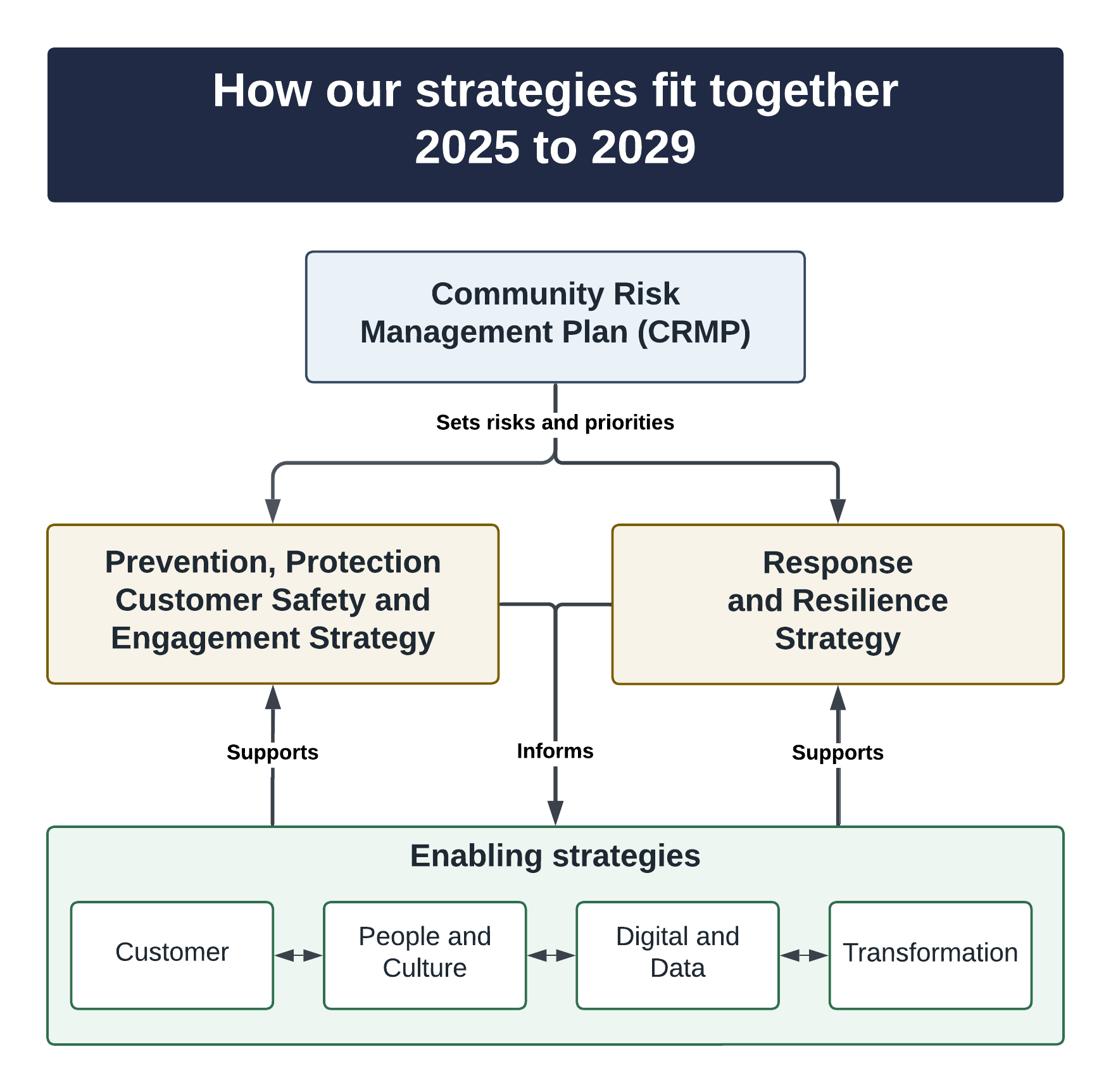
The Community Risk Management Plan sets risks and priorities for the service strategies. The service strategies inform the four enabling strategies, which support delivery of both service strategies. The enabling strategies are Customer, People and Culture, Digital, Data, Technology and AI, and Transformation.
Governance and Risk Management • Fleet and Equipment • Property Services • Procurement • Finance • Core Support Systems and Processes • Business Continuity
June 2025 - Incorporating Capital Works Programme and Legislative Updates
Updated July 2026 - Aligned to the Community Risk Management Plan (CRMP), the KFRS Code of Good Governance 2026/27, the Medium-Term Financial Plan (MTFP) 2026/27 – 2029/30, and the Infrastructure Plan (including Capital Strategy) 2026/27 – 2035/36.
Executive Summary
KFRS depends on its property, fleet, equipment, procurement and other essential internal services such as the Programme Management Office (PMO), information and people functions operating as one connected enabling system to ensure excellent support to the front line and saving lives.
The central idea is one of coordinated transformation, rather than isolated asset replacement. KFRS will use evidence about condition, compliance, operational need, whole-life cost, utilisation, carbon and colleague experience to decide what to retain, adapt, replace, consolidate or develop. Major investments will be designed around the operating capability they must enable and will be governed through the Service's strategic investment and portfolio arrangements.
The same discipline applies to the core support processes and systems. Governance, procurement, finance and corporate systems are the “operating system” of the Service: when they are clear, digital and outcome-focused they free people to spend time on what matters; when they are fragmented, manual or duplicated they create hidden risk and cost. KFRS starts from a position of strength, HMICFRS’s 2023–25 inspection graded the Service outstanding in three areas and found it makes good use of public money, and this plan is about sustaining that performance through a period of significant legislative, financial and structural change.
Our strategic vision for transformation: KFRS has safe places, reliable vehicles, fit-for-purpose equipment, trusted information and lean, well-governed core support services it needs to protect communities and support its people.
The strategy at a glance
Explore table: Executive Summary: The strategy at a glance
Domain | Where we are going by 2029 | Flagship commitments |
|---|---|---|
Governance and Risk | Agile, outcome-focused governance; risk embedded in planning and budgets; | Code of Good Governance 2026/27 in use; action-focused Annual Governance Statement with focus on outcome reporting; The Government Orange Book-aligned risk framework |
Fleet and Equipment | A proactive, data-led fleet and equipment function operating from a modern integrated facility with a balanced, lower-carbon fleet | Working from a new fleet and equipment services facility called the Asset Resource Centre (ARC); a managed Vehicle and Equipment Replacement Programme (VERP); replacement of majority of rescue appliances in life of strategy; fleet management system replacement; telematics and CCTV replacement; Hydrogenated Vegetable Oil fuel trial; charging across the estate. |
Property Services | A safe, inclusive, resilient, data-led estate aligned to service delivery and affordability | Eight estate commitments (P1–P8); Ashford Live Fire operational; delivery of Asset Resource Centre; CAFM property management system; contaminant control; gender-neutral facilities at 90% of sites |
Procurement and Commercial | Full Procurement Act 2023 compliance, strong contract management and collaborative buying | Pipeline and transparency notices; KPIs on major contracts; tail-spend control; social value |
Finance | A business-partnering finance function, budgets tied to CRMP priorities and a resilient MTFP | Business World cloud migration and module optimisation; Finance Business Partners; CIPFA FM Code self-assessment; priority-based budgeting; long-term sustainable financial planning, timely delivery of published accounts, unqualified audit opinions |
Core Support Systems and Processes | One trusted view of people, assets and money; process debt removed; secure and digitally confident workforce | iTrent case management; new time and attendance system; data governance; AI governance; Cyber Essentials Plus; Lean reviews; mandatory training to 90% |
Business Continuity underpins everything | Up-to-date risk assessments; pre-programmed and rehearsed business continuity arrangements; actions prioritised around mission critical functions; procedures widely understood | Business continuity planning aligned to corporate risk register; action cards updated; range of risk descriptors and tools improve consistency of decision making in response. |
Introduction
The Transformation Enabling Strategy is one of four enabling strategies, alongside the People and Culture Enabling Strategy, Customer Enabling Strategy, and Digital, Data, Technology and AI Transformation Enabling Strategy. Together, the four enabling strategies support delivery of the Response and Resilience Strategy and the Prevention and Protection Strategy, and ultimately the Community Risk Management Plan (CRMP).
This strategy sets out the principal governance, asset, infrastructure, commercial, financial and cross-organisational process improvements needed to support delivery of the Response and Resilience, and Prevention and Protection Strategies. It draws on the KFRS Code of Good Governance 2026/27, Vehicle and Equipment Replacement Programme, Property Services Plan, Infrastructure Plan, capital and revenue programmes, and the corporate transformation portfolio.
This is a four-year enabling strategy covering 2025–2029. It is supported by longer-term assets, infrastructure and investment planning horizons where this is necessary to reflect asset lifecycles and the development and delivery timescales of major investments. The plan will be reviewed annually alongside the CRMP delivery arrangements, Medium-Term Financial Plan, capital programme and corporate portfolio.
Where an action is led through another enabling strategy, it is identified here as a dependency rather than duplicated as a separate commitment. This strategy does not reproduce every team-level or project-level action. Detailed delivery activity will continue to be managed through the relevant delivery plans, approved project and programme plans, and the corporate portfolio.
- Chapter 1 – Governance and Risk Management
- Chapter 2 – Fleet and Equipment
- Chapter 3 – Property Services
- Chapter 4 – Procurement and Commercial
- Chapter 5 – Finance
- Chapter 6 – Core Support Systems and Processes (Process Engineering and Systems)
Business Continuity underpins everything as we ensure we can maintain business in face of any issues.
Each chapter follows a common structure: objectives and context, the best-practice foundations it applies and measures of success. Detailed actions are in the Transformation Delivery Plan. Actions are aligned to the Authority’s Community Risk Management Plan (CRMP) priorities.
The strategy has been developed alongside the current Medium-Term Financial Plan, capital programme and Infrastructure Plan. Activities that have already received the necessary approval are funded within those plans. Other commitments, including major capital schemes, system replacements and material changes to operating models, remain subject to business cases, whole-life affordability assessment, prioritisation against competing demands and the relevant Corporate Management Board or Authority Decision.
Approval of this enabling strategy does not constitute approval of individual projects, expenditure or additional people resourcing. Each proposal must proceed through the applicable financial, commercial, procurement, governance and delegated decision-making requirements before a commitment is entered into.
Status of commitment in this strategy
Actions and investments in this strategy may be at different stages of development. For governance and financial planning purposes, each material commitment will be classified as one of the following:
- approved and funded;
- approved in principle, subject to a final business case or procurement outcome;
- included as a financial planning assumption;
- proposed and subject to prioritisation or identification of funding;
- resource-neutral process improvement; or
- exploration, with no commitment to implementation.
The relevant project or programme record, rather than inclusion in this strategy alone, will be required to provide authoritative approval and funding status.
1. Purpose, scope and planning horizons
The strategy provides a common strategic framework for transformation across many of our core support functions. It covers fleet and equipment, property, procurement, finance, business continuity, and governance. It also covers the major transformation propositions needed to improve systems and processes for better efficiency and the ability to deliver better services.
It sets outcomes, principles, major commitments, dependencies and governance requirements. It is supported by:
- Separate detailed delivery plans, including the Fleet and Equipment and Property Services plans;
- Approved project and programme business cases;
- The corporate portfolio and annual delivery plan; and
- The Medium-Term Financial Plan and Infrastructure Plan (including 10-year Capital Plan).
Detailed project milestones, operational activity and routine capital work should be managed in those supporting documents and reported here only where they materially affect delivery of a strategic outcome.
The strategy covers the 2025–2029 period. Some activities within it look further ahead because of asset lifecycles.
1.1 The external context to the Enabling Strategies
Explore table: Purpose, scope and planning horizons: The external context to the Enabling Strategies
Development | Implication for this strategy |
|---|---|
Royal Assent 29 April 2026. The Act lets mayoral strategic authorities take on fire and rescue functions and allows police and fire boundaries to be aligned. Any future Kent and Medway devolution or local government reorganisation could change governance, budget-setting and precept arrangements; governance scanning and scenario planning are included in Chapter 1. | |
Fire Standards Board updates | The Code of Ethics Fire Standard was refreshed in 2026, and revisions to the Leading the Service and Leading and Developing People Standards were expected in summer 2026 following HMICFRS’s misconduct thematic review. Digital and Cyber standards are under review. |
Royal Assent 18 December 2025. It repealed the Workers (Predictable Terms and Conditions) Act 2023 (in full of 6 January 2026) and introduces guaranteed-hours and shift-notice rights to be phased in through secondary legislation. Action G9 has been updated accordingly. | |
Equality (Race and Disability) Bill | In March 2026 the Government confirmed it will legislate mandatory ethnicity and disability pay gap reporting, with action plans, for employers with 250 or more staff. The Bill itself is still awaited; KFRS will establish its baseline early (G10). |
Live since 24 February 2025, with transparency notices across the whole contract lifecycle and KPI publication for major contracts (Chapter 4). | |
Implementation period running with the Security Industry Authority as regulator; KFRS premises assessment in progress. |
2. Digital and data dependencies
This strategy is dependent on, but does not duplicate, the Digital, Data, Technology and AI Transformation Enabling Strategy, which will lead enterprise architecture, integration standards, cyber security, information governance, AI governance, digital capability and the lifecycle management of technology. This Transformation Enabling Strategy will define the operational, financial and asset-management outcomes that individual systems must enable. No material technology procurement should proceed without confirmation of its architectural fit, integration requirements, information ownership, cyber and data-protection controls, support model and funded exit or replacement plan.
2.1 Interface with other enabling strategies
The four enabling strategies form one corporate delivery framework:
- Transformation: physical assets, infrastructure, procurement, finance, governance, portfolio disciplines and cross-organisational process improvement;
- People and Culture: workforce strategy, organisational design, leadership, capability, inclusion, employee relations and cultural change;
- Customer: external and internal customer experience, service standards, engagement and feedback;
- Digital, Data, Technology and AI Transformation: technology, enterprise architecture, data, cyber security, AI governance and digital capability.
Where an outcome depends on more than one strategy, one strategy will be identified as the lead and the others as contributors. Shared dependencies, measures and unresolved conflicts will be considered through the corporate portfolio and Corporate Management Board.
3. Shared outcomes and principles
Explore table: Shared outcomes and principles
Shared outcome | What it requires |
|---|---|
Saving lives and reducing harm | Operational assets, facilities and training environments are safe, available and matched to risk. |
Improving customer experiences | Internal services are responsive, predictable and designed around operational need, with fewer hand-offs and avoidable journeys. |
A professional, safe, healthy and inclusive workplace | Facilities, workflows and equipment support welfare, accessibility, contaminant control, dignity and an inclusive workforce. |
Keeping KFRS lawful and resilient | Compliance, condition, roadworthiness, maintenance, security, continuity and critical dependencies are actively assured. |
Using money and resources well | Choices use whole-life cost, utilisation, capacity, productivity and benefits evidence rather than short-term replacement alone. |
Looking after the environment | Estate carbon, mileage, fuels, vehicle technologies and infrastructure are treated as one transition pathway. |
3.1 Design principles applied across all work
- Outcomes before outputs — every action states the difference it will make, not only the activity.
- Do it once, record it once — one system of record per data domain (people, money, assets, contracts, decisions); no parallel spreadsheets.
- Proportionate control — the level of governance matches the value, risk and reversibility of a decision (project tiers 1–4).
- Whole-life thinking — capital, revenue, carbon, people and benefits are assessed together before commitment.
- Designed with users — colleagues who will use a building, vehicle or system shape its requirements and test it.
- Collaborate where it adds value — 4F South-East, BlueLight Commercial, NFCC and public-sector partners, without weakening operational resilience or organisational autonomy.
- Ethical by default — decisions consistent with the KFRS Code of Ethical Conduct.
4. Integrated governance, investment and delivery
4.1 Governance and process maturity model
This strategy is underpinned by a five-level maturity model that evaluates KFRS’s ability to transition from ad-hoc, manual interventions to embedded, system-driven controls. Each chapter is self-assessed against the model annually, and progress is reported to CMB.
Explore table: Integrated governance, investment and delivery: Governance and process maturity model
Focus area | Level 1: Initial | Level 2: Developing | Level 3: Defined | Level 4: Managed | Level 5: Adaptive |
|---|---|---|---|---|---|
Accountability | Blame-oriented | Task-based | Role-based | Performance-based | Outcome-based |
Compliance | Avoidance | Reactive | Alignment | Assured | Strategic advantage |
Change | Chaotic / painful | Ad hoc projects | Structured / managed | Portfolio-led | Fluid / natural |
Systems | Silos | Partly connected | Integrated | Data-driven | Autonomous |
Each maturity level will be supported by defined evidence criteria. Annual self-assessments and internal audits will identify the evidence relied upon, areas of partial achievement, outstanding actions and the officer responsible for moderation. The target level is an indicator of our development and is not, by itself, evidence that individual controls are operating effectively.
4.2 Strategic resilience indicators
As KFRS progresses through maturity levels, we are effectively establishing robust internal controls and eliminating inefficient manual workarounds. Three diagnostic questions frame this transformation:
- Operational Continuity: If key process owners were unavailable tomorrow, would the system continue to function securely and efficiently without reliance on single-point key-person dependencies?
- Assurance and Reporting: Are we eliminating manual data extraction to streamline the preparation of the Narrative Report and core financial statements, ensuring critical statutory deadlines such as the publication of the Draft Statement of Accounts are met with maximum efficiency and minimal manual intervention?
- Regulatory Agility: How rapidly and effectively can we adapt core processes in response to statutory changes, emerging financial regulations, or shifting KFRS Community Risk Management Plan (CRMP) priorities?
4.3 How decisions and investment are governed
Explore table: Integrated governance, investment and delivery: How decisions and investment are governed
Body | Role in this strategy |
|---|---|
Kent and Medway Fire and Rescue Authority | Approves the CRMP, revenue budget, MTFP, capital programme and those major investments reserved to the Authority by the constitution or scheme of delegation. Approval of this enabling strategy does not replace the need for separate approval of individual projects where required. |
Audit and Governance Committee | Independent assurance on governance, risk, internal control and financial reporting; signs off the Local Code of Good Governance and Annual Governance Statement; receives internal and external audit reports. |
Corporate Management Board (CMB) | Provides collective strategic oversight of the four enabling strategies; prioritises activity within the resources and delegations available; resolves cross-directorate dependencies, capacity constraints and risks; and recommends material investment decisions to the Authority where required. CMB may require an activity to be rephased, rescoped, paused or stopped where affordability, capacity or benefits are insufficient. |
Strategic Leadership Board (SLB) | Overall management and leadership of KFRS is coordinated in this forum. |
Portfolio Board (PB) | Maintains the integrated programme and portfolio view, including delivery confidence, cost, risk, dependencies, capacity and benefits. PB reviews business cases and may approve them only where approval by the Authority is not required, as per the constitution or scheme of delegation. |
Vehicle and Equipment Replacement Programme and Property Programme Delivery Groups | Oversee the development and delivery of the approved fleet, equipment, property and infrastructure programmes within its agreed terms of reference. It monitors delivery, risk, cost and benefits but does not approve expenditure beyond its delegated authority. |
Portfolio Office | Project tiering (1–4), business case standards, benefits register, dependency tracking and post-implementation reviews. |
Delivery groups (e.g. Driving Support, Climate, Data Governance) | Day-to-day delivery and reporting of specific action sets, under Terms of Reference set out in the Meetings Policy. |
Investment and decision gates
- All proposals demonstrate strategic relevance to CRMP outcomes and related plans.
- Before a proposal moves to procurement or contractual commitment, it must have a proportionate and approved business case that assesses:
- the case for change and strategic contribution;
- a credible range of options, including do-minimum and non-asset options;
- capital, revenue and whole life cost;
- affordability and funding sources;
- operational, workforce, digital, data, cyber, equality and carbon implications;
- delivery and procurement capacity;
- risks, sensitivities and optimism bias;
- cashable, non-cashable and non-financial benefits;
- business continuity, implementation and transition; and
- the consequences of delay or non-delivery.
- Major proposals are considered alongside competing investment demands across all teams, not as stand-alone commitments.
- Business cases identify sponsor, benefit owner, operational continuity requirements, procurement route, data and cyber implications, and post-implementation review.
- Decisions are recorded in the Central Record of Decisions and Actions (CRODA) in line with the KFRS Decision Making approach.
Affordability and financial assurance
Transformation priorities will be considered collectively through the Medium-Term Financial Plan, capital strategy and corporate portfolio. The Authority will not assume that every proposal can proceed concurrently. Where affordability or delivery capacity is constrained, projects will be prioritised, re-phased, rescoped, paused or stopped.
For each material proposal, the financial assessment will identify:
- capital and implementation costs;
- recurring revenue and staffing implications;
- financing costs and Minimum Revenue Provision, where applicable;
- software, support, maintenance and lifecycle replacement costs;
- transition, migration, decommissioning and business-continuity costs;
- the proposed funding source;
- financial benefits, cost avoidance and non-financial benefits;
- key assumptions, sensitivities and optimism bias; and
- the financial effect if expected benefits are delayed or not realised.
Benefits or savings will not be reflected in the MTFP until there is sufficient evidence that they are deliverable, measurable and not already recognised elsewhere. Reserve funding will not normally be used to support recurring expenditure without an identified and sustainable exit strategy.
Organisational capacity
The strategy creates significant and concurrent demand for operational specialists, project and programme management, procurement, finance, IT, data, HR, property, fleet, legal and information-governance capacity. The corporate portfolio will therefore maintain a consolidated view of resource demand and availability. A project will not move into active delivery solely because funding is available.
Before starting, the relevant governance forum must be satisfied that KFRS and its suppliers have sufficient capability and capacity to deliver the change while maintaining statutory responsibilities, operational readiness and core services.
4.4 Best-practice foundations
The KFRS Code of Good Governance 2026/27, signed off by the Audit and Governance Committee in April 2026, is the anchor for this strategy. It applies the seven principles of the CIPFA/SOLACE Delivering Good Governance in Local Government framework (2016), which the sector widely uses as the basis for local codes of corporate governance.
The table below shows how each principle is applied across the transformation domains.
Explore table: Integrated governance, investment and delivery: Best-practice foundations
CIPFA/SOLACE principle | How this strategy applies it |
|---|---|
A. Behaving with integrity, demonstrating strong commitment to ethical values and respecting the rule of law | Code of Ethical Conduct embedded in decision-making and procurement; legal risk register reviewed annually by each internal services team for new legislation; Procurement Act conflicts-of-interest duties. |
B. Ensuring openness and comprehensive stakeholder engagement | Public outcomes dashboard; Procurement Act transparency notices; colleague engagement built into every major estate and fleet change (“see, feel, hear”). |
C. Defining outcomes in terms of sustainable economic, social and environmental benefits | Structured outcome reporting; whole-life costing; Climate Action Plan; social value in procurement. |
D. Determining the interventions necessary to optimise the achievement of the intended outcomes | Project tiering, business cases and options appraisal; Resource Review; Estate target model; VERP. |
E. Developing the entity’s capacity, including the capability of its leadership and the individuals within it | Finance Business Partners; FES workforce model; apprenticeships; digital skills audit and Digital Champions; risk and project training. |
F. Managing risks and performance through robust internal control and strong public financial management | Orange Book-aligned risk framework; CIPFA Financial Management Code; internal audit; benefits register; Cyber Essentials Plus. |
G. Implementing good practices in transparency, reporting and audit to deliver effective accountability | Action-focused Annual Governance Statement; timely, unqualified accounts; Audit and Governance Committee oversight; HMICFRS self-assessment. |
Other sector standards used throughout the strategy include the Fire Standards Board’s Internal Governance and Assurance, Code of Ethics, Leading the Service, Data Management and Digital and Cyber Fire Standards; HM Treasury’s Orange Book on risk management; the CIPFA Financial Management and Prudential Codes; NFCC fleet and contaminants guidance; and the National Procurement Policy Statement. Each chapter sets out the sources most relevant to it, and Appendix C lists them.
Chapter 1. Governance and Risk Management
Establishing agile, outcome-focused governance structures with an embedded risk management culture
1.1 Objective
To create flexible, outcome-focused governance structures aligned to the CIPFA/SOLACE Delivering Good Governance Framework, embed a strong risk management culture, and ensure all planning is integrated and strategically aligned to CRMP priorities. To ensure financial sustainability, legal compliance, and transparent public accountability.
1.2 Where we are now
KFRS has strong foundations. The CIPFA/SOLACE framework is adopted; the constitution and scheme of delegation are in place; the Authority meets three times a year and an Audit and Governance Committee has been in operation since October 2021. In April 2026 the Audit and Governance Committee approved a revised and updated Code of Good Governance 2026/27, and a new Decision-Making Policy, which sets out the good governance arrangements for decision making in KFRS. In addition, we have a Meetings Policy, which lists every internal meeting as a Board, Steering Group or Delivery Group with Terms of Reference. OurCentral Record of Decisions and Actions (CRODA) is the definitive record of decisions.
The opportunities now are to shift reporting from output to outcomes, to formalise risk management understanding and Government Orange Book alignment, to raise project and programme maturity, and to prepare for structural changes in fire governance.
1.3 Best-practice foundations
Explore table: Governance and Risk Management: Best-practice foundations
Best practice source | What it means for KFRS |
|---|---|
KFRS Code of Good Governance 2026/27 | Our published local code applies to the seven CIPFA/SOLACE principles. It is the base for a more action-focused Annual Governance Statement that reports what will change next year, not only what was in place. |
CIPFA/SOLACE Delivering Good Governance in Local Government (2016) | The recognised framework for fire authorities’ local codes. Good practice is to review compliance against the code annually and publish the result in the Annual Governance Statement. |
Fire Standards: Internal Governance and Assurance; Leading the Service; Code of Ethics | Services are expected to have clear assurance arrangements, adopt the Core Code of Ethics (aligned to the Nolan Principles – we have a Code of Ethical Conduct derived from these documents) in decisions, policies and processes, and designate a senior leader to promote it. Those governing the service hold the Chief Executive to account for implementing it. |
HM Treasury Orange Book and the Three Lines model | Risk management integrated with planning and budgeting; clear first-line ownership, second-line oversight (risk, finance, H&S, legal) and independent third-line assurance (internal audit). |
CIPFA Position Statement on Audit Committees (2022) | Audit committees should be independent, cover governance, risk, control, financial reporting and audit, and report annually on their effectiveness to the Authority. |
LGA “Leading the fire sector” guidance | Practical advice for fire authority members on applying good-governance principles, with particular focus on performance oversight and scrutiny. |
HMICFRS inspection framework | Effectiveness, efficiency and people pillar; areas for improvement tracked to closure with evidence. |
Good practice we are adopting: treat the Annual Governance Statement as a forward plan. Each significant governance issue is given an owner, an action, a date and a measure and reported to the Audit and Governance Committee at mid-year.
1.4 Key actions
Explore table: Governance and Risk Management: Key actions
Ref | Action | What's in place now | Owner | Timeline | Progress / comments |
|---|---|---|---|---|---|
G1 | Establish Agile Governance Framework: Develop adaptable governance structures and a unified planning cycle (removing duplication) that allows for fast, accountable decision-making and rapid adaptation to new threats and technology. | CIPFA/SOLACE framework adopted. Constitution and scheme of delegation in place. Authority meets 3 times per year. Audit and Governance Committee established Oct 2021. | Director of Finance & Corporate Services / CMB | 2025–2026 | Unified planning cycle through station reviews, annual planning, and tiering of projects 1–4. Code of Good Governance 2026/27 published. |
G2 | Code of Good Governance and action-focused assurance: Develop a Code of Good Governance and change how we report on annual assurance statements to better focus on future actions. | We currently do an annual governance statement. | Director of Finance & Corporate Services / CMB | Q3 2025 | Complete. Local Code developed and signed off at Audit and Governance Committee April 2026. Now used as base for more action-focused Annual Governance Statement. |
G3 | KFRS Decision Making approach: Clarify in policy the KFRS Decision Making approach. | Decision making is described in the Decision Making in KFRS policy and framework. | CEO / Director of Finance & Corporate Services / CMB | Complete with sign-off at Audit and Governance Committee April 2026. Used to ensure all decisions follow appropriate governance. | |
G4 | Embed Outcome-Based Accountability: Change external and internal reporting to focus on Outcomes (results achieved) over Outputs (activity done). Make data-driven insights publicly available (where privacy allows) for transparency and accountability. Embed use of the reporting framework. | Reporting currently output focused. Some public performance data published. | CMB / Director of Finance & Corporate Services | 2025–2027 | Reporting templates to be updated by Q4 2026. Public dashboard concept scoped. Annual Authority report to lead with outcomes narrative. |
G5 | Risk Management and Planning: Maintain a comprehensive Risk Management Framework aligned to the Orange Book/ISO 31000 (with ISO 37000 for governance). Actively link risks to delivery plans, ensuring all major spending directly supports CRMP goals. Develop and deliver risk management training to CMB and SLB. | Risk register maintained. Orange Book alignment being assessed. Risk management training not yet formalised. Risk appetite statement to be agreed by CMB | Director of Finance & Corporate Services / CMB | Ongoing 2025–2029 | Risk-to-budget linkage formalised in MTFP 2026/27. |
G6 | Maturity in Project and Programme Management: Improve understanding and use of project disciplines (business cases, benefits realisation, people impact assessments) by leaders. Develop a scalable Agile-compatible project methodology. | Project methodology in place. Business cases required for Tier 1/2 projects. Maturity assessment completed. | CMB / All Directors | 2025–2027 | Project methodology refreshed by Q3 2026. Leader workshop on business case disciplines delivered. |
G7 | Strengthen Organisational Resilience: Embed resilience and business continuity principles across the organisation (Business Continuity, Corporate Command, Control and Communications Policy). Maintain an annual exercise programme testing corporate response to significant risks including Major/Critical Incidents. | Business Continuity Policy in place. Exercise programme active. Corporate Command, Control and Communications Policy published. | Assistant Director Resilience | Ongoing 2025–2029 | Annual exercise programme reported to CMB. Business Continuity plans reviewed. Lessons from exercises embedded in Management and Co-ordination process. Cyber incident exercise undertaken . |
G8 | Code of Ethical Conduct and leadership standards: Assure compliance with the refreshed Code of Ethics Fire Standard and the revised Leading the Service and Leading and Developing People Fire Standards; respond to HMICFRS misconduct thematic recommendations. Support mini reviews of stations and teams including culture review. | Core Code adopted. Fire Standards gap analysis process in place. | CEO / Assistant Director of HR / Head of Policy | 2026–2027 | Gap analysis against revised standards within 6 months of publication. Senior ethics lead confirmed. Annual Fire Standards compliance report to Audit and Governance Committee. Culture review process embedded in station review cycle. |
G9 | Governance horizon scanning and devolution readiness: Assess the implications of the English Devolution and Community Empowerment Act 2026 and any Kent and Medway local government reorganisation for fire governance, budget-setting and partnerships. | Legal register maintained. | CEO / Monitoring Officer / Director of Finance & Corporate Services | 2026–2028 | Constitution and Code of Good Governance reviewed against any changes. Stakeholder engagement plan in place. |
G10 | Audit and Governance Committee effectiveness: Self-assess the Committee’s performance. | Committee established 2021 with clear Terms of Reference. | Monitoring Officer / Director of Finance & Corporate Services / Chair of Committee | Annually | Self-assessment completed and annual report presented. Training provided to members. Independent member arrangements reviewed. |
G11 | HMICFRS readiness and improvement tracking: Maintain a single tracker of HMICFRS areas for improvement and Fire Standards gaps, with evidence of closure, and prepare for the next inspection round. | Areas for improvement from 2023–25 inspection identified (prevention quality assurance; on-call availability). | CMB / SM Data & Intelligence | Ongoing 2025–2029 | Tracker reviewed quarterly by CMB. Evidence packs maintained. Self-assessment against inspection framework completed before next round. |
1.5 Measures of success
Explore table: Governance and Risk Management: Measures of success
Metric | Target | Reporting frequency |
|---|---|---|
Risk Register Compliance | Evidence of regular use of corporate risk register to manage risk mitigation actions with control measures in place | Quarterly |
Risk Management Maturity | Achieve external assurance that the risk management framework is aligned to the Government Orange Book | Biannually |
Project Delivery Success | Year-on-year improvement in organisational maturity assessments; increase of projects delivered on time and within quality each year | Annually |
Risk Culture | 100% of CMB and SLB complete risk management training. Evidence of risk management in decision making | Annually |
Financial Assurance | Unqualified accounts and External Auditor’s Audit Findings Report and Annual Report not identifying any significant weaknesses in control systems and/or financial statements or value for money arrangements | Annually |
Legal Compliance | Aiming to Zero significant compliance failures; legal register reviewed and up to date | Quarterly |
Procurement Act Compliance | Increasing number of contracts above threshold using central digital platform; Payments Compliance Notice published within statutory timescales (see Chapter 4) | Quarterly |
Outcome Reporting | Authority report and public dashboard reporting on outcomes, not just outputs | Annually |
Governance Statement Actions | >90% of Annual Governance Statement actions delivered on time | Annually |
Fire Standards and HMICFRS | All published Fire Standards gap-assessed within 6 months of their publication or review; all HMICFRS areas for improvement with evidenced action plans | Quarterly |
Chapter 2. Fleet and Equipment
Modernising the fleet and equipment service to be safe, efficient, sustainable and aligned to operational requirements
2.1 Overview and objective
Fleet and Equipment Services (FES) provides vehicles, equipment, systems and specialist support that allow operational teams to deliver safe, effective and resilient services across Kent and Medway. Sitting within the Response and Resilience Directorate, FES manages the full life cycle of fleet and equipment assets, from procurement and conversion through maintenance and fuelling to disposal. It is also responsible for in-vehicle video recording and telematics.
Objective: To modernise fleet operations, infrastructure, and systems to maximise driver safety, operational effectiveness, and environmental sustainability. Fleet transformation is directly linked to CRMP operational priorities and the KFRS decarbonisation agenda.
Future state: FES will be a proactive, data-led and trusted enabling function. Firefighters will have reliable vehicles, equipment and support when and where they need them. Managers will have clear assurance and performance information, and the public will see a resilient service that uses public money responsibly.
2.2 Best-practice foundations
Our approach is built on the following standards and guidance.
Explore table: Fleet and Equipment: Best-practice foundations
Best practice source | What it means for KFRS |
|---|---|
NFCC fleet guidance and DVSA Guide to Maintaining Roadworthiness | Although fire appliances are exempt from Operator Licensing, adopt standards at least equivalent to the Continuing Roadworthiness Guidance : daily walkaround checks, planned preventive maintenance, rapid defect rectification and inspection records retained for at least 15 months. Systematic inspection intervals, documented defect reporting and independent audit of maintenance standards |
Whole-life cost (WLC) and optimum replacement point | Replace assets when the combined curve of depreciation and rising running cost per mile reaches its minimum, rather than on age alone (the basis of VERP). |
Health and Safety at Work Act 1974 and Working Time Regulations 1998 | Duty of care for work-related driving, including fatigue risk management for extended journeys and mutual aid. |
Zero Emission Vehicle (ZEV) Mandate | Rising manufacturer targets for zero-emission cars and vans from 2024, with all new cars and vans expected to be zero emission by 2035 — fleet replacement and charging must be planned together. EV charging consultancy is in progress in 2026, but the installation project won’t start until 2028/29 and will span 2 years at current estimation, to meet the target date given by FES of 2030 when manufacturers fines are expected |
UK GDPR and ICO guidance on video surveillance | Telematics and in-vehicle CCTV require a clear lawful basis, data protection impact assessment, proportionate access controls and retention rules. |
2.3 Infrastructure
FES currently operates from two Maidstone sites. A three-bay workshop at one site and a Distribution Centre at another.
More detail: 2.3 Infrastructure
These premises are deteriorating and no longer suit the scale or ambition of the function. Limited space, poor layout and separated teams create avoidable vehicle movements, extra handling in stores and duplicated administration. Further investment in them would offer only short-term mitigation.
Our long-term requirement is a single, fit-for-purpose facility close to the arterial road network that brings workshops, stores and administration together. This is the Asset Resource Centre (ARC) set out in Chapter 3 (commitment P4). Bringing these functions together would:
- reduce travel time and downtime for operational vehicles, and the technician time spent moving vehicles between sites (72 working days in 2024/25);
- keep parts on site, cutting lead times, and provide secure storage for specialist tools and equipment;
- give colleagues safe, modern and inclusive working conditions, including welfare and changing facilities suitable for all, helping us attract new talent and introduce apprenticeships;
- reduce avoidable mileage, fuel use and emissions; and
- enable new in-house capabilities, including parts function, vehicle commissioning and decommissioning, a make-ready centre for faster changeovers to reserve appliances, and small vehicle and van maintenance, reducing our reliance on external contractors.
An interim satellite workshop operating from Ashford fire station will add capacity and local responsiveness in the meantime, but it will not resolve the inefficiencies of a split estate.
Delivery route
No decision has yet been made on how the ARC will be delivered. Scoping began in 2025 and site options are being reviewed near the M20 (Maidstone) and M2 (Medway) junctions. Alongside acquiring land or buildings, we are assessing the potential for leasing suitable premises. Each route will be tested through an options appraisal and business case covering cost, timescale, operational suitability and risk, before a preferred option is recommended. Figure 1 summarises the routes under assessment.
Explore table: Fleet and Equipment: Delivery route
Delivery route | Key considerations |
|---|---|
Lease new premises | Potentially faster occupation and lower upfront capital, with costs met largely from revenue. Depends on finding suitable premises on acceptable terms, and on the landlord agreeing to specialist adaptations. |
Purchase and adapt existing premises | Greater long-term control of the asset and its adaptation, with capital costs for acquisition and refurbishment. Timescales depend on what is available and the extent of works needed. |
Acquire land and build | Full design control and a facility shaped around future needs, but the highest capital cost and the longest lead-in, with an indicative 49-month programme from scoping to occupation. |
Figure 1: ARC delivery routes under assessment
Time is the main constraint. The current lease expires in August 2028, and a three-year extension has been agreed, so the new facility needs to be operational by August 2031 at the latest. Whichever route is chosen, delivery will be managed as a multi-year programme with clear milestones for securing premises, design, fit-out and relocation.
Future state: FES will operate from a modern, integrated facility. Firefighters will see faster turnaround of appliances and equipment, and dependable access to reserve vehicles and parts. Managers will see improved productivity and less reliance on external suppliers, and the public will see frontline resources returned to service more quickly.
2.4 Information
Fleet data is held in our fleet management system, which can record age, mileage, whole-life cost, defects, parts, workshop scheduling, availability and productivity. In practice it is used mainly for job cards and inventory, so teams rely on separate spreadsheets and there is no single view of fleet performance, cost or compliance. Data quality needs improvement, with open job cards more than two years old and some service records showing activity five years overdue (despite jobs being completed), and there has been no clear system owner. A cleanse of priority records is under way.
More detail: 2.4 Information
Current system support is expected to end within 18 to 36 months. We will procure a replacement against clear requirements, data standards and reporting needs.
Equipment information is being developed through a wider Service asset management project. Asset tagging is under way to create a baseline inventory, with delivery now expected in 2026. This will support equipment replacement, maintenance and disposal planning.
Future state: Fleet and equipment information will be accurate, well governed and held in trusted systems. Firefighters will see clear information on asset availability and defects. Managers will have one reliable view of compliance, cost and risk, and the public can be confident that high-value assets are safe, roadworthy and well managed.
2.5 Vehicles
In 2024 the fleet comprised 392 assets, from motorcycles and cars to off-road vehicles and fire appliances. Together they travel around 2.5 million miles and use around 650,000 litres of fuel a year. Because diesel also powers the pumping at incidents, fuel economy is not always a reliable measure of vehicle efficiency. Figure 2 shows the fleet by Chartered Institute of Public Finance and Accountancy (CIPFA) category.
Explore table: Figure 2: Breakdown of KFRS vehicles by CIPFA category, March 2024.
| CIPFA category | Number of vehicles |
|---|---|
| Pumping Appliances | 75 |
| Aerial Appliance | 3 |
| Other Appliances | 32 |
| Officer Response Vehicle | 67 |
| Total Resilience | 10 |
| Other Fleet Vehicles | 182 |
| Reserve Appliances | 13 |
| Training Appliances | 10 |
| Grand Total | 392 |
The age of the fleet is a significant risk. In March 2024 the average age of the large goods vehicle (LGV) fleet was fifteen years, several vehicles were more than twenty years old, and 32% of the fleet was older than the fifteen-year guide. Older vehicles cost more to maintain, spend longer off the run, are harder to find parts for and miss out on newer safety and emissions technology. Historic bulk buying has also created peaks and troughs that make maintenance, spending and procurement harder to plan.
The Vehicle and Equipment Replacement Programme (VERP) has been updated and now sets a replacement cycle for every vehicle type at the where the asset investment in maximised. VERP will move towards optimum point, where combined depreciation and running cost per mile is lowest when sufficient data is available to support (Figure 3). This smooths purchasing and makes replacement business as usual rather than a periodic project. For low-mileage smaller vehicles, it extends life where that offers better value. A new appliance replacement contract is due from April 2026, with the first vehicles expected in July 2027, allowing the oldest assets to be retired.
View diagram: Figure 3: Optimum replacement point — depreciation and running cost per mile over vehicle life.
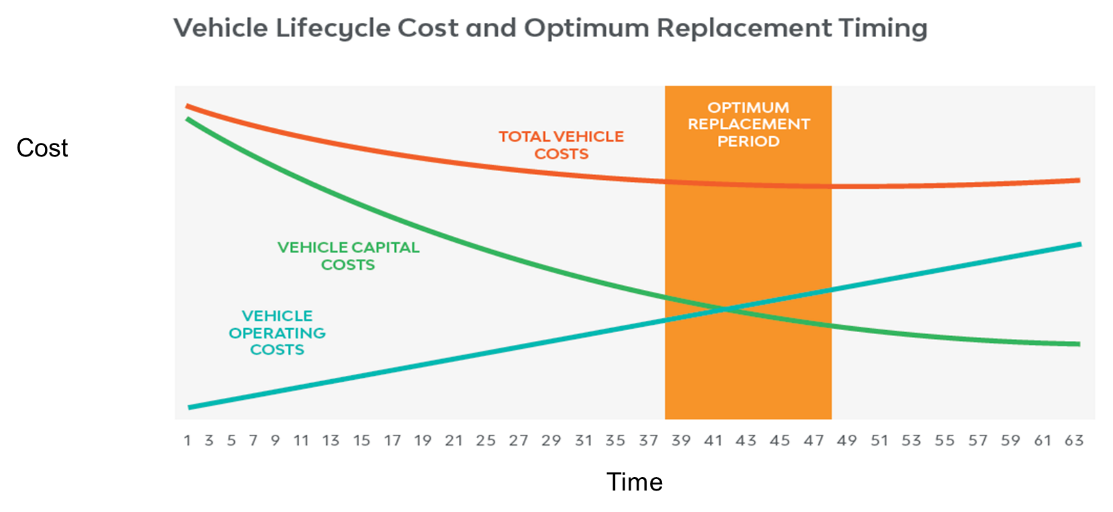
Capital costs fall over the vehicle life cycle, while operating costs rise. Total vehicle costs reach a broad minimum in the highlighted optimum replacement period before rising again. The horizontal scale is numbered but does not name a unit, so the graphic does not establish a specific duration in years.
Cars and vans make up 63% of the fleet. Under the Zero Emission Vehicle (ZEV) Mandate, manufacturers must sell a rising share of electric vehicles, and penalties for missing targets are likely to be passed on to buyers. All new cars and vans, and heavy goods vehicles under 44 tonnes, are expected to be zero emission by 2035. Vehicle replacement, charging infrastructure (being planned with Property Services) and funding must therefore be planned together.
Future state: KFRS will run a planned, affordable and evidence-based replacement programme. Firefighters will have safer, more reliable vehicles with modern technology. Managers will see a balanced age profile and predictable investment, and the public will see dependable emergency response.
2.6 Environment
Fleet has the largest carbon footprint of any KFRS business area, with diesel and petrol emissions of 1,724 tonnes in 2023/24 according to the recent LASER survey. Reducing this means cutting avoidable mileage, buying more efficient vehicles, using alternative fuels in the existing fleet, and introducing hybrid and electric vehicles through VERP.
Progress is under way. The fleet includes 61 self-charging hybrids, and 239 vehicles use AdBlue to cut harmful emissions. A trial of Hydrogenated Vegetable Oil (HVO) as a diesel substitute will start in 2026 using the SHQ fuel tank, and the fuel contract has been amended to include it. HVO typically costs 10–15% more than diesel and can increase fuel use by around 3%, so the trial will weigh environmental benefit against cost and practicality.
Future state: The environmental impact of the fleet will fall while operational readiness is protected. Firefighters will have practical, reliable vehicles and fuelling. Managers will see measurable reductions in mileage and emissions, and the public will see a service reducing its own footprint.
2.7 People
FES has thirty knowledgeable and committed colleagues, but the team does not yet reflect the diversity of the communities we serve, and current facilities limit inclusivity, although gender-neutral showers have been installed in the workshop.
More detail: 2.7 People
Some specialist roles are single points of failure. The new facility will need a planned workforce model, with succession planning, clear development routes and apprenticeships, which can be introduced once suitable facilities are in place. Productivity cannot yet be measured consistently because of the limits of current systems.
Recruiting and keeping skilled vehicle technicians has been a long-standing challenge, with pay and the working environment being the main barriers. Recognising technicians’ specialist skills through job assessment reduced the vacancy rate from a peak of 40% to zero during 2025. The next step is to align pay, facilities, structure and development so these gains are sustained.
Future state: FES will have an inclusive, skilled and resilient workforce with clear roles and succession plans. Firefighters will be supported by knowledgeable technicians, and managers will see fewer single points of failure and a sustainable pipeline of specialist skills.
2.8 Telematics and CCTV
Telematics was introduced across the fleet, and CCTV on response vehicles, in 2019, but the benefits have not been fully realised, partly due to the switch off of the 3G network, which created data connectivity problems. We are resetting our requirements, with a new contract due in 2027 and benefits from 2028. Used well, these systems will help us
- reduce accidents and improve driver behaviour through clearer feedback and targeted learning;
- reduce mileage, downtime and fleet size through better utilisation data;
- lower insurance costs and speed up investigations and complaint resolution with reliable evidence; and
- support lone workers and colleagues working away from fixed sites.
The new system will be treated as an organisational capability rather than a fleet tool, with clear ownership, governance, lawful basis, access controls and reporting.
Future state: Telematics and CCTV will be trusted organisational capabilities. Firefighters will see fair use of evidence to support safer driving and lone-worker protection, and managers will have reliable insight into vehicle use, driving risk and resource deployment.
2.9 Summary
Key messages
- The current FES estate limits efficiency and resilience. The ARC will bring workshops, stores and administration together, with the delivery route to be decided through an options appraisal of leasing, purchasing or building.
- Fleet and equipment information must be held in trusted, well-governed systems that provide a single source of truth.
- VERP provides the mechanism to improve the age profile of the fleet, manage whole-life cost and support resilience.
- Environmental progress needs a coordinated approach to mileage, alternative fuels, electric vehicles and charging infrastructure.
- People, facilities, systems and governance must be developed together so that benefits are sustained.
These priorities depend on each other and will be managed as one connected programme, with shared governance, benefits tracking and aligned investment.
2.10 Measures of success
Explore table: Fleet and Equipment: Measures of success
Metric | Target | Reporting frequency |
|---|---|---|
Fleet System Implementation | New fleet management system live and operational with full data migration completed | Project-specific (2027) |
Telematics Replacement | New telematics system deployed across all vehicles with driver behaviour reporting active | 2027-2028 |
Alternative Fuel Transition | % of fleet transitioned to alternative fuels — figure published annually in decarbonisation update | Annually |
Fleet Carbon | Reduction in fleet tCO2e against the 2023/24 baseline of 1,724 tonnes | Annually |
Driver Safety | Reduction in at-fault incidents and fuel consumption per kilometre | Quarterly |
VERP Compliance | 100% of vehicles replaced within planned lifecycle or documented exception authorised; reduction in % of fleet over 15 years from 32% | Annually |
Fleet Talent Retention | Fleet vacancy rates and specialist skills gaps tracked; succession plans in place for all critical roles | Annually |
EV Charging Readiness | Charging infrastructure in place and operational for EVs planned within VERP. | Annually (from 2027) |
Roadworthiness Compliance | 100% of vehicles with current inspection records held for min 15 months; defect rectification within target timescales; zero overdue services | Quarterly |
Driver Fatigue Risk | Fatigue risk management controls in place; journey-hours monitoring operational; reviewed following any at-fault RTC | Annually |
ADAS Adoption | % of new vehicles procured with ADAS specification; workshop ADAS competency achieved for 100% of relevant colleagues | Annually (from 2026) |
Whole Life Cost | WLC methodology adopted; VERP fully funded in MTFP; annual benchmarking report completed | Annually |
EV / HV Fleet Safety | HV safe working procedures adopted; relevant workshop colleagues HV-competent; EV storage risk assessments completed | Annually |
Vehicle Availability and Downtime | Appliance availability and average workshop turnaround improved year on year; technician days spent moving vehicles reduced | Quarterly |
Chapter 3. Property Services
Modernising the estate to be inclusive, safe, sustainable, resilient and operationally effective
3.1 Purpose and strategic intent
This plan sets out how KFRS will transform its property estate between 2025 and 2029. It moves beyond managing individual buildings and maintenance requests to make deliberate choices about the estate required to deliver the Community Risk Management Plan (CRMP), protect colleagues, support operational capability and remain financially sustainable.
More detail: 3.1 Purpose and strategic intent
Objective: To modernise the KFRS estate so that every building is operationally fit, environmentally sustainable, inclusive for all colleagues, and appropriately maintained. Estate decisions are aligned to the CRMP, the MTFP, and KFRS’s broader decarbonisation and inclusion commitments.
Transformation objective: By 2029, KFRS will have a safer, more inclusive, resilient, data-led estate that is aligned to service delivery, workforce needs and long-term affordability.
What this plan changes
- It separates statutory compliance, planned maintenance and reactive works from transformational estate investment.
- It creates a single five-year programme with strategic commitments, accountabilities, decision-making points, risks and benefits.
- It connects property decisions to CRMP delivery, fleet, training, sustainability, data, finance and partnership opportunities.
- It requires major estate proposals to be considered through portfolio, Strategic Leadership Board, and Authority governance.
3.2 Best-practice foundations
Explore table: Property Services: Best-practice foundations
Best practice source | What it means for KFRS |
|---|---|
Government Functional Standard GovS 004: Property | Manage the estate as a strategic asset: with a clear strategy and asset management plan, reliable property data, and decisions about retaining, sharing or disposing of property based on service need and value. |
One Public Estate and partnership use | Look for opportunities to share sites with blue-light and public partners where this improves value without weakening operational resilience or autonomy. |
NFCC contaminants guidance and the FBU/UCLan research | Clean/dirty zoning, decontamination pathways, BA room design and PPE storage that minimise firefighter exposure to fire contaminants. |
Building Safety Act 2022 and Fire Safety (England) Regulations 2022 | Higher-risk building duty-holder regime (none qualifying in the KFRS estate); fire door checks, wayfinding and fire safety system testing evidenced within statutory timescales. |
Assess premises against the qualifying thresholds; proportionate security procedures and plans where required; Security Industry Authority as regulator. | |
Equality Act 2010 and inclusive design (BS 8300) | Accessible, private and dignified welfare facilities for a diverse workforce, including gender-neutral provision and neurodiversity-aware sensory environments. |
RICS and planned preventive maintenance good practice | Condition surveys by qualified surveyors, PPM schedules, and a CAFM system as the single source of truth for assets, defects and compliance. |
Public Sector Decarbonisation and carbon reduction good practice | Fabric first, then low-carbon heat, renewable generation and smart controls, sequenced by condition and lifecycle so carbon investment coincides with planned replacement. |
3.3 Case for change
The existing Estates Delivery Plan identifies a broad range of pressures: an ageing estate, contaminants, facilities designed for a historically male workforce, live-fire training capacity, unsuitable fleet workshop and logistics arrangements, carbon and energy demand, security requirements and the need for better asset information. It also identifies the proposed Computer Aided Facilities Management (CAFM) system, Asset Resource Centre (ARC), and a substantial potential decarbonisation pipeline and completion of the Ashford Live fire facility.
The strategic issue is not simply whether each problem is valid. It is whether KFRS can make the right choices across the estate as one organisation: what must be maintained, what should be transformed, what must be funded first, and which changes create measurable service, resilience and financial benefit.
Explore table: Property Services: Case for change
Current position | Transformation response |
|---|---|
Estate risks and projects are documented well within the Property Services team but not widely understood across Strategic Leadership Board stakeholders. | Create one prioritised transformation programme, across all transformation teams. |
Facilities require adaptation for contaminants, inclusion and modern operational needs. | Deliver a targeted safe, inclusive and contaminant-resilient estate programme. |
Training, fleet workshops, logistics and critical sites have distinct requirements. | Make investment decisions through a joined-up operational and transformation programme. |
Implement a Computer Aided Facilities Management (CAFM) system to improve facilities management and evolve to provide a property data repository to support evidence-led decision making. | Deliver a fully functional CAFM system that integrates estate assets, defect reporting and compliance monitoring, to support evidence-led decision making. |
Sharing, disposal and relocation opportunities exist but are not connected to a target estate model. | Optimise the estate footprint and utilise partnership collaboration where this improves value without weakening operations, nor organisational autonomy. |
Decarbonisation obligations are emerging but not yet a fully prioritised transformation proposition. | Use trusted data, lifecycle information and affordability to sequence investment. |
3.4 Strategic outcomes by 2029
- Ensure financial and other resources are aligned with the corporate priorities as set out in the Community Risk Management Plan (CRMP), and supporting plans.
- Estate decisions are based on service delivery requirements, risk, condition, utilisation, affordability and deliverability.
- Provide appropriate controls for contaminants, welfare, privacy and accessibility.
- Deliver a fully functional CAFM system to support evidence-led decision making.
- Critical training and operational facilities are fit for purpose, resilient and aligned to service delivery requirements.
- The estate is intelligently utilised and supports partnership collaboration where compatible with operational resilience and organisational autonomy.
- Complete the Ashford Live Fire facility.
- Design and build a fit-for-purpose Asset Resource Centre (ARC) to meet KFRS’s fleet transformation requirements.
- KFRS has a prioritised low-carbon programme to move towards a sustainable and low-carbon estate.
3.5 Estate transformation commitments
The property programme is organised around seven strategic commitments. Individual projects, site scope, cost and sequencing will be coordinated through the Infrastructure Plan, business cases and portfolio governance.
Explore table: Property Services: Estate transformation commitments
Commitment | What this means | Success by 2029 |
|---|---|---|
P1. Establish an integrated transformation programme, to align financial and other resources with corporate priorities | Bring condition, compliance, service delivery requirements, risk, utilisation, affordability and deliverability risks into one prioritised estate transformation programme. | A board-approved programme linked to CRMP, the Infrastructure Plan and portfolio governance. |
P2. Create a safe, inclusive and contaminant-resilient estate | Make targeted changes to the estate to ensure that working environments protect colleague health and safety and enable a diverse workforce. | Provide appropriate controls for contaminants, welfare, privacy and accessibility. |
P3. Modernise critical operational, training and resilience infrastructure | Ensure the estate supports operational competence, training accessibility and continuity of critical services. | Training and critical operational facilities are demonstrably fit for purpose and resilient. |
P4. Deliver a future-ready Asset Resource Centre to meet KFRS’s fleet transformation requirements | Replace unsuitable fleet and logistics arrangements to prepare the estate for evolving fleet requirements and technology. | Deliver a custom-built Asset Resource Centre (ARC) to meet KFRS’s fleet transformation requirements. |
P5. Deliver a fully functional CAFM system to support evidence-led decision making | Implement a Computer Aided Facilities Management (CAFM) system to improve facilities management and evolve to provide a property data repository to support evidence-led decision making. | Implemented CAFM system, providing reliable estate data including estate assets, defect trends and compliance monitoring, to support evidence-led decision making. |
P6. Optimise the estate footprint, partnership use and long-term affordability | Make evidence-led decisions to retain, adapt, share, relocate and dispose of property estate assets that strengthen service delivery and value. | The estate is better utilised and supports partnership collaboration where compatible with operational resilience and organisational autonomy. |
P7. Build a sustainable and low-carbon estate | Use asset data, energy information and lifecycle planning to make evidence-led decisions and reduce avoidable cost and carbon. | A prioritised low-carbon programme to guide investment decisions. |
P8. Complete and open the Ashford Live Fire facility | The ability to have a multipurpose live fire and complex incidents training facility | This will go live in 2026, with the first courses taking place in January 2027. |
3.6 Flagship transformation propositions
Two investments illustrate the purpose of this plan: not replacing buildings like for like, but transforming the operational capability KFRS can provide. Ashford Live Fire (ALF) and the Asset Resource Centre (ARC) are both strategic builds for a safer, more capable and more resilient Service.
A) Ashford Live Fire (ALF): a centre of excellence for firefighter competence, confidence and safety
Ashford Live Fire will be more than a replacement training structure. It will be KFRS’s principal centre of excellence for live-fire firefighting, high-rise tactics and operational learning: a realistic, resilient and safer environment where firefighters, incident commanders and instructors can develop and maintain the skills needed for the incidents they will face.
The facility will bring together live-fire exposure, breathing-apparatus training, firefighting tactics, incident command and operational learning in a way that cannot be consistently achieved through classroom learning, cold training or reliance on third-party venues. It responds directly to learning from Grenfell and the need for practical experience of fire behaviour, multistorey environments and complex operational decision-making.
What changes: KFRS gains an in-county, multipurpose and KFRS-controlled facility for Class A live-fire and high-rise training, supported by trained instructors, safer contamination-management arrangements, improved welfare and accommodation, and a more resilient training-estate model.
Explore table: Property Services: A) Ashford Live Fire (ALF): a centre of excellence for firefighter competence, confidence and safety
Operational benefit | What colleagues will see, feel and hear |
|---|---|
Safer, more confident firefighting | Crews will train in realistic conditions before meeting them at incidents. They will feel better prepared to understand fire behaviour, apply tactics and make decisions under pressure. |
Training that reflects the risks faced | Firefighters and officers will see live fire, breathing apparatus, tactical and command learning brought together rather than experienced as disconnected exercises. |
A reliable training offer | Colleagues will hear about predictable training opportunities at a KFRS-controlled venue, with less dependence on external bookings, cancellations, insurance arrangements and long travel. |
A healthier, more inclusive environment | They will see cleaner pathways, better welfare and improved accommodation; they should feel that their health, dignity and development have been designed into the facility. |
Pride and professional development | Instructors and crews will experience a modern centre of operational learning that demonstrates KFRS is investing in the capability and safety of its people. |
B) Asset Resource Centre (ARC): an operational asset hub
The Asset Resource Centre will be KFRS’s integrated operational asset hub: a purpose-built facility that brings together fleet maintenance, equipment services, logistics, vehicle commissioning and decommissioning, stores and, where viable, make-ready activity. It will transform how KFRS keeps its operational assets available, safe, equipped, maintained and ready for use.
The current workshop is limited to three HGV bays, has no secure external appliance parking and no parts store. It has insufficient capacity for current maintenance requirements and technicians spent 72 working days moving vehicles in 2024/25. The Distribution Centre is also constrained, and equipment, workwear and PPE are managed across dispersed locations. The ARC addresses these constraints through one designed operating model rather than a series of workarounds. Its operating model, capacity and workforce requirements are set out in Chapter 2 (section 2.3).
What changes: KFRS gains a long-term, financially stable and operationally resilient platform for fleet maintenance, equipment logistics, parts, secure vehicle parking and future fleet technologies, designed around the end-to-end lifecycle of operational assets.
Explore table: Property Services: B) Asset Resource Centre (ARC): an operational asset hub
Operational benefit | What colleagues will see, feel and hear |
|---|---|
More reliable vehicle and equipment availability | Station colleagues will see a more responsive asset-support service. They will feel greater confidence that vehicles, specialist equipment, PPE and workwear will be available when needed. |
Less waste and better use of expertise | Fleet colleagues will work in a facility designed for maintenance, parts and safe vehicle flow rather than spend time shuffling vehicles, travelling between sites or working around a constrained building. |
A joined-up asset service | Colleagues will see fleet, equipment, stores, commissioning and logistics work as one coordinated service rather than several disconnected activities. |
Readiness for the future fleet | Technicians will see safe systems, space and infrastructure designed for changing vehicle technologies, rather than retrofit arrangements imposed on an unsuitable leased building. |
A better working environment and sense of value | Fleet and logistics colleagues will experience a professional, secure and fit-for-purpose workplace that recognises the critical contribution they make to frontline response. |
Benefits realisation: what people should see, feel and hear
The success of estate transformation cannot be judged only by assets completed, money spent or compliance certificates obtained. Each major intervention must make a meaningful difference to the day-to-day experience of colleagues, site condition, and to the service received by the public.
Explore table: Property Services: Benefits realisation: what people should see, feel and hear
Benefit lens | What good looks like by 2029 |
|---|---|
See | Visible improvements in the working environments, information and support available to colleagues: inclusive facilities, safer contaminant pathways, purposeful training spaces and better-maintained sites. |
Feel | Greater safety, confidence, dignity, pride, operational readiness and trust that KFRS has designed services and facilities around the people who use them. |
Hear | Clear, honest communication about why change is happening, what is changing, how disruption will be managed, when benefits will arrive and where colleague feedback has influenced decisions. |
Experience | Less waiting, workarounds, site disruption and uncertainty; more reliable access to the facilities and support needed to do a good job. |
Contribute | Meaningful engagement with operational and internal services colleagues and partners at the points where their experience can improve the design or delivery. |
3.7 Delivery sequence
The estate cannot be transformed through one capital programme alone. The sequence below ensures that major investment choices are based on evidence, operational requirements and affordability, while urgent health, safety and compliance activity continues.
Explore table: Property Services: Delivery sequence
Phase | Primary focus | Key outputs | Timing |
|---|---|---|---|
1. Baseline and choice | Estate evidence, strategic requirements, governance and investment choices. | Integrated estate baseline; transformation criteria; prioritised programme; benefits and risk framework. | 2025–2026 |
2. Critical safety and operational change | Contaminants, inclusive facilities, training and critical-site resilience. | Phased clean/dirty pathways and PPE storage; inclusive facilities programme; live-fire transition; ARC build. | 2025–2029 |
3. Sustainability | Decarbonisation of estate. | Prioritised low-carbon programme. | 2025–2026 |
4. Property data | Collection and cleansing of property data into CAFM system to support evidence-led decision making. | A fully functional CAFM system that integrates estate assets, defect reporting and compliance monitoring. | 2025–2027 |
5. Optimise and embed | Make data-led decisions regarding property estate assets and partnership working. | Shared-premises register, Licences to Occupy, Service Occupancy Agreements, and annual review. | 2025–2029 |
3.8 Transformation delivery plans
The following actions establish the plan baseline. These should be refined into project or programme plans where they pass the agreed investment and portfolio thresholds.
P1. Establish an integrated transformation programme, to align financial and other resources with corporate priorities
Accountable leadership: AD Transformation / Director of Finance / Head of Property Services / Portfolio Office
Explore table: Property Services: P1. Establish an integrated transformation programme, to align financial and other resources with corporate priorities
Delivery action | Expected output | Timing |
|---|---|---|
Establish an estate transformation baseline | One auditable project and works pipeline to capture compliance requirements and future demands upon the estate. | 2025 |
Define the target estate needs | Principles for retain, adapt, consolidate, share, relocate, acquire and dispose choices. | 2025 |
Separate BAU from transformation investment | Published investment classification and pipeline. | 2025 |
Create a prioritised 2025–29 programme | Sequenced transformation programme based on value, risk, affordability, deliverability and benefits. | 2025–2026 |
Annual review | Requirements and benefit ownership through portfolio governance. | 2025–2029 |
P2. Create a safe, inclusive and contaminant-resilient estate
Accountable leadership: Head of Property Services / Health and Safety
Explore table: Property Services: P2. Create a safe, inclusive and contaminant-resilient estate
Delivery action | Expected output | Timing |
|---|---|---|
Adopt estate design standards | Standards for inclusion, contaminants, accessibility, security and welfare. | 2025 |
Prioritise contaminant-control interventions | Phased clean/dirty pathways, BA room upgrades, PPE storage and related design changes. | 2025–2029 |
Complete priority inclusive-facilities upgrades | Gender-neutral ablutions, privacy and accommodation improvements. | 2025–2029 |
P3. Modernise critical operational, training and resilience infrastructure
Accountable leadership: Operational Directors / Technical Training and Professionalism (TT&P) / Property Services / Resilience / IT
Explore table: Property Services: P3. Modernise critical operational, training and resilience infrastructure
Delivery action | Expected output | Timing |
|---|---|---|
Deliver and handover Ashford LFT facility | Handover, operational readiness, maintenance arrangements and benefits monitoring. | 2026 |
Support training-tier estate model | Implement requirements from TT&P on site-specific training facilities. | 2026 |
Create critical-site resilience plan | Loss-of-site, utilities, security and technology mitigations. | 2025–2027 |
Integrate requirements into estate-wide transformation programme | One auditable project and works pipeline, prioritised across all teams. | 2026 |
P4. Deliver a future-ready Asset Resource Centre to meet KFRS’s fleet transformation requirements
Accountable leadership: CMB / Head of Property Services / Head of Fleet and Equipment Services / Procurement / Portfolio Office
Explore table: Property Services: P4. Deliver a future-ready Asset Resource Centre to meet KFRS’s fleet transformation requirements
Delivery action | Expected output | Timing |
|---|---|---|
Confirm ARC requirements and options | Operating model, capacity, workflow, resilience, carbon and technology requirements. | 2025–2026 |
Secure investment and delivery route | Business case, funding, secure land, procurement route and Authority decision. | 2025–2026 |
Deliver ARC through controlled governance | Design, build, transition, continuity and benefits management. | 2026–2029 |
Plan estate infrastructure for future fleet | Servicing and maintenance requirements. | 2026–2029 |
Measure logistics and operational benefits | Vehicle flow, turnaround, distribution capacity and operating-cost benefits. | 2028–2029 |
P5. Deliver a fully functional CAFM system to support evidence-led decision making
Accountable leadership: Head of Property Services
Explore table: Property Services: P5. Deliver a fully functional CAFM system to support evidence-led decision making
Delivery action | Expected output | Timing |
|---|---|---|
Embed CAFM system across all teams | Asset and plant condition data, estate compliance status, PPM plans and defect reporting. | 2026–2027 |
Create estate performance dashboards | Compliance, defects, asset condition, helpdesk SLAs. | 2026–2027 |
P6. Optimise the estate footprint, partnership use and long-term affordability
Accountable leadership: CMB / Head of Property Services / Finance
Explore table: Property Services: P6. Optimise the estate footprint, partnership use and long-term affordability
Delivery action | Expected output | Timing |
|---|---|---|
Assess estate utilisation and strategic value | Site use, operational importance, cost, condition, partner potential and future fit. | 2025–2029 |
Make evidence-led site decisions | Retention/disposal plan based on operational need, occupancy, condition and cost. | 2025–2029 |
Appraise future site location decisions | Options that compare service delivery, mobilisation requirements, resilience and cost (informed by the Emergency Cover Review). | 2025–2029 |
Embed annual estate transformation review | Annual refreshed plan aligned to CRMP, financial planning and changing risks. | 2025–2029 |
P7. Build a sustainable and low-carbon estate
Accountable leadership: Head of Property Services / Head of Fleet and Equipment Services / Procurement
Explore table: Property Services: P7. Build a sustainable and low-carbon estate
Delivery action | Expected output | Timing |
|---|---|---|
Create a KFRS Climate Action Plan | Measured actions with defined deliverables and allocated owners. | Completed 2021 |
Decarbonisation investment proposal | Costed programme assessed against building recommendations, carbon impact and affordability. | Submitted 2025 |
Build delivery capacity | Costed delivery and procurement plan. | 2025–2029 |
P8. Complete and open the Ashford Live Fire (ALF) Facility
Accountable leadership: CMB / Head of Property Services / Procurement / Portfolio Office / Area Manager TT&P
Explore table: Property Services: P8. Complete and open the Ashford Live Fire (ALF) Facility
Delivery action | Expected output | Timing |
|---|---|---|
Complete construction and handover of ALF facility | Physical completion, statutory certification, and operational handover | 2026 |
Facility operational mobilisation | Instructor cadre training, safe systems of work established, and scheduling finalised | 2026 |
Deliver first operational courses | First cohort of firefighters completing live-fire training on site | Jan 2027 |
3.10 Governance, investment and assurance
Strategic governance
CMB retains strategic oversight of the estate transformation agenda, including decisions that materially affect CRMP delivery, affordability, organisational risk, cross-directorate dependencies or enterprise investment priorities. PB and relevant portfolio governance routes will maintain the integrated programme view, including delivery confidence, risk, dependencies, capacity and benefits. All capital works are governed through the Assets Board and Property Steering Group and tracked within the corporate capital programme.
Investment and decision gates
- All proposals demonstrate strategic relevance to CRMP outcomes and related plans.
- Proposals are assessed for options, whole-life cost, affordability, benefits, resilience and deliverability.
- Major proposals are considered alongside competing investment demands across all teams, not as stand-alone property commitments.
- Business cases identify sponsor, benefit owner, operational continuity requirements, procurement route and post-implementation review.
Risk and assurance priorities
Explore table: Property Services: Risk and assurance priorities
Priority risk | Required control |
|---|---|
Delivery capacity and procurement | Early resource and market assessment; proportionate programme / procurement strategy; clear sponsorship. |
Operational disruption | Operational continuity and colleague engagement built into each major change. |
Affordability | Integrated capital, revenue, lifecycle, carbon and benefit assessment before commitment. |
Weak estate data | Assessment by qualified and experienced surveyors, quality assurance before reliance on analytics or prioritisation. |
Unmanaged dependency | Portfolio-level tracking of ARC, fleet, training, sustainability, digital/data, CRMP and partner dependencies. |
3.11 Measures of success, colleague experience and annual refresh
The programme will be reviewed at least annually alongside the CRMP delivery plan, Infrastructure Plan and medium-term financial plan (MTFP). Measures will cover compliance and condition, operational availability and resilience, workforce inclusion and contamination controls, financial and portfolio performance, estate utilisation, partnership use and affordability.
More detail: 3.11 Measures of success, colleague experience and annual refresh
Every flagship investment will also maintain a colleague-experience measure. This will combine user feedback, operational evidence and practical observations of whether the intended change is being felt in daily work: safer conditions, better access to training or assets, fewer workarounds, clearer information, improved welfare and a stronger sense that KFRS has listened to the people who use the estate.
First-year priority: Confirm the estate transformation baseline, define the target estate needs, ARC decision pathway, prioritised safety/inclusion programme and evidence needed to sequence low-carbon investment. This provides the basis for credible choices during the remainder of the CRMP period.
Explore table: Property Services: Measures of success, colleague experience and annual refresh
Metric | Target | Reporting frequency |
|---|---|---|
Estate Optimisation Progress | 10-Year Infrastructure Plan and Property Programme published | Annually |
Gender-Neutral Facilities | 90% of sites upgraded to individual gender-neutral facilities by end of programme (80% / 49 of 61 as at July 2026) | Annually |
Decarbonisation of the Estate | 100% of actions within Climate Action Plan completed within target timescales | Quarterly |
New Property Helpdesk System | Compliance and Helpdesk modules to be fully implemented within target timescales | Quarterly |
BA Room Programme | 100% of BA room replacement programme completed against capital plan | Annually |
Accessibility | 90% of sites with completed accessibility audit and time-bound improvement plan | Biannually (from 2027) |
Sensory Environment | 100% of sensory environment assessment and action plans completed for individuals who have requested them, and equipment provided as identified in assessments | Annually |
Roofing Programme | 100% of identified roofing replacements completed or scheduled within capital plan | Annually |
Boiler/Heating Replacement | 100% of heating assets condition-surveyed within first year of new contract; replacements completed against programme | Annually |
Cyclical Capital Enhancements | 90% of planned projects completed or scheduled within capital plan | Annually |
ARC New Build | Full Business Case approved; project on track within capital plan | Annually |
EV Charging Infrastructure | Charging infrastructure live for minimum 114 vehicles | Annually from 2030 |
Building Safety Act Compliance | Estate assessed for any qualifying higher-risk buildings | Complete |
Fire Safety Regulations Compliance | 100% of fire safety system inspections completed and evidenced within statutory timescales | Annually |
Colleague Experience (flagships) | Positive colleague-experience measure for ALF and ARC; reduction in reported workarounds | Annually |
3.12 Sources and boundaries
This chapter is based on the PS-AM-17 Estates Delivery Plan (2025–2035) and the accompanying PS-AM-14 Property Services Programme and PS-AM-18 Property Budgets Overview (Infrastructure Plan).
It does not create approved funding, change statutory responsibilities or pre-empt Authority decisions. Costs, site-level scope, owners and timing must be validated through the adopted Infrastructure Plan, business cases and portfolio baseline.
Chapter 4. Procurement and Commercial
Compliant, transparent and value-driven procurement with strong contract management
4.1 Objective
To fully embed the Procurement Act 2023 and National Procurement Policy Statement, achieve value for money throughout the contract lifecycle, maximise collaborative purchasing, strengthen business continuity and disaster recovery arrangements, and deliver social value, ethical supply chains and the Service’s environmental commitments through procurement. Procurement is the route through which most of this plan is delivered including appliances, the fleet management system, telematics, CAFM, the ARC and the estate work programme meaning commercial capability is a critical dependency for every other chapter.
4.2 Where we are now
Procurement policies are in place, a contracts register is maintained, and a Modern Slavery Statement is published annually. The Procurement Act 2023 has applied to new procurements since February 2025, and Find a Tender is actively used for publishing notices. Some collaborative contracts are in place through 4F South-East, Blue Light Commercial and the Service’s insurance mutual membership. Tail spending is not yet systematically managed, contract performance is not consistently measured through KPIs and consistent contract management processes are not yet embedded.
4.3 Best-practice foundations
Explore table: Procurement and Commercial: Best-practice foundations
Best practice source | What it means for KFRS |
|---|---|
In force from 24 February 2025 for procurements published on or after that date. Impacts the whole lifecycle including but not limited to market engagement, tender, award, contract performance, variation and termination. Publishing notices on the Central Digital Platform (CDP) throughout the lifecycle substantially increases transparency. For public contracts with an estimated value above the applicable statutory threshold, at least three KPIs must be set and published unless performance cannot appropriately be assessed by reference to KPIs or another statutory exclusion applies. Performance against applicable KPIs must then be assessed and published in accordance with the Act and regulations. | |
Notices | The increase in required notices means increased visibility of the market on how KFRS awards opportunities. Increased oversight means clear and precise application of PA23 in all procurement activity, specifically the direct award of contracts. Notices must be published throughout the procurement lifecycle; their type and frequency depend on the route to market and value. Contract change notices must be published before most modifications, and termination notices within 30 days. Prompt payment terms (30 days for undisputed invoices) flow down the supply chain. Contracting authorities must publish contract payment information quarterly and payment compliance notices every six months. |
Pipeline notices | Authorities spending more than £100 million under relevant contracts publish a pipeline notice outlining planned procurements worth £2 million or more over the next 18 months. Although this requirement does not apply to KFRS, an extract of the Contract Register is published on our website to support market engagement, SME access, capacity planning and compliance with the Local Government Transparency Code 2015. |
National Procurement Policy Statement (February 2025) | Contracting authorities must have regard to the NPPS, which prioritises value for money, social value, economic growth, SME and VCSE access and commercial capability. |
Conflicts of interest | The Act requires conflicts to be identified, assessed and mitigated, with a conflicts assessment for covered procurements aligned to the Code of Ethical Conduct. |
Modern Slavery Act 2015 and ethical supply chains | Annual transparency statement; risk-based due diligence on high-risk categories such as PPE, uniforms and electronics. |
Collaboration (Policing and Crime Act 2017; NFCC; Blue Light Commercial) | Use national and regional frameworks where they offer better value and standardisation, for example the Blue Light Commercial fleet management system route expected later in 2026. |
CIPS / Government Commercial Function contract management good practice | Tier contracts by value and risk; assign named contract managers; hold regular performance reviews; manage strategic suppliers through relationship plans. |
Good practice we have adopted: category management. Spend is grouped into categories (fleet, operational equipment, FM & Construction, ICT and digital, PPE and uniform, professional services) with a lead and a forward plan for each, so that renewals are planned 18 months ahead and collaborative options are tested every time.
4.4 Procurement and Contract Management: Strategic Intentions
Our ambition is a procurement function that is fully compliant, well planned and commercially capable, that delivers value for money and wider social and environmental benefit for the communities we serve.
1. Compliant, transparent and ethical procurement
We will fully embed the Procurement Act 2023 across the whole procurement lifecycle. That means actively using the central digital platform for relevant contracts, meeting our transparency and payment reporting duties on time, and refreshing internal thresholds and delegations to reflect the Act and our decision-making framework. Every covered procurement will include a conflict-of-interest assessment, consistent with the Core Code of Ethics.
2. Planned and well-managed contracts
We will move from case-by-case renewals to forward planning, with an 18-month procurement pipeline linked to the capital programme and contract expiries, supported by category strategies. Every strategic contract will have a named contract manager, proportionate performance measures and regular reviews. Our most critical suppliers will be identified in collaboration with the Resilience team and subsequently contract managed to maintain contract delivery, relationships and test their financial, cyber and business continuity resilience.
3. Value for money and collaboration
We will bring tail spend under control and make the most of collaborative buying through our insurance mutual, 4F South-East and national frameworks. We will continue to track and report both the cashable and non-cashable savings this delivers to the NFCC via Blue Light Commercial.
4. Social value, sustainability and fairness
We will apply a consistent social value model and, where relevant and proportionate, include carbon, whole-life cost, equality, diversity and inclusion, and modern slavery considerations in how we design and evaluate contracts. We will report social value outcomes every year.
5. Commercial capability
We will build the skills of our procurement staff and contract managers, so that everyone responsible for strategic contracts is trained and the contract manager role is clearly defined.
What success looks like by 2029
Procurement is fully compliant with the Act and independently audited each year. Renewals are planned, not rushed, with no emergency direct awards caused by missed deadlines. Strategic suppliers are actively managed and resilient. Savings and social value are measured and reported. Our people have the commercial skills to get the best from every contract.
4.5 Measures of success
Explore table: Procurement and Commercial: Measures of success
Metric | Target | Reporting frequency |
|---|---|---|
Procurement Act Compliance | 100% of contracts above threshold using central digital platform; all required notices published within statutory timescales | Quarterly |
Payments Compliance | Payment compliance information published on time; >95% of undisputed invoices paid within 30 days | Annually |
Procurement Compliance | 100% of strategic contracts formally managed with agreed and measured KPIs; KPI performance published for contracts over £5m | Annually |
Supply Chain Transparency | Annual Modern Slavery Statement and Transparency in Supply Chains statement published | Annually |
Collaborative Value | Savings and cost avoidance from collaborative and framework procurement tracked and reported | Annually |
Tail Spend | Reduction in off-contract and unmanaged spend year on year | Quarterly |
Pipeline Coverage | 100% of contracts expiring in the next 18 months on the pipeline with an agreed route | Quarterly |
Social Value | Social value commitments secured and delivered on in-scope contracts | Annually |
Chapter 5. Finance
A resilient, business-partnering finance function with resources tied to CRMP priorities
5.1 Objective
To ensure financial sustainability and strong public financial management by aligning resources directly to CRMP priorities, professionalising financial support across the organisation, modernising finance systems and processes, and producing timely, high-quality financial statements that receive unqualified audit opinions.
5.2 Where we are now
The Business World finance system is hosted on-premise, payroll is managed separately and asset data is held across multiple systems. The finance function provides central support but a business partnering model is not yet formalised. Budgets are largely incremental. HMICFRS found in its 2023–25 inspection that the Service makes good use of public money, and the plan states that all actions and Infrastructure Capital and Revenue works are fully funded within the MTFP. The challenge is to sustain this while funding the asset renewal described in Chapters 2 and 3 — appliances, the ARC, EV transition and estate decarbonisation — within an uncertain national funding outlook.
5.3 Best-practice foundations
Explore table: Finance: Best-practice foundations
Best practice source | What it means for KFRS |
|---|---|
CIPFA Financial Management Code (FM Code) | Standards of financial management covering leadership, governance, medium-term planning, resilience, stakeholder engagement and monitoring. Good practice is an annual self-assessment reported to the Audit and Governance Committee and referenced in the Annual Governance Statement. |
CIPFA Prudential Code and Capital Strategy | Capital investment must be affordable, prudent and sustainable, with a capital strategy linking long-term asset needs (VERP, Infrastructure Plan, ARC) to financing and revenue consequences. |
Accounts and Audit Regulations 2015 and statutory audit backstops | Publish the draft Statement of Accounts by the statutory deadline (30 June in this plan) and support the auditor to give an opinion before the statutory backstop date. |
Reserves strategy and financial resilience | Earmarked and general reserves held for clear purposes and risk-assessed; resilience tested against scenarios (pay, inflation, funding settlements, devolution or reorganisation). |
Priority-based and outcome budgeting | Resources are allocated to CRMP outcomes rather than rolled forward incrementally; investment requests compete through a single prioritisation process. |
HM Treasury Green Book / Five Case Model | Proportionate business cases (strategic, economic, commercial, financial, management) for Tier 1–2 projects, with benefits realisation built in. |
Finance business partnering (CIPFA, CIMA) | Finance staff work alongside service leaders to forecast, challenge and support decisions, freeing transactional work through automation. |
5.4 Strategic intentions – Finance
Our finance plan is built around four strategic intentions. Each one describes the outcome we want to achieve for the Service, the main ways we will get there and how we will know we have succeeded.
Intention 1: Direct our resources to where community risk is greatest
We will make sure the way we allocate money reflects the priorities in our Community Risk Management Plan (CRMP), so that resources follow risk rather than historic spending patterns.
How we will achieve this
- Replace incremental budgeting with priority-based budgeting, scoring every growth and savings proposal against CRMP outcomes.
- Bring revenue and capital bids through a single investment prioritisation process.
- Plan major investment – VERP, the Infrastructure Plan, the ARC, EV charging and estate decarbonisation – through one capital strategy, using whole-life cost and setting out financing options and revenue consequences.
How we will know we have succeeded
- CRMP linkage formalised in the MTFP from 2026/27 and the budget-setting cycle redesigned.
- All growth and savings proposals scored against CRMP outcomes.
- Capital strategy approved annually with the budget, and whole-life cost used in all asset business cases.
Timeframe: 2026–2029
Intention 2: Modernise our financial systems so information is timely, joined-up and reliable
We will build a modern, integrated finance platform that reduces manual effort, improves the quality of our data and gives decision-makers the information they need when they need it.
How we will achieve this
- Move Business World to the Cloud as our finance system, integrating payroll and, where feasible, HR data, and bringing asset data together.
- Automate reconciliations and asset register feeds and reduce manual data extraction in preparing the Narrative Report and core financial statements.
How we will know we have succeeded
- Cloud migration delivered, with successful rollout and adoption of new functionality and modules to support budget managers and financial reporting.
- Draft Statement of Accounts published by 30 June each year.
- Fewer manual journals and reconciliations, and an unqualified audit opinion before the statutory backstop.
Timeframe: 2025–2028
Intention 3: Strengthen financial capability and accountability across the Service
We will make good financial management everyone's business, giving managers professional support to plan and control their budgets, and making sure our investments deliver the benefits we expect.
How we will achieve this
- Introduce Finance Business Partners to support every service area with budget management, forecasting and strategic financial planning.
- Embed benefits realisation across all significant projects, tracking both financial and non-financial benefits through a single register.
How we will know we have succeeded
- Finance Business Partner roles confirmed in Q1 2026.
- Variance between forecast and actual spend of 5% or less.
- Benefits register covering all Tier 1 and Tier 2 projects, with an annual benefits report presented to the Authority.
Timeframe: 2025–2027
Intention 4: Safeguard our long-term financial resilience and governance
We will protect the Service against financial uncertainty and demonstrate, openly and every year, that our financial management meets recognised professional standards.
How we will achieve this
- Review reserves against our risks, including funding settlement uncertainty, pay awards, inflation, devolution or reorganisation, and peaks in major asset replacement.
- Publish a scenario-tested Medium Term Financial Plan each year.
- Complete an annual self-assessment against the CIPFA Financial Management Code and act on any gaps.
How we will know we have succeeded
- Reserves strategy approved with the budget each year, with resilience indicators and prudential indicators reported to the Authority.
- Scenario-tested MTFP published annually.
- FM Code self-assessment reported to the Audit and Governance Committee and summarised in the Annual Governance Statement.
Timeframe: Annually from 2026/27
5.5 Measures of success
Explore table: Finance: Measures of success
Metric | Target | Reporting frequency |
|---|---|---|
Setting a Balanced Budget, and ensuring Long-Term Financial Resilience | Statutory approval by the Authority of a balanced net revenue budget, scenario-tested 4-5 year MTFP, Reserves Strategy, and fully funded 10-Year Capital Infrastructure Plan by February annually. | Annually |
Budget Alignment | 100% of growth and investment bids prioritised against CRMP outcomes. | Annually |
Revenue Budget Compliance | Net revenue outturn contained within overall approved net revenue budget (excluding unbudgeted nationally agreed pay awards). | Quarterly |
Savings Delivery | 100% of controllable savings delivered in-year, or non-delivery fully mitigated through alternative in-year efficiencies. | Quarterly |
Capital Budget Compliance | Annual capital expenditure contained within the approved capital budget envelope (adjusting for formally approved and justifiable rephasing of project budgets). | Quarterly |
Statutory Deadlines | Draft Statement of Accounts and Narrative Report published by 30 June. | Annually |
Financial Assurance | Unqualified audit opinion and value-for-money assessment with no significant weaknesses. | Annually |
Audit Recommendations | 100% of agreed high/medium internal and external audit recommendations relating to financial management implemented within agreed timescales. | Annually |
FM Code | Annual self-assessment completed; all gaps with action plans. | Annually |
Benefits Realisation | Benefits register maintained for all Tier 1–2 projects; annual benefits report presented to Authority. | Annually |
Finance System Optimisation | Successful deployment of additional features and modules to support budget holders and enhance financial reporting. | Project Specific |
Chapter 6. Core Support Systems and Processes
Eliminating process debt and embedding system-based excellence across enabling functions
6.1 Objective
To remove avoidable process complexity and embed continuous improvement across the enabling functions within the scope of this plan. The chapter identifies cross-organisational process changes and dependencies but does not replace the lead responsibilities of the People and Culture, Customer, or Digital, Data, Technology and AI Transformation Enabling Strategies.
Actions relating primarily to HR systems, digital capability, data governance, cyber security or AI governance should be led and reported through the relevant enabling plan, with this plan recording only the dependency, required business outcome and effect on the wider transformation portfolio. Finance and procurement system actions now sit in Chapters 4 and 5.
6.2 Best-practice foundations
Explore table: Core Support Systems and Processes: Best-practice foundations
Best practice source | What it means for KFRS |
|---|---|
Fire Standards: Data Management; Digital and Cyber | Data treated as a strategic asset with clear ownership, quality standards and governance; digital services secure by design (the Data Management and Protection Standards were re-published in 2026 and Digital and Cyber is under review). |
UK GDPR, Data Protection Act 2018 and ICO guidance | Data protection by design, DPIAs for new systems, records of processing, data sharing agreements and retention schedules. |
NCSC Cyber Essentials Plus and Cyber Assessment Framework | Independently tested baseline controls, supply chain assurance and regular penetration testing and incident exercises. |
ICO and Government guidance on AI | Clear acceptable-use rules for generative AI; human oversight of decisions; transparency, bias and data protection assessment before use with personal data. |
Lean and service design | Map processes end-to-end from the user’s point of view, remove waste and hand-offs, digitise once and measure cycle time and rework. |
6.3 Strategic intentions – Systems and processes
Our plan for systems and processes is built around five strategic intentions. Each one describes the outcome we want to achieve for the Service, the main ways we will get there and how we will know we have succeeded.
Intention 1: Build connected systems that share information rather than duplicate it
We will move from separately procured systems with manual interfaces to a joined-up set of modern systems, built around a single target architecture, so that colleagues enter information once and can rely on it everywhere.
How we will achieve this
- Define a target architecture so that iTrent, Business World, the Kronos replacement, fleet, equipment and CAFM systems share master data and integrate rather than duplicate.
- Continue transforming iTrent using Lean methods, completing case management for disciplinary and absence cases.
- Replace Kronos with a modern time and attendance solution that gives all colleagues, including on-call colleagues, remote access and integrates with payroll.
How we will know we have succeeded
- Target architecture agreed, with integration standards applied to every new system procurement.
- Number of manual interfaces reduced.
- iTrent disciplinary and absence case management modules live.
- Remote time and attendance access for all users by July 2027, addressing the HMICFRS area for improvement on on-call availability.
Intention 2: Make our data trusted, well governed and used to drive decisions
We will treat data as a strategic asset: lawfully managed, clearly owned, kept up to date and turned into insight that leaders and operational crews can act on with confidence.
How we will achieve this
- Manage data and information assets through the Data Governance Steering Group and the Information Architecture project, in line with UK GDPR and the Data Protection Act 2018.
- Provide one trusted Power BI view of people, asset, compliance and financial performance for CMB, PB and the Authority, feeding the public outcomes dashboard (G4).
- Keep water provision information accurate and current and integrate it into operational mobilising and GIS systems so crews can be confident of supply at incidents.
How we will know we have succeeded
- Named data owners for people, finance, fleet, equipment and property data (links to FL14 and P5).
- Core dashboards live for CMB, data definitions published and spreadsheet reports retired.
- Water provision data reviewed annually, integrated with mobilising and GIS systems by Q4 2026, and tested through operational exercises.
Intention 3: Use technology safely, securely and responsibly
We will protect the Service, our communities and our colleagues from cyber threats, and make sure new technologies such as artificial intelligence are adopted in a way that is lawful, ethical and transparent.
How we will achieve this
- Publish a formal AI (Artificial Intelligence) Policy covering acceptable use of generative and AI-assisted tools, data protection, bias, transparency, copyright and ICO guidance.
- Strengthen cyber security in line with the NCSC Cyber Essentials Plus framework, with annual testing, vulnerability assessment and colleague awareness training.
- Review ICT supply chain security.
How we will know we have succeeded
- AI Policy consulted on and published, with a mandatory LMS awareness module and a maintained register of approved AI tools and use cases.
- Cyber Essentials Plus certification maintained and penetration testing completed every year.
- ICT supply chain review completed by Q4 2026, and a cyber incident exercise included in the annual exercise programme (G7).
Intention 4: Equip our people with the skills and simpler processes to work effectively
We will remove unnecessary effort from the way we work and give every colleague the digital confidence and training they need, so that time is spent on what matters most to our communities.
How we will achieve this
- Apply Lean methodology across KFRS to remove duplication and replace unnecessary face-to-face processes with digital alternatives, starting with recruitment, purchase-to-pay, defect reporting and absence.
- Carry out a digital skills audit, provide foundational digital literacy training for all colleagues and establish a Digital Champions network.
- Raise statutory and mandatory training compliance through data quality corrections, more accessible content and system improvements.
How we will know we have succeeded
- Initial Lean review reported to CMB in Q3 2026, with continuous improvement embedded as a cultural norm.
- Digital skills audit completed by Q4 2026 and Digital Champions network in place by Q1 2027.
- Mandatory training compliance raised from 54.4% to 90% within 12 months, with 95% of modules completed on time.
Intention 5: Make clear, accountable decisions and put our resources where risk is greatest
We will make sure decisions are taken through well-defined governance and recorded transparently, and that our emergency cover is shaped by evidence of community risk.
How we will achieve this
- Categorise every internal meeting as a Board, Steering Group or Delivery Group with formal Terms of Reference and maintain the Central Record of Decisions and Actions (CRODA).
- Deliver an Emergency Cover Review aligned to CRMP risk priorities, and implement its outcomes on station locations, appliance types, crewing arrangements and on-call resource models.
How we will know we have succeeded
- Meetings Policy has scheduled review period and CRODA maintained as the definitive record of decisions.
- Emergency Cover Review completed and outcomes reported to the Authority by Q3 2026.
- Implementation plan agreed and tracked through CMB, feeding estate (P6), fleet (VERP) and on-call systems (SP2).
6.4 Measures of success
Explore table: Core Support Systems and Processes: Measures of success
Metric | Target | Reporting frequency |
|---|---|---|
HR System Coverage | 100% of disciplinary and absence cases managed via iTrent case management | Quarterly (from Q3 2026) |
Mandatory Training Compliance | Improve from 54.4% to 90% overall compliance within 12 months; 95% module completion on time | Monthly / Quarterly |
Digital Skills | Digital skills audit completed; Digital Champions network operational | Annually (from Q4 2026) |
Data Governance | All data sharing agreements reviewed and compliant; data quality score baseline established | Biannually |
AI Governance | AI Policy published and communicated; mandatory awareness module live | Annually (from 2026) |
Sexual Harassment Prevention | Annual risk assessment and training cycle complete; colleague survey metrics reviewed by Board | Annually |
Cyber Essentials Plus | Certification maintained annually; penetration test completed; supply chain review complete | Annually |
Water Provision Data | Water provision data current and integrated with operational systems; accuracy validated through exercises | Annually |
Emergency Cover Review | Review completed and outcomes reported to Authority; implementation plan in place | Annually (from 2026) |
Process Efficiency | Cycle time and manual hand-offs reduced for priority Lean processes | Six-monthly |
Appendix A — Best-practice and legislative references
Explore table: Appendix A — Best-practice and legislative references
Reference | Used in |
|---|---|
KFRS Code of Good Governance 2026/27 (signed off by Audit and Governance Committee, April 2026) | All chapters |
CIPFA/SOLACE, Delivering Good Governance in Local Government: Framework (2016) and Guidance Notes | Part A; Chapter 1 |
CIPFA Position Statement: Audit Committees in Local Authorities and Police (2022) | Chapter 1 |
HM Treasury, The Orange Book: Management of Risk — Principles and Concepts | Chapter 1 |
Fire Standards Board: Code of Ethics (updated 2026); Leading the Service; Leading and Developing People; Internal Governance and Assurance; Data Management and Protection; Digital and Cyber | Chapters 1 and 6 |
Core Code of Ethics for Fire and Rescue Services (England) and the Seven Principles of Public Life | Part A; Chapters 1 and 4 |
LGA, Leading the fire sector: governance guidance for fire and rescue authority members | Chapter 1 |
HMICFRS, Kent Fire and Rescue Service effectiveness, efficiency and people inspection 2023–25 | Part A; Chapters 1 and 6 |
English Devolution and Community Empowerment Act 2026 (Royal Assent 29 April 2026) | Part A; Chapter 1 |
Employment Rights Act 2025 (Royal Assent 18 December 2025) | Chapters 1 and 6 |
Government response on mandatory ethnicity and disability pay gap reporting (25 March 2026); Equality (Race and Disability) Bill | Chapter 1 |
Chapter 6 | |
Procurement Act 2023; Procurement Regulations 2024; National Procurement Policy Statement (February 2025) | Chapter 4 |
Modern Slavery Act 2015; Policing and Crime Act 2017 (emergency services collaboration duty) | Chapters 2 and 4 |
CIPFA Financial Management Code; CIPFA Prudential Code; Accounts and Audit Regulations 2015; HM Treasury Green Book | Chapter 5 |
Building Safety Act 2022; Fire Safety (England) Regulations 2022; Terrorism (Protection of Premises) Act 2025 | Chapters 1 and 3 |
Government Functional Standard GovS 004: Property; One Public Estate | Chapter 3 |
NFCC fleet guidance; DVSA Guide to Maintaining Roadworthiness; Working Time Regulations 1998; Health and Safety at Work Act 1974 | Chapter 2 |
NFCC contaminants guidance / Contamination Road Map | Chapter 3 |
Zero Emission Vehicle Mandate | Chapter 2 |
UK GDPR; Data Protection Act 2018; ICO guidance on AI and video surveillance; NCSC Cyber Essentials Plus and Cyber Assessment Framework | Chapters 2 and 6 |